
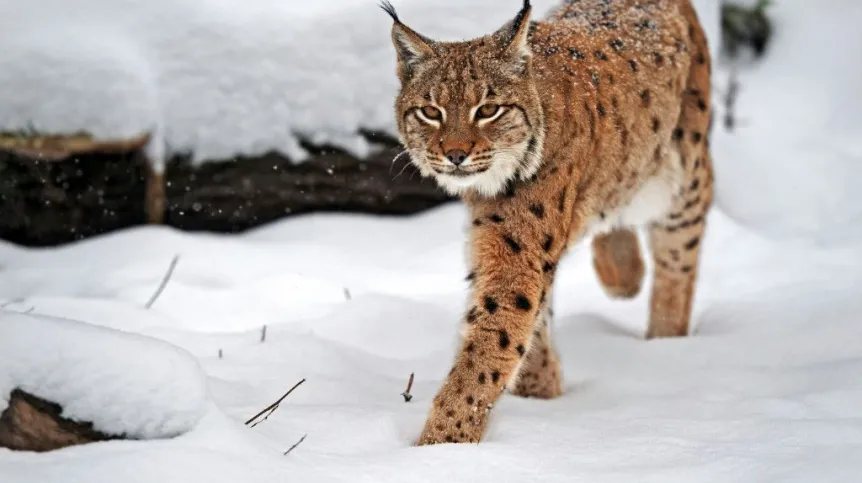
The forests of Podkarpacie are home to 344 European bison, 200 bears, 565 wolves, 255 lynxes, 196 wildcats and 9.6 thousand beavers. The work of summarizing the annual inventory of the wild animals ended in the region.
In the south-eastern Poland there are also nearly 10 thousand red deer, 36 thousand roe deer, 7.9 thousand wild boars and nearly 340 elk. The elk population has doubled in the last three years. While the number of foxes dropped slightly to 9.2 thousand; there were 10.3 thousand three years ago.
Smaller predators are quite numerous in Podkarpacie. There are 5.2 thousand martens and 2.7 thousand of each badgers and polecats. Foresters also counted 23 thousand pheasants and 14 thousand hares.
"The analysis shows that, despite some fluctuations in the numbers of individual species, Podkarpacie forest is the habitat of stable populations of both wild game, as well as protected animals" - said the spokesman for the Regional Directorate of State Forests in Krosno Edward Marszałek.
"Podkarpacie forests are one of the main refuges of game, but their conservation values are determined by the presence of the largest protected predators including bears, wolves, lynx and wildcats, as well as strong herds of bison living in the wild in the Bieszczady Mountains" - noted the director of the Krosno Regional Directorate of State Forests Grażyna Zagrobelna.
Bison herds grew to 344 animals, which is and unprecedented level. The exact number could be determined on the basis of the monitoring of wild herds in the Bieszczady forest districts conducted since 2007 and analysis of records of photo traps.
Director reminded that the purpose of the annual inventory conducted in forest districts, in cooperation with hunting clubs, "is mainly to assess of the situation of wild game, but on this occasion we also analyse the numbers of protected animals".
"You have to remember that the food of protected predators are primarily representatives of game species, such as red deer, roe deer and wild boar. Reconciliation of all the aspects of the economy of hunting with the objectives of nature conservation is a priority task for the preservation of the full biodiversity of our forests" - she added.
The growing number and variety of species of wildlife in the forests of the Regional Directorate of State Forests in Krosno on the one hand proves the good condition of forests, but strongly affects the cost of forest and farmland cultivation. Large herds of deer can destroy young generation of forest.
This year, the Krosno forest districts will spend 3.5 million zlotys on chemical and mechanical protection of seedlings against animals. The cost of fencing parts of the crops add to this; in 2016 foresters plan to fence 467 hectares at the expense of 2.3 million zlotys.
PAP - Science and Scholarship in Poland
kyc/ par/ mrt/
tr. RL