Adobe Stock

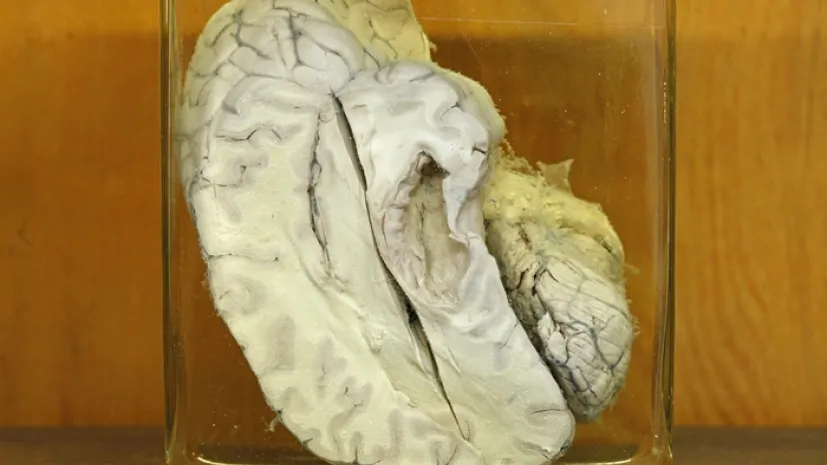
Non-invasive brain stimulation can improve control over impulsive decisions

The ability to control impulses, such as the decision to gamble, is linked to specific neurobiological processes that can be modified, according to a new study involving researchers from the Jagiellonian University. After stimulation of a specific brain region, participants made more rational decisions, suggesting that neuromodulation techniques could in the future complement psychotherapy.

  • Fragments of exaggerated anthropomorphic figures. Damage caused by weathering. Credit: Paweł Polkowski

    Ancient Egyptian rock art reveals two very different relationships between humans and animals

    For thousands of years, prehistoric artists in Egypt’s Dakhleh Oasis carved humans and animals into desert rocks — but they did not always tell the same story. Some images show people and wildlife existing side by side in harmony, while others portray hunting, control and violence.

  • Giraffe held on a rope. Credit: Paweł Polkowski

    Climate change threatens Egypt’s ancient rock art as Polish archaeologists race to document it

    Thousands of ancient rock carvings scattered across Egypt’s Western Desert are slowly disappearing. Rising temperatures, stronger winds, increasingly regular heavy rainfall and human activity are damaging some of Africa’s richest collections of prehistoric art, while Polish archaeologists are working to document what remains before it is lost.

  • Adobe Stock
    Health

    New MRI breakthrough could spot hidden optic nerve damage before vision loss

    Standard MRI scans can show the structure of the brain and eye sockets, but they cannot reveal subtle damage to the microscopic fibres of the optic nerve - changes that may appear before irreversible vision loss. Polish researchers have developed a new method of analysing MRI images that could help doctors detect this hidden damage earlier and make more informed treatment decisions.

  • Adobe Stock
    Health

    Polish scientists develop tiny capsules that keep probiotics alive in cosmetics

    Polish scientists have developed and patented tiny protective capsules that allow live probiotic bacteria to survive in cosmetics for more than a year, overcoming one of the biggest challenges in creating probiotic skincare products.

  • Krystian Barzykowski, PhD, a professor at the Jagiellonian University (L), photo by Agnieszka Fiejka, and Professor Chris Moulin (R), photo from private archive.

    Polish and French scientists win award for groundbreaking ‘déjà vu’ research

    A Polish and a French psychologist have won the 2026 Marie Skłodowska-Curie and Pierre Curie Polish-French Science Award for pioneering research that has transformed scientists' understanding of déjà vu and spontaneous memories.

  • Adobe Stock
    Life

    Polish researcher's team first to build synthetic cell from scratch

    A team of scientists from the University of Minnesota, led by Polish researcher Katarzyna (Kate) Adamala, has created a synthetic cell capable of taking in nutrients, growing and dividing using only non-living components. The achievement, reported by Science, marks the most advanced step so far towards building a synthetic equivalent of a living cell from scratch.

  • Adobe Stock
    Space

    Harnessing the power of the Sun: Polish physicists help unravel the fusion challenge

    Most of the energy that reaches Earth comes from nuclear fusion in the Sun. Can a similar process be controlled on Earth? The results of the MAST Upgrade programme, involving Polish physicists from Warsaw and Opole, demonstrate just how challenging that task remains.

  • Photo from press release
    Health

    Polish scientists create 'mini livers' to improve diagnosis and treatment of metabolic diseases

    Scientists in Poland are developing laboratory-grown "mini livers" that could improve the diagnosis of metabolic diseases, help test new plant-based medicines and enable artificial intelligence to identify hidden signs of illness.

  • Marcin Runowski, photo from private archive

    Scientists develop 'smart' material that glows under friction, heat and ultrasound

    An international team of scientists, including researchers from Poland, has developed a new material that emits light when exposed to friction, impact, heat and even ultrasound.

Most Popular

  • Adobe Stock

    New MRI breakthrough could spot hidden optic nerve damage before vision loss

  • Ancient Egyptian rock art reveals two very different relationships between humans and animals

  • Polish researcher's team first to build synthetic cell from scratch

  • Polish and French scientists win award for groundbreaking ‘déjà vu’ research

  • Wild forest honey found to contain unusually high levels of health-boosting compounds

Recommended

Fragments of exaggerated anthropomorphic figures. Damage caused by weathering. Credit: Paweł Polkowski

Ancient Egyptian rock art reveals two very different relationships between humans and animals

For thousands of years, prehistoric artists in Egypt’s Dakhleh Oasis carved humans and animals into desert rocks — but they did not always tell the same story. Some images show people and wildlife existing side by side in harmony, while others portray hunting, control and violence.