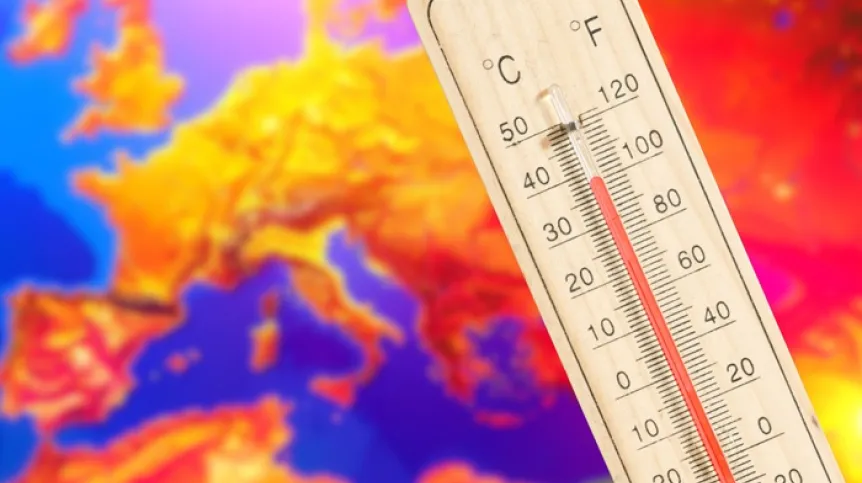
Global temperatures in 2025 reached the third-highest level on record, edging close to 1.5 degrees Celsius above pre-industrial averages and signaling the emergence of a new “climate norm.”
“Currently, warming is around 1.5°C – temperatures are sometimes slightly below this threshold, and sometimes exceed it. Therefore, we can say that 2025 is, in a sense, the year of a new climate norm,” said Professor Bogdan Chojnicki of the Poznań University of Life Sciences.
Globally, the average annual temperature in 2025 exceeded 1.4°C above the 1850-1900 pre-industrial baseline. Average temperatures in 2023 and 2024 surpassed the 1.5°C threshold. In Poland, record temperatures occurred in 2019 and 2024.
“This past year was cooler than 2024, but still warmer than the norm,” he said.
Chojnicki warned that warming in Poland could reach 4–4.5°C by the end of the century, with current levels already above 2°C.
“This means we are roughly halfway there. And we are still in an upward trend. This means that the chances of limiting global warming to less than 2 degrees Celsius compared to the pre-industrial era are decreasing. However, this does not excuse us from the obligation to act,” he said.
He also cautioned that the term “new climate norm” could provide false reassurance.
“In my opinion, the term ‘new climate norm’ could be detrimental, because in a sense it reassures us. Meanwhile, we are already struggling with very low water levels in most Polish rivers in the summer, while the Genoa lows are associated with increasingly heavy rainfall, bringing flooding and sometimes devastating floods,” he said.
Chojnicki continued that infrastructure designed for past climate conditions may be insufficient as temperatures rise, saying: “We have to adapt to this new reality, for example, with cooling systems and access to water.”
The climatologist went on to warn that the new climate norm will likely bring higher temperatures and greater disruptions to water availability, with agricultural droughts and water shortages already causing noticeable costs.
“When we talk about adapting to climate change today, we can no longer consider relocating to another, more convenient location, because there are already 8 billion of us on Earth, and climate change is taking place practically everywhere,” he said.
Chojnicki stressed that adaptation is not guaranteed and may not always be affordable, citing the costs of rebuilding after floods.
“It may turn out that we are experiencing losses that we cannot afford to compensate for. We also cannot forget that climate change will bring a whole host of new problems that we are unaware of today,” he said.
He also warned that exceeding the 2°C warming threshold could trigger self-reinforcing climate processes.
“This should be of great concern to us, because it is not the case that climate change will merely make our planet a more pleasant place to live. Many places are at risk of flooding due to rising sea levels and increased hurricane activity, which, among other things, push water inland. Therefore, climate change is not creating a safe world. It is creating a world with a very serious question mark,” he said.
Emphasising the need for continued action, he said: “That is why I believe we should keep combating climate change – to stop it, or at least significantly slow it down.”
Chojnicki highlighted that climate change affects natural ecosystems as well as humans.
“Meanwhile, organisms living in the natural environment, exposed to completely new conditions, do not have the same adaptive capabilities as humans,” he said.
He noted that even long-lived trees planted centuries ago under cooler conditions have limited flexibility.
“Climate change therefore calls into question the functioning of natural ecosystems,” he concluded.
Joanna Morga (PAP)
jjj/ zan/ js/ kap/
tr. RL