
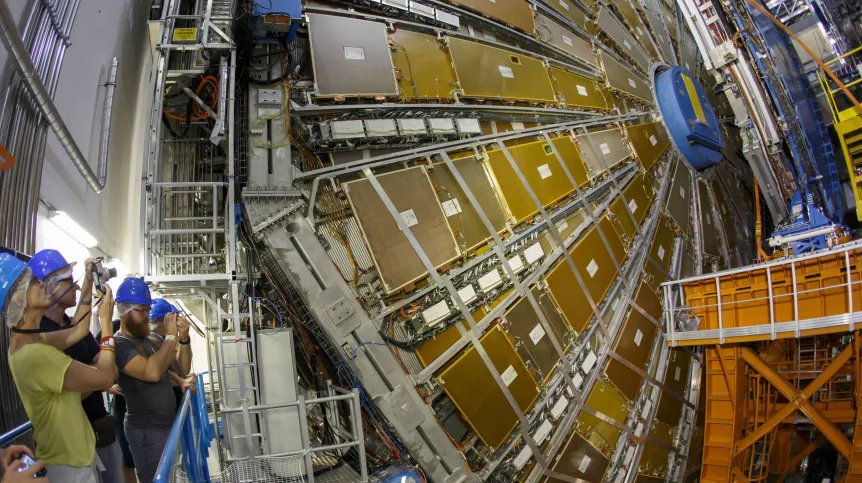
The CMS experiment at CERN has measured the mass of the W boson with a precision approaching 10 MeV, producing a result consistent with the standard model of particle physics and challenging earlier findings that hinted at possible new physics.
The result, published in Nature (doi: 10.1038/s41586-026-10168-5), gives the mass of the W boson as 80,360.2 ± 9.9 MeV. The value closely matches the standard model prediction of about 80,353 ± 6 MeV derived from global electroweak data fits, while differing from an earlier measurement by the Collider Detector at Fermilab (CDF), which had reported a significantly higher value.
The W and Z bosons are carriers of the weak nuclear force, which governs processes such as radioactive decay. In the standard model, the mass of the W boson is linked to other fundamental quantities, including the masses of the Higgs boson and top quark. Physicists regard it as a sensitive test of the theory because even a small deviation from the predicted value could point to the influence of unknown particles or forces.
The earlier CDF result from Fermi National Accelerator Laboratory had generated intense debate because its higher measurement suggested a possible inconsistency with the standard model.
The CMS analysis used proton collision data collected in 2016 at an energy of 13 TeV at the Large Hadron Collider. Researchers studied more than 117 million events in which a W boson decayed into a muon and a neutrino.
Because neutrinos pass through matter almost undetected, the W boson mass could not be measured directly. Instead, scientists reconstructed it indirectly using the precisely measured motion of the muon produced in the decay.
To improve accuracy, the CMS team carried out extensive detector calibration. Researchers used decays of the J/ψ particle into muon pairs to calibrate the muon momentum scale and verified the method using decays of the Z boson, whose mass is already known with high precision.
The analysis also included a so-called “W-like” measurement of the Z boson, treating one muon as invisible in order to simulate the conditions of W boson decays involving an undetected neutrino.
The CMS result has a precision comparable to the CDF measurement and exceeds that of previous Large Hadron Collider measurements, making it one of the most significant contributions to the debate over the W boson mass.
Researchers said the findings strengthen confidence in the standard model while intensifying scrutiny of the earlier CDF result, which now requires further comparison of methods, data and uncertainties.
The CMS collaboration includes physicists and engineers from AGH University of Science and Technology, National Centre for Nuclear Research, University of Warsaw and Warsaw University of Technology. (PAP)
kmp/ zan/
tr. RL