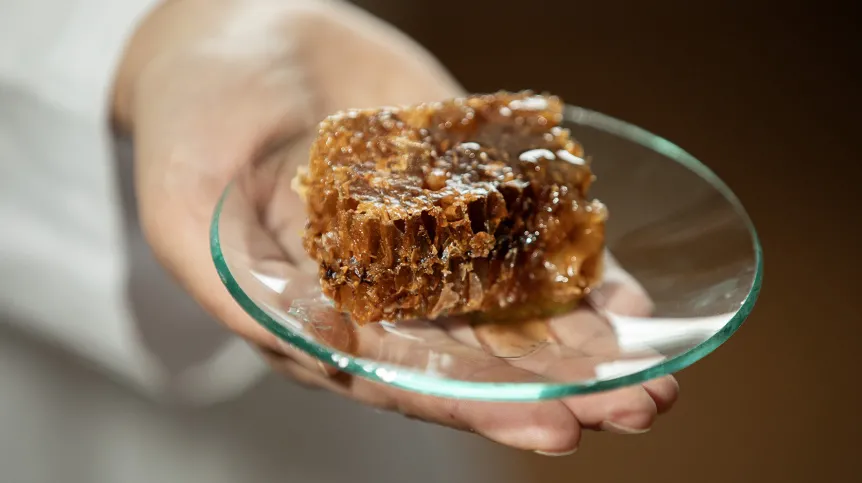
Traditional wild forest honey produced by bees living in tree hives contains unusually high levels of natural compounds linked to antimicrobial and antioxidant properties, according to new research by Polish scientists.
Researchers from the Wrocław Medical University found that wild bee honey contains concentrations of beneficial phenolic acids six to 13 times higher than those typically found in Polish honey. The study also showed the honey has antimicrobial activity, supporting historical claims that it was used as a medicinal remedy.
The findings were published in the Journal of Ethnopharmacology by researchers from the Wrocław Medical University, the Institute of History of the Polish Academy of Sciences, the Poznań University of Medical Sciences and the University of Wrocław.
The team analysed honey collected from two wild beehives in the Świętokrzyskie region, examining its chemical composition, pollen content, water content, conductivity and antimicrobial properties.
They found the honey has a unique phytochemical profile, including exceptionally high levels of ferulic and p-coumaric acids – natural compounds derived from propolis – as well as elevated levels of kynurenic acid. These substances are known for their antioxidant and antimicrobial properties.
The research grew out of an earlier project to recreate theriac, a famous medicinal remedy used in Europe for centuries as an antidote to poisoning and protection against plague.
Lead author Dr Danuta Raj, from the Department of Pharmacognosy and Plant Medicine at Wrocław Medical University, said her team was the first to recreate the remedy exactly according to a 17th-century recipe.
"When reconstructing this preparation, which was used as an antidote for poisoning and protection against the plague, we tried to faithfully reproduce it according to the 17th-century recipe. Theriac has already been studied by contemporary scientists, but our team is the only one in the world to recreate it exactly as it was, following period procedures meticulously and in detail. After some time, it turned out that the preparation we obtained fermented, whereas this process did not occur in other recreated preparations.”

The researchers concluded that the difference was likely due to one key ingredient. Their reconstruction used traditional wild bee honey, while previous attempts had relied on honey from managed apiaries.
According to Dr Raj, the distinctive properties of wild bee honey are probably a result of the way it is produced.
"The special properties of wild bee honey most likely result from the specific nature of wild beekeeping. The bees themselves choose their own hives, organize their own nests, use diverse forest resources, they are not regularly moved or intensively exploited, thus experiencing less stress. The beekeeper visits them infrequently, and collects honey at most once a year, so the product has longer contact with the comb, which is also rich in various beneficial substances,” she said.

The study also reconstructed historical methods of assessing honey quality. Rather than laboratory testing, early modern beekeepers judged honey by its colour, smell, taste, density and viscosity, with one traditional test involving checking how well it stretched and stuck between the fingers.
Dr Raj said: "The pharmacists' analysis alone would only be part of the truth about wild bee honey. We were interested in the historical context, because while beekeeping has a centuries-old tradition, its origins have remained a mystery until now,” she said. (PAP)
PAP - Science in Poland
ros/ zan/
tr. RL