Scientists have directly observed the alpha decay of tellurium-104 for the first time, providing new evidence about how alpha particles form inside atomic nuclei before they are emitted.
The findings, published in Nature (doi: 10.1038/s41586-026-10581-w), show that tellurium-104 has a half-life of just 7.2 nanoseconds, making it the fastest known ground-state alpha emitter. The research was conducted by an international team that included Aleksander Augustyn, a doctoral candidate at Poland's National Centre for Nuclear Research.
Alpha decay is one of the oldest known nuclear processes. In alpha decay, an atomic nucleus emits an alpha particle, a helium nucleus consisting of two protons and two neutrons. Although the process has been studied since the late 19th century, physicists have long debated whether alpha particles exist as pre-formed structures inside a nucleus before they are emitted.
The decay itself is described by quantum tunnelling, a phenomenon in which a particle passes through an energy barrier that classical physics would not allow it to overcome. While this model successfully explains the lifetimes of radioactive nuclei, the question of how an alpha particle forms inside the nucleus before emission has remained unresolved.
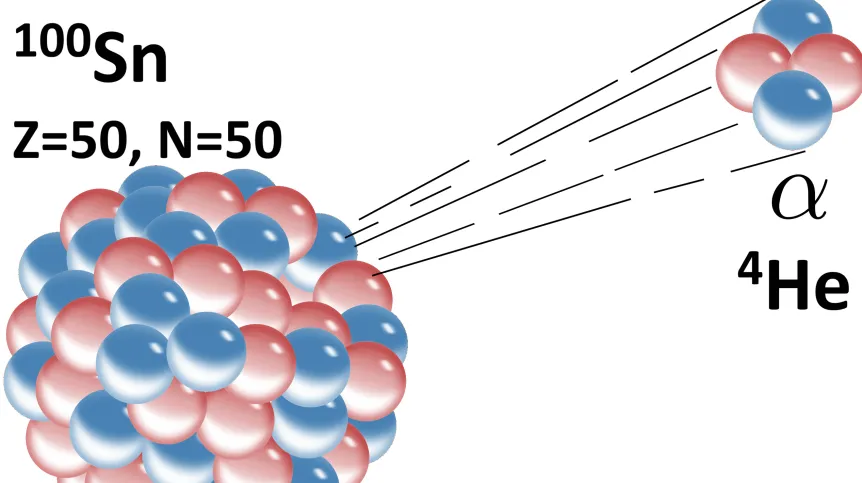
Tellurium-104 offers a particularly useful system for studying the issue. Physicists describe it as a tin-100 nucleus combined with an alpha particle. Tin-100 is considered a "double magic" nucleus because both its proton and neutron shells are completely filled, creating an unusually stable nuclear configuration.
Researchers said this makes tellurium-104 an ideal candidate for investigating whether alpha particles can form within a highly stable nuclear core before decay occurs.
The experiment was carried out at the RIKEN research centre in Japan. Scientists first produced xenon-108, which decays into tellurium-104. Tellurium-104 subsequently decays into tin-100.
Because tellurium-104 exists for only a tiny fraction of a second, researchers had to identify it through this decay chain. During 124 hours of measurements, the team detected only 12 xenon-108 nuclei, nine of which were linked to subsequent decay events.
The researchers measured the half-life of tellurium-104 at 7.2 nanoseconds, with an uncertainty range of +2.3 and -1.5 nanoseconds. They also measured the energy of the emitted alpha particle at 5.03 megaelectronvolts and estimated the total decay energy at 5.23 megaelectronvolts.
Analysis of the data indicated an exceptionally high probability that an alpha particle had already formed inside the nucleus before emission.
To assess this, researchers used a parameter known as the reduced width, which separates the effects of quantum tunnelling from the nucleus's intrinsic tendency to emit an alpha particle. Comparisons with other known alpha-emitting nuclei showed that tellurium-104 exhibits the strongest alpha pre-formation signal observed so far.
The result provides an important test for theoretical models of nuclear structure, including those used to describe very heavy and superheavy elements that can only be produced in specialized laboratories.
Aleksander Augustyn, co-author of the paper and a fourth-year doctoral candidate at the National Centre for Nuclear Research, said: "This extreme measurement provides hard data for testing and calibrating the theoretical models we use to describe alpha decay of nuclei that can only be produced in specialized laboratories.” (PAP)
PAP - Science in Poland
kmp/ agt/
tr. RL