Volcano myths and misleading terminology can make people underestimate real, life-threatening dangers, while alarmist coverage can fuel unnecessary panic, according to an international team of volcanologists.
The team, led by volcanologist and science communicator Janine Krippner, PhD, and Sam Poppe, PhD, from the Space Research Centre of the Polish Academy of Sciences in Warsaw, has identified 18 frequently misunderstood issues surrounding volcanoes and eruptions.
The review, published in the Journal of Applied Volcanology, covers six broad areas: seismology; volcanoes and climate; volcanic systems and structures; volcanic hazards; timescales of volcanic activity; and misleading photographs and films.
The authors examine seven case studies involving Agung, Etna, Kīlauea, Tajogaite, La Soufrière, Taal and Yellowstone Caldera.
Among the commonly misunderstood terms are the Pacific Ring of Fire, ‘supervolcanoes’ and ‘megatsunamis’.
Some of the most common misconceptions involve the language used to describe volcanic eruptions.
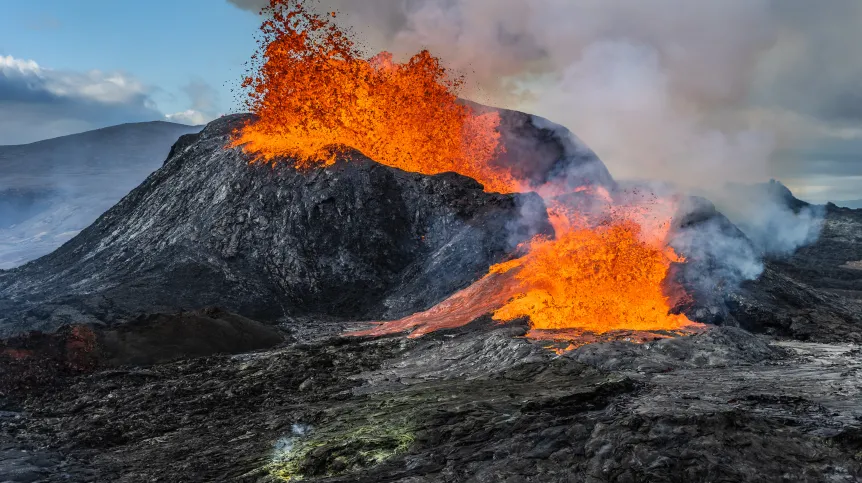
‘Contrary to appearances, volcanoes do not produce smoke or erupt with fire. In fact, they eject clouds of tiny, cooled magma particles, rocks broken off from beneath the eruption crater, volcanic gases, and water vapour. Such clouds pose entirely different threats than fire and smoke. After all, they are falling heated rock fragments. We also noted the disturbing use of the term 'cold lava flows' in reference to volcanic mudflows, known as lahars, which creates a false sense of security. This misconception is precisely what exposed tourists to real danger during the 2017 eruption of Mount Agung in Indonesia’, says Sam Poppe from the Space Research Centre PAS.
The researchers also warn against sensational claims about so-called supervolcanoes.
‘Finally, press articles and social media posts often frighten people with imminent eruptions of +supervolcanoes+ that would destroy our civilization. Meanwhile, volcanoes like Yellowstone in the USA or the Phlegraean Fields in Italy are much more likely to produce smaller, localized eruptions, and are usually very closely monitored by volcanic observatories’, Poppe adds.
The authors say they have decades of experience working for national agencies, volcano observatories and universities, including during and between volcanic crises in Indonesia, the Philippines, New Zealand, Australia, Chile, the United States and Europe.
‘Decades of experience in national agencies, volcano observatories, and universities, working during and between volcanic crises around the world, including Indonesia, the Philippines, New Zealand, Australia, Chile, the United States, and Europe. Throughout this time, they have repeatedly found themselves at the centre of media responses, closely observing where misinformation originates from and how to effectively correct it’, says the Space Research Centre PAS press release.
Volcanoes fascinate people because of their spectacular natural displays, but they can also threaten infrastructure, air traffic and people living nearby.
The researchers say that accurate, science-based information can be particularly important during a volcanic crisis, when scientific knowledge needs to be communicated quickly and rumours can spread rapidly.
‘The overuse or inappropriate use of terminology related to volcanism can lead to a disregard for the dangers posed by volcanoes. Within local communities, this can result, for example, in ignoring evacuation orders. In the case of Polish tourists visiting active volcanic regions, this may indicate a lack of awareness of real, life-threatening dangers’, Poppe points out.
But misinformation can also have the opposite effect, creating fear where there is no immediate danger.
‘Alarmist and misleading media reports and messages on social media can also lead to unnecessary panic or long-term distrust of the authorities. All of this can hinder the rescue efforts that local authorities are trying to undertake to protect human life and infrastructure. It is important for people who travel to volcanic regions to prepare well in advance. Among other things, they should check which local authority is responsible for monitoring active volcanoes near their destination. Who is responsible for warning residents? Is it possible to download the appropriate app? Where can they find interesting facts about these volcanoes?’, says Poppe.
The review is intended to help volcanologists, journalists, decision-makers and the public communicate more accurately about volcanic hazards and understand the risks posed by eruptions.
‘A trip to the vicinity of volcanoes can be an unforgettable experience; you just need to prepare for it in a way that ensures you return safe and sound’, says Poppe. (PAP)
PAP - Science in Poland
zan/ agt/
tr. RL