The strongest geomagnetic storm in two decades was not caused by a single solar eruption. Instead, ten clouds of superheated plasma caught up with one another, merged and compressed, creating a cosmic pile-up that made the storm particularly difficult to predict.
A new model has reconstructed how the chain reaction unfolded, showing why even relatively moderate solar eruptions can combine to produce a much stronger space-weather event. A physicist from Maria Curie-Skłodowska University in Poland is among the study’s co-authors.
On a busy motorway, a faster car can crash into a slower one, with vehicles behind them piling into the wreckage. Something similar can happen in the space between the Sun and Earth.
Plasma clouds ejected from the Sun at different times travel at different speeds. Faster clouds can catch up with slower ones, pushing and compressing them, altering their magnetic fields and changing the movement of the entire group.
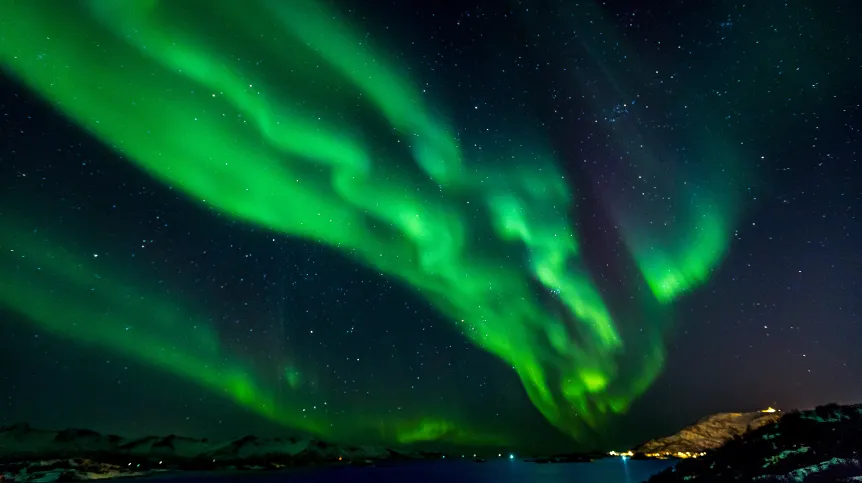
Such a chain of events preceded the geomagnetic storm of May 2024. In Poland, the event is remembered mainly for spectacular auroras visible far from the polar regions. For space-weather researchers, however, it was the strongest storm in roughly two decades and an exceptionally difficult test of forecasting methods.
Between May 8 and 11, at least ten coronal mass ejections (CMEs) – massive clouds of magnetised plasma – were launched from the Sun in quick succession.
They did not reach Earth as ten separate waves. As they travelled through space, they caught up with one another and partially merged. Ultimately, instruments near Earth detected five complex magnetic structures.
Scientists from the United States, India, Belgium and Poland reconstructed the sequence of events. One of the study’s co-authors is Stefaan Poedts, affiliated with the Institute of Physics at Maria Curie-Skłodowska University in Lublin and KU Leuven. The findings were published in The Astrophysical Journal.
The researchers combined images from two space observatories: SOHO, located about 1.5 million kilometres from Earth towards the Sun, and STEREO-A, which orbits the Sun along a path similar to Earth's.
The two different viewpoints allowed the researchers to reconstruct the three-dimensional shapes and trajectories of the eruptions. They then fed the data into the EUHFORIA model, which simulates the flow of plasma and the magnetic field it carries.
The simulations showed that the storm’s intensity was not determined simply by the speed of the eruptions. Their interactions with one another also played a crucial role.
The first clouds merged relatively close to the Sun, while later ones caught up with, accelerated or compressed them. In one interaction, a slower eruption was pushed sideways enough to join an earlier structure.
Other waves then moved into lower-density regions left behind by earlier eruptions, allowing them to travel faster.
The direction of the magnetic field reaching Earth was particularly important. When the field pointed southward, opposing Earth’s magnetic field on the dayside of the magnetosphere, energy could enter the magnetosphere more easily.
Successive eruptions prolonged this unfavourable alignment and intensified the disturbance. As a result, several moderate events combined to produce effects far more severe than an assessment of each eruption on its own might have suggested.
The best simulation, using data available at the time of forecasting, predicted the arrival of the first wave with an error of about two hours. However, it reproduced only about two-thirds of the storm’s measured strength.
A more detailed analysis carried out after the event captured about 70 percent of the observed intensity. Using different but still plausible initial speeds shifted the predicted arrival time by as much as seven or eight hours.
The results illustrate both the capabilities and limitations of current forecasting methods. When ten eruptions are involved, even a small uncertainty in the direction or speed of one can affect all the interactions that follow.
The model also simplifies the shape and internal structure of the plasma clouds, assumes a calmer background solar wind and does not reproduce some smaller-scale processes.
The study is a retrospective analysis of a single event rather than a ready-to-use early warning system. But it shows what future forecasting systems will need to account for.
Detecting the largest eruption and calculating how long it will take to reach Earth is not enough. Forecasters also need to track the entire sequence and predict how the individual clouds will interact.
In space weather, the greatest threat may emerge not from a single eruption, but from what happens along the way. (PAP)
kmp/ agt/
tr. RL