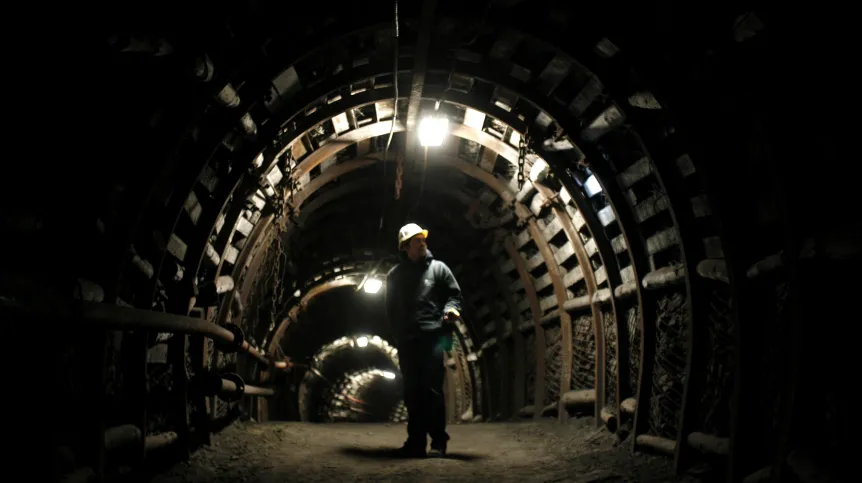
Long-term comprehensive research project to verify and expand the existing knowledge about the impact of underground mining on the surface infrastructure is being prepared by scientists at the Central Mining Institute and historic mine "Guido" in Zabrze.
The value of the project included among the proposed key projects of the Regional Operational Programme for Silesian Voivodeship for the years 2014-2020 was estimated at PLN 177 million. Its results should translate into practical knowledge that will help better protect the residents of present or former mining towns, as well as achieve significant cost savings.
Tomasz Bugaj of mine "Guido" explained that some rock mass behaviour theories developed since the beginning of the last century treat it as a perfect object.
"In fact, it is not that simple, because there are unidentified pockets that disturb rock mass behaviour. So, for example, experts calculate that subsidence during the mining activities will not exceed certain values, and then operations begin and houses tilt or other strange things happen" - said Bugaj.
Therefore, the main task of the project will be thorough examination of the actual relationship between the current and historical mining activities and the surface. "This is a not fully investigated issue, and full of surprises, which we can see from the events of Bytom Karb three years ago" - noted Bugaj. "We have theoretical knowledge, no one focused on experiments. (...) The result is a burden of error in a number of calculations" - said the specialist.
The research of Central Mining Institute scientists will be carried out in Zabrze on the excavation "Guido", and in one of the oldest and largest of Silesian mines: founded in 1791 "Koenigin Louise" (later "Zabrze"). Old mining maps will allow scientists to check the current condition of the surface over old pits marked on the maps.
"Scientists will enter the pits and check whether the rock mass has already calmed, as it should according to the theory, and we suspect that it has not" - said Bugaj. The thorough verification of the behaviour pits from different periods and with different depths should allow to determine the actual rate of rock calming.
Combined action of the surface and underground will allow to conduct experiments that involve artificially induced phenomena and assess their impact in order to confirm, verify or refine existing theories. The project will also involve continuous verification and developed of research methods, as well as the improvement and development of new computing devices. Better and more accurate calculations should give greater certainty as to the possibility of development of land in the former mining areas.
The project also has a section on water relations in mining areas. Currently, mines spend a lot of money on pumping groundwater from both active and closed excavation pits.
"If we stopped pumping water in Zabrze right now, in a few years half of the homes would have flooded basements. Two hundred years ago, when there was no mining, the area of the today’s Zabrze was largely swamp" - said the expert. He added that a detailed knowledge of the subject would allow to optimise the process of mine water pumping.
Another research issue will be underground coal gasification using borehole. So far mainly coal gasification in deep deposits has been studied. However, the researchers want to examine the possibility of underground burning of known shallow deposits or their remnants, the traditional mining of which is not cost effective. Facilities sited over such holes could utilise obtained gas and heat.
Part of the study will to be devoted to the accuracy of geophysical methods. For example, research carried out with georadars often return difficult or impossible to interpret results today - for example, in the event of detection of anomalies. Underground pits already examined by other methods can be used to improve the methods for locating underground pockets.
Development of practical methods and equipment for quick testing and safety analysis of buildings and structures at risk, especially in the case of sudden ground surface deformation, is important not only for the mining areas. If such a method existed, it would probably be possible to quickly and accurately investigate the flooding of the Warsaw Powiśle subway station.
The shape of the current project covers several different issues. Considerable costs are associated not only with the scale, but also the nature of the research, some of which has never been conducted. Hence the lack of necessary research equipment and the need for its development.
PAP - Science and Scholarship in Poland
mtb/ abe/ mrt/
tr. RL