
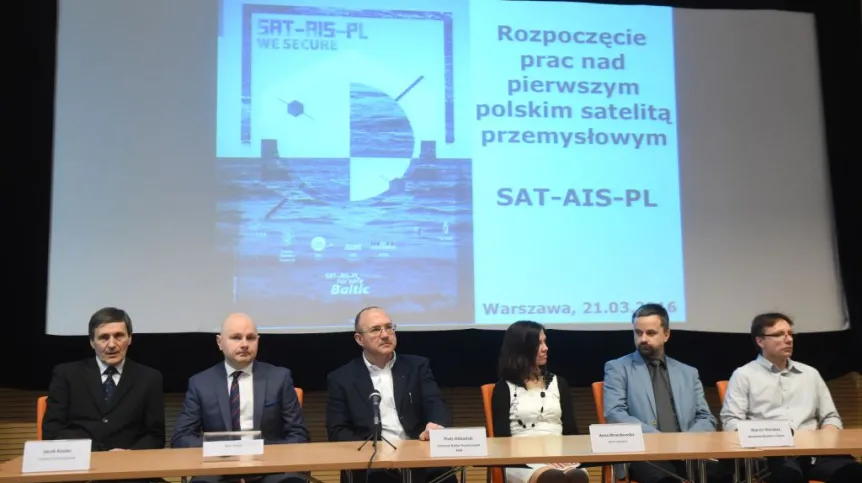
Poland\'s first satellite SAT-AIS-PL is being built by a consortium of domestic companies and research institutions for the European Space Agency. The satellite will be part of the maritime traffic safety system. It will be in orbit around the year 2020.
The satellite will weigh about 40 kg. The system will also include a receiver of signals from AIS transmitters, ground communications station, flight control and command centre and AIS data terminal, which will be available to users. All ground infrastructure system components will be located in Poland.
The members of the consortium building the satellite - in addition to Creotech Instruments SA - are: Hertz Systems Sp. with o.o., Atos Polska SA, Silesian Centre for Science and Technology of Aviation Industry, and scientific institutions: Space Research Centre PAS, National Institute of Telecommunications, Maritime Academy in Gdynia.
"SAT-AIS-PL is the first Polish commercial, utility satellite. The project is carried out in cooperation between Polish companies and scientific institutions. The complexity of this project can be visualized by the fact that our satellite will be described with about 10 thousand specific parameters, which we will have to achieve" - said during the press conference Jacek Kosiec from Creotech Instruments SA, the consortium leader.
The task of SAT-AIS-PL will be collecting information from the automatic identification system (AIS) for the safety of maritime traffic. "Automatic Identification System - AIS - allows to receive the signals transmitted by ships and determine both the position of each ship at sea, as well as other information, such as the destination port, or cargo" - said Kosiec.
The system is mandatory for all international voyaging vessels with gross tonnage of 300 tonnes or more; cargo ships with gross tonnage of 500 tonnes or more as well as all the passenger carriers. "Originally it was a ground-based system, the purpose of which was to prevent collisions at sea. The signals from ships were received by coast stations. For some time now, however, the system is satellite-based. There are a few satellites in different orbits that receive signals from ships. This way, the system coverage can be increased from about 40 nautical miles from the shore to global coverage" - described Kosiec.
This allows the recipient of signals, which are mainly institutions and organizations responsible for safety at sea, to have a full picture of maritime traffic. They can prevent accidents or intervene in the event of collisions or dangerous situations.
Data collected by the SAT-AIS-PL will be delivered to the European Maritime Safety Agency (EMSA) and the Polish institutions: Maritime Offices, the Polish Army, the Border Guard, the Maritime Search and Rescue Service. Foreign institutions will receive data from EMSA. "We send our data to EMSA, because this way we have the possibility of obtaining data from other satellites that the agency manages" - explained Kosiec.
The program will run for seven years. The first phase will continue until 2017 and includes the preparation of the mission project and creating the architecture of subsystems. In the years 2017-2020 - during the second phase - prototype of the system and the final satellite will be build. The last phase, to be completed in 2022, and include the launch of the rocket, which will carry the satellite into orbit, the implementation of the mission and bring the satellite from orbit after the mission is completed. "We are planning to launch around 2020, but it all depends on the timeline of the earlier stages of work" - Kosiec told PAP.
Each phase will have to be approved by the European Space Agency. For now, ESA guaranteed funds to determine the parameters of the satellite and for its design. "Further funds will be awarded as the project progresses" - noted Kosiec.
The satellite will cost several million euros, and the launch about 30 thousand euros per kilogram. "The final cost, however, will depend on the functionality of the satellite. In addition to the basic task, we can offer additional functions, such as measurement of atmospheric parameters, additional communication capabilities. However, each additional kilo will increase the costs of launching the satellite" - Kosiec told PAP.
Currently, there are two Polish satellites in space: Lem and Heweliusz. They have been built at the Space Research Centre PAS and have solely scientific function. Student research satellite PW-Sat, built by students of Warsaw University of Technology, has also been launched.
PAP - Science and Scholarship in Poland
ekr/ ula/ mrt/
tr. RL