
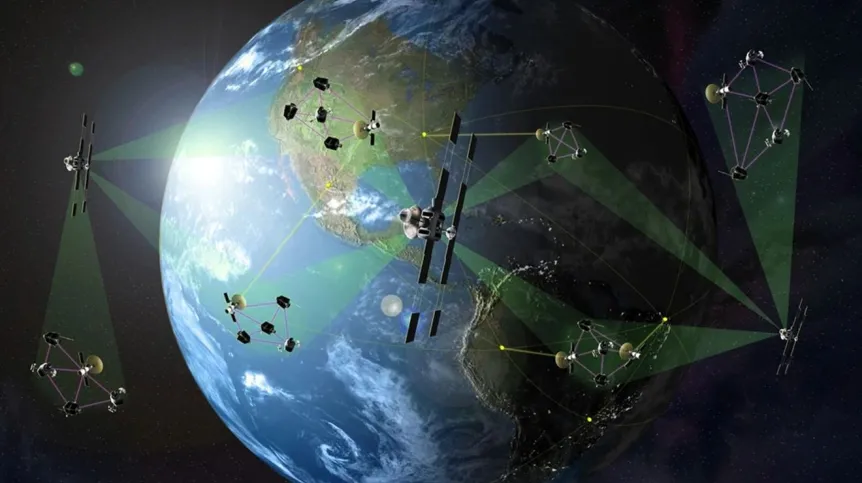
Scientists have developed a new satellite communication technology that dramatically increases data throughput without requiring additional radio spectrum, marking what experts describe as a breakthrough for the Internet of Things.
The solution, known as E-SSA (Enhanced Spread Spectrum Aloha), was created by an international team including researchers from Wrocław University of Science and Technology, engineers from the European Space Agency, and specialists from OrbitsIQ Global. According to a university press release, the system could make data transmission from millions of devices worldwide faster and more reliable.
The technology allows large numbers of devices to transmit data simultaneously over the same radio channel, eliminating the bottlenecks that have traditionally limited satellite-based communication.
‘It works like a multi-lane highway. It allows hundreds of devices to transmit data simultaneously on the same radio channel, without interfering with each other's transmissions’, explains Paweł Kabacik, PhD, from the Wrocław University of Science and Technology.
In tests conducted on a satellite model, the system supported 500 devices communicating at the same time and successfully received up to 30,000 data packets per second.
Researchers say the advance addresses a growing demand for satellite data transmission across sectors including transport, logistics, agriculture and energy, where millions of sensors depend on reliable connectivity.
Kabacik said the team rethought how devices share radio spectrum, combining modern integrated circuits, processors and advances in signal processing.
‘Using state-of-the-art integrated circuits and processors, as well as the latest advances in signal processing, we have presented a system that has a significantly higher capacity and ensures proper handling of the need to exchange large amounts of short pieces of information’, Kabacik adds.
The project brings together academic research and industry expertise, combining the knowledge of Wrocław University scientists with the experience of European Space Agency engineers and OrbitsIQ Global specialists.
‘Our collaboration with Wrocław Tech is a key step in building secure connectivity worldwide. This technology is not just an incremental improvement, but a major disruption in the market for widely accessible satellite communication services’, says OrbitsIQ Global CEO Joe Euteneuer. (PAP)
PAP - Science in Poland
ros/ zan/
tr. RL