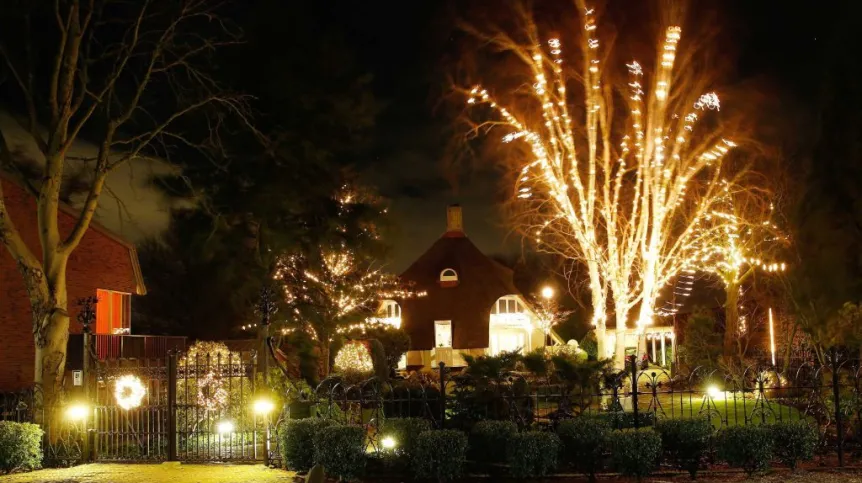
Poles like holiday decorations, but do not yet illuminate "everything and everywhere" as, for example, in the US, where the holiday illuminations increase the level of light pollution in the country by up to 10 percent. This can be seen even from orbit.
"Illuminations in some cities in the US during the holiday season increase the level of light pollution in the country by up to 10 percent" - noted in an interview with PAP Piotr Nawalkowski from the Association POLARIS-OPP, implementing the program "Dark Sky" in Poland. He cite data from 2009 provided by the International Dark-Sky Association (IDA) - organization was established in the United States, that has been dealing with the problem of light pollution for the longest time.
According to US agencies NASA and NOAA reports (from 2014), during the holiday season in the suburbs of major US cities night lights shine from 20 to 50 percent brighter than during the rest of the year. In the cities it is 20-30 percent. The difference can be seen in satellite data showing changes in intensity of night lighting on the face of the entire planet.
In Poland, the situation is different. "Even in big cities it is not in our fashion to illuminate everything and everywhere. Of course, the media report on exceptional illumination in cities, and that the people install seasonal lighting on their own initiative - said Piotr Nawalkowski. – But while the light decorations are impressive, they are not as common as in the West. The Poles illuminate the various parts of buildings, or trees in front of houses, but we are far from almost every resident illuminating the entire building including the roof, and on top of that the garden and the whole environment".
The abundance of festive decorations increases light pollution, because it means an increase in the number of illuminations scattering light in all directions. Snow adds to the problem by increasing the level of light reflection from the surface, thus further increasing the amount of light escaping into the sky in the form of a glow - explained Nawalkowski.
At the same time he suggested that it would be possible to find a compromise between the attachment to the magic of Christmas and common sense. "The matter of mood and the related tradition of lighting is important for us too. We try to point out that during the holidays - with the possible exception of Christmas Eve - you can find a compromise. The idea is simple: Illuminate houses, streets or trees growing outside... But after midnight, when no one admires them anymore, turn out the lights" - he said.
He also recommended using inexpensive timers, which at night automatically turn off festive illumination. It will bring savings, because each lamp consumes electricity (even LEDs), and make life easier for environment, because the neighbours will sleep better at night if nothing lights up their bedroom.
When planning the illumination of larger areas or objects, it is best to put lights under a roof. "In the case of large buildings, lighting can be installed on the facade, but under a roof - so that the light does not escape directly upwards" - said Piotr Nawalkowski.
He also drew attention to the issue of illuminating trees with powerful spotlights - so that they give the impression of frozen structures. "It is better to use the so-called garlands of lights. Tiny lamps, evenly distributed on trees, make a much better impression than a strong spotlight shining from the bottom up under a tree or mast" - he added.
Nawalkowski reminded the holiday season is considered an exception even in Slovenia, where there is one of the most precise and restrictive laws related to pollution by artificial light. "Thelocal law provides for an exemption from the rule of reducing pollution by artificial light exactly during the holiday season, from 15 December to 15 January. At that time, illumination of objects is not subject to the principles of the protection of night".
In his view, excessive artificial light illumination deprives us of what matters most. "After all, from the time of Christ the sky proclaims his birth to us by the Star of Bethlehem. There is a reason, why we put a symbolic decoration in the form of a star on top of Christmas trees - he reminded. - I remember how my grandparents and my parents encouraged me, as a young child, to look for the first star in the sky before Christmas Eve. How happy I was when on clear evenings I was actually able to see the star Vega in the constellation Lyra, or the planet Venus called the evening star."
He added that this year there would not be any bright planets visible in the evening sky, only the stars - like Vega and Capella in the constellation Auriga - and the moon. "I hope it does not turn out that in large Polish cities only it (the moon - ed. PAP) will be visible in the sky among the LEDs and neon signs, or countless decorations and street lights. In the last decade we are We losing something that for hundreds of years was an important element of Christmas" - said the representative of POLARIS-OPP.
In recent years there are more and more arguments in favour of "protecting the night". Scientists have shown, for example, that artificial lighting of cities and their surrounding areas affects animals. They found that light pollution can disrupt the reproductive process and migration of birds, adversely affect the behaviour of bats and insect populations. The all-night lighting is not indifferent to human health, as our circadian rhythm is regulated, among others, by light and darkness. New studies show that excess light at night (including light pollution) can cause or worsen diseases of civilization.
PAP - Science and Scholarship in Poland, Anna Ślązak
zan/ agt/
tr. RL