
All 10 instruments aboard NASA’s Interstellar Mapping and Acceleration Probe (IMAP) have successfully recorded their first measurements in space, NASA has announced, marking the start of preliminary scientific data collection as the spacecraft travels toward the Sun.
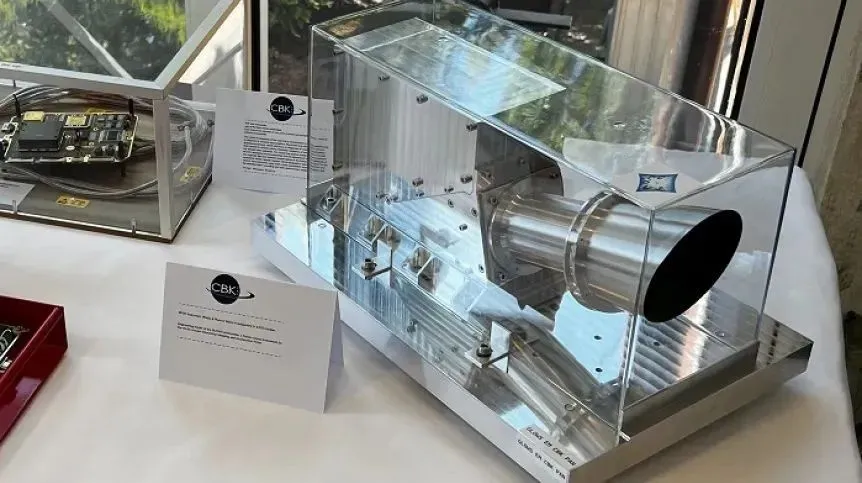
Among the instruments is GLOWS, designed and built at the Space Research Centre of the Polish Academy of Sciences (PAS).
According to a Space Research Centre PAS press release, the observations, referred to as “first light,” confirm that the instruments are operating correctly. IMAP is currently heading to the first Lagrange point (L1), an observation station located about 1.5 million kilometres from Earth in the direction of the Sun.
NASA’s IMAP spacecraft was launched on September 24 from the Kennedy Space Center in Florida. The mission will measure the solar wind, high-energy particles and magnetic fields, with data also intended to support an early warning system for astronauts and spacecraft near Earth.
Based on NASA data, the Space Research Centre PAS said the IMAP measurements will be used to develop an alert system capable of warning at least 30 minutes in advance of increased cosmic radiation caused by the solar wind. IMAP is already measuring the solar wind in near-real time, but the alert system will become operational once the spacecraft begins regular observations at L1.
IMAP carries 10 scientific instruments, including the Polish-built GLOWS (GLObal solar Wind Structure). The photometer observes far-ultraviolet afterglow emissions to study the global structure of the solar wind. It detects photons with a wavelength of 121.5 nanometres, known as Lyman-alpha.
GLOWS is designed to investigate the acceleration of energetic particles and the interaction between the solar wind and the local interstellar medium within the heliosphere, the region surrounding the Sun where solar wind pressure dominates over galactic winds, forming a bubble of ionised matter and magnetic fields.
According to the Space Research Centre PAS, the first observations made by GLOWS met expectations.
“Most importantly, GLOWS observes the heliospheric glow extremely well, and the extragalactic background has a negligible impact on our measurements – exactly as we predicted. This confirms that the instrument is operating as designed,” said Maciej Bzowski, PhD, principal investigator of GLOWS, quoted in the press release.
Analysis of the initial data also revealed an unexpected detection. The first light curve showed an additional light source that was later identified as a comet.
“There is no bright star in the area where the signal appeared. This anomaly was noticed by Marek Strumik, PhD. The source disappeared after a few days. We verified and confirmed that GLOWS detected comet C/2025 K1 (Atlas),” Bzowski said, adding that the instrument recorded it very clearly.
IMAP is scheduled to reach L1 in early January and to begin routine scientific observations on February 1 next year. GLOWS is currently in the commissioning phase, with work under way to optimise its settings. Full scientific operations are planned to begin at the end of January 2026, in parallel with the other IMAP instruments.
The GLOWS instrument was financed from the state budget. The Ministry of Science and Higher Education allocated more than PLN 20.8 million to the project for the years 2021–2027 under an agreement with the Space Research Centre of the Polish Academy of Sciences. (PAP)
PAP - Science in Poland
abu/ agt/
tr. RL