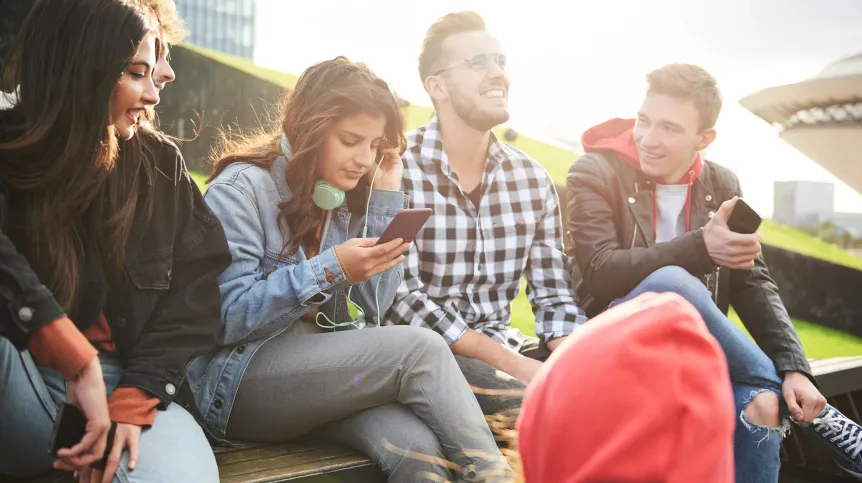
Teenagers are growing up in a consumer culture that promotes material success as the main path to happiness, which may harm their well-being, says psychologist Anna Maria Zawadzka from University of Gdańsk.
“Teenagers of today live in a culture of consumption, in a single information bubble, hearing that the pursuit of materialistic values is the only path to happiness and success in life,” she says.
Research shows that the pursuit of materialistic values is linked to declining life satisfaction and positive emotions, as well as poorer health, increased anxiety and fear, depression, negative emotions and addictions. The decline in well-being is most pronounced among people under 18, the researcher notes.
Medical reports also point to a worsening mental health situation among young people. According to a report published by the National Health Fund in 2023, the number of children and adolescents receiving treatment for depressive and anxiety disorders increased by 120 percent between 2013 and 2021. A November 2025 report by the World Health Organization also indicates a broader mental health crisis among children and adolescents.
Zawadzka explains that adolescence is a period when young people search for answers to key questions about identity and their place in society.
“What happens during that period often has implications for a person's functioning in adulthood,” emphasises the psychologist, head of the Department of Economic and Organizational Psychology at the University of Gdańsk and author of the book Wplątani w konsumpcjonizm. Podaruj nastolatkowi szczęście.
According to Zawadzka, teenagers asking fundamental questions about identity often receive a clear message from their environment.
“The message being promoted is +you are what you have, you are what you experience, be rich, build an image, be famous, and you will be accepted, loved, and happy+,” she says.
Media play a central role in spreading these messages. Teenagers communicate and socialise largely through digital platforms.
“Their conversations revolve around what is on social media, such as TikTok, Instagram, YouTube, games, TV series, movies, cartoons, and other platforms,” the psychologist says, noting that content aimed at young audiences is saturated with materialistic messages.
“Ubiquitous marketing promotes the slogan: you can be whoever you want, as long as you're a good consumer; your self-worth depends on having plenty of money and being able to buy whatever you want, whenever you want,” she says. “A teenager living in a consumer culture lives in a single information bubble about what constitutes happiness and success in life: that it is the pursuit of materialistic values.”
Zawadzka defines materialism as “living with the belief that wealth and the pursuit of financial success are the supreme value in life, allowing to purchase material goods and experiences without any restrictions, and that this is the only indicator of social status and the only key to happiness in life”.
“Contemporary materialism is primarily a dominant focus on a set of values and goals that give priority to extrinsic motivation over autonomous motivation,” she explains. “Extrinsic motivation is the pursuit of culturally accepted goals: financial success, fame, and a desirable image, as well as high social status, which is determined by wealth and consumption. For a materialist, autonomous motivation, which involves undertaking actions out of passion, for the satisfaction of the action itself, is relegated to the bottom of the list of life goals.”
The psychologist says that one source of materialism is the difficulty in meeting basic psychological needs such as security, autonomy, competence, acceptance and deep relationships.
The development of a materialistic orientation can be reinforced by family and social environments that make it harder for young people to satisfy these needs.
Overprotective, authoritarian, controlling or permissive parenting, lack of clear rules at home, family conflicts, anxiety and stress can contribute to this problem. Divorced parents, financial difficulties, lack of parental and peer support, exclusion from peer groups and low self-esteem can also play a role, the researcher says.
Another source of materialism is “the more or less unconscious adoption of materialistic values and goals that dominate our immediate surroundings and the ubiquitous consumer culture promoted by the media and opinion leaders”.
“Therefore, the more difficult our environment in which we grew up or in which we live makes it to meet our basic needs, and the more this environment promotes and lives by materialistic values, the more strongly we are oriented towards materialism in life,” the psychologist concludes.
Zawadzka notes that adolescence is also a time of hormonal changes that can intensify insecurity and emotional instability.
“This state is associated with a reduced sense of security, which fosters a greater susceptibility to materialism, a commonly promoted way to boost self-esteem and happiness,” she says.
Teenagers may attempt to cope with insecurity, mood swings and loneliness through consumption.
“Therefore, to be happy and feel valued, they must keep buying. And this will remain the case into adulthood,” the psychologist adds.
According to Zawadzka, promoting alternative values can help counteract the influence of materialism. Encouraging teenagers to reflect on their goals and values by asking questions such as “Why is this important?” and “How does what we do demonstrate what is important to us?” may be useful.
She suggests promoting non-materialistic values such as kindness and universalism, as well as goals including self-acceptance, belonging, strong relationships, community engagement, spiritual development and the strengthening of autonomous motivation based on interests, passions and skills.
The development of social skills is also important, she adds, including cooperation and mutual support in school groups, hobby organisations, sports clubs, religious communities and volunteer activities. Teaching gratitude and building authentic self-esteem are also key.
“Happiness of teenagers is linked to whether they live in an environment that allows them to meet their basic needs: autonomy, competence, and relationships with others, in a supportive environment (meaning everyone is willing to support others) and in an environment that allows them to choose values other than materialistic ones,” the psychologist says.
She stresses that “the media, parents, schools, educational institutions, and social programs should collaborate to create an environment that allows teenagers to be happy”.
Zawadzka also argues that consumer culture has broader social effects on young people.
“Consumption culture sexualises and objectifies teenagers, teaching them to view themselves and others as body parts, not persons. It also teaches them that they need everything immediately, here and now, to be happy, distracting them from learning perseverance and coping with challenges,” she says.
According to the psychologist, “consumption culture is associated with an aversion to learning, or reinforces learning for the sake of competition”.
“Consumption culture reinforces self-absorption and entitlement, and teaches us to compensate for what is important for our health (deep relationships and friendships) with shopping and fulfilling our shopping craving's,” she emphasises.
She adds that consumer culture may also encourage risky behaviours among teenagers.
It “reinforces teenagers' willingness to engage in risky behaviours, such as drinking alcohol, smoking, using drugs, and engaging in sexual behaviour, and directs teenagers to seek meaning in life through being good consumers, which ultimately leads to a sense of meaninglessness”.
The psychologist notes that consumerism is particularly widespread in countries described by the acronym WEIRD — Western, educated, industrialised, wealthy and democratic societies.
“Poland is one such country. Therefore, just like in other developed, educated countries, we are susceptible to consumerism,” Zawadzka says.
PAP - Science in Poland, Anna Mikołajczyk-Kłębek
tr. RL
wl/zan/