
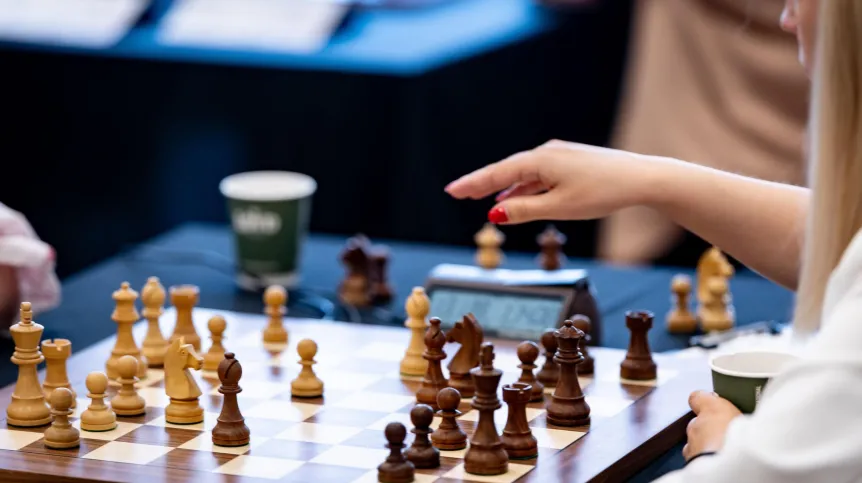
Playing chess can help develop self-awareness and even change life patterns, research focused on how female students applied lessons from chess to understanding their own behaviours has shown.
Jacek Bylica, PhD, director of the Institute of Pedagogy at the Faculty of Philosophy of the Jagiellonian University, analysed participants in the “Education Through Chess” course.
The study included second-year students of preschool and early school pedagogy from the academic years 2021/2022 and 2022/2023. Students, mostly beginners, learned the basics of chess, its history, and game rules, while recording their experiences and emotions during play.
“The game of chess can be seen as a metaphor for life, and situations on the chessboard may reflect real-life events. Playing chess may foster the development of self-awareness and perhaps even support the modification of problematic life patterns,” Bylica said in a press release from the university.
He added: “For instance, students may reflect on their cognitive patterns, barriers, approaches to difficult situations, (...) competition, logical and strategic thinking, the risk of addictions and many other issues. By confronting these topics during the game, they may attempt to develop effective ways of overcoming them, ultimately implementing these changes in their lives.”
Students quickly noticed parallels between chess and everyday dilemmas, including uncertainty, decision-making under pressure, competition, and satisfaction with a job well done. “The idea of life transfer emerged—transferring experiences from the game to an understanding of one's own behaviours and patterns of functioning,” Bylica explained.
Starting to play chess requires learning rules and organising actions, similar to facing new life situations. Many students observed that routines and patterns can be both safe and limiting, noting fear of failure or reluctance to change.
“The middlegame turned out to be a powerful metaphor for everyday struggles. They emphasised that in life—as on the chessboard—one must continually take risks, seek support and develop an individual style of action,” the release said.
Timed, 10-minute matches were the most stressful yet “life-like” part of the course, according to students. Limited time increased pressure, hindered concentration, and led to impulsive decisions, but also mobilised action.
In chess endgames, the challenge is to make the best use of remaining pieces. Bylica said that, in life, people often act with limited resources—time, energy, and opportunities. Students observed that the endgame, like endings of relationships, projects, or life stages, teaches acceptance and focus on what is realistically available.
A small group of students reported no signs of life transfer, citing either a lack of connection between the game and life or a course duration too short to notice changes.
“This scepticism is important because it shows that there is no single, universal path to learning through chess,” Bylica said. (PAP)
abu/ agt/
tr. RL