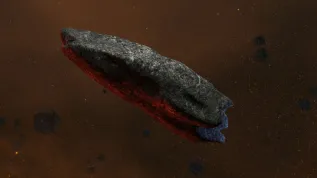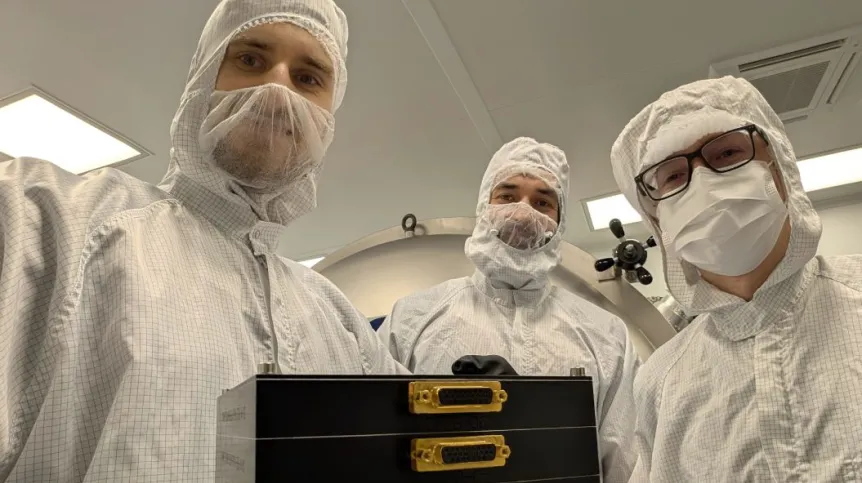
Polish scientists have completed and delivered the first flight-ready instrument for the European Space Agency’s Comet Interceptor mission, which aims to study a comet entering the Solar System for the first time and possibly even an object originating from interstellar space.
The instrument, developed by the Space Research Centre of the Polish Academy of Sciences, will analyse dust, plasma and magnetic fields surrounding comets during close flybys.
According to the institute, the DFP-B2 instrument was recently delivered to Spanish aerospace company Sener, which is responsible for integrating the mission spacecraft. Final tests of the device were successfully completed last week.
The mission marks the first ESA project specifically designed to wait in space for the appearance of an unknown target before intercepting it.
Under the mission plan, the spacecraft will be launched and positioned at a holding point in space. Once a suitable comet is identified, the main spacecraft will deploy two smaller probes to fly through and analyse material released by the object.
Scientists hope the mission will provide direct insight into matter preserved since the formation of the Solar System.
The Space Research Centre PAS is leading the international consortium responsible for the DFP, or Dust, Fields and Plasma, instrument package. The consortium is headed by Professor Hanna Rothkaehl of the Space Research Centre PAS.
Comet Interceptor will consist of a main spacecraft, designated A, and two smaller probes, B1 and B2. DFP instruments will be mounted on spacecraft A and on probe B2.
The instruments will measure plasma density, temperature and velocity, as well as the energy distributions of electrons, ions and neutral atoms. They will also examine the properties of dusty plasma surrounding the comet.
Researchers said the data will help reconstruct the comet’s structure, study processes occurring on its surface and analyse interactions between the comet and the solar wind.
The mission is part of ESA’s Cosmic Vision programme, a long-term scientific initiative focused on understanding planetary formation, the workings of the Solar System and the origins of the Universe.
The Space Research Centre PAS is responsible for overall management of the DFP instrument, including integration of its subsystems, operation of the data acquisition system, transmission of control commands during the mission and coordination of scientific work.
The next stage of the project involves completing the larger DFP instrument intended for the mission’s main spacecraft.
“Tests of the second, larger instrument, which will be mounted on the mothership, should be completed by mid-summer. It will be equipped with sensors similar to those on the smaller probe, but also with additional plasma analysers, Langmuir probes, and two particle analysers,” said Konrad Aleksiejuk, head of the Satellite Mechatronics and Robotics Laboratory at the Space Research Centre PAS and a member of the Comet Interceptor mission team.
The mission is scheduled for launch around 2029 aboard an Ariane 6 rocket.
After launch, the spacecraft will travel to the L2 libration point, located about 1.5 million kilometres from Earth along the Earth-Sun line, where it will wait for scientists to identify a suitable target.
Researchers are particularly interested in the possibility of intercepting an object originating outside the Solar System.
“Comets are a kind of time capsule. Their nuclei contain frozen molecules from the formation of the Solar System or - in the case of interstellar objects - from other planetary systems. Studying such an object would provide a unique opportunity to understand the conditions during the birth of planets and planetary systems,” Professor Hanna Rothkaehl said. (PAP)
abu/agt/
tr. RL