
Instances of restrictions on academic freedom are being observed across several European countries, researchers and representatives of young academies said during a meeting in Warsaw in May, where participants warned that scientific independence is being shaped not only by political decisions but also by funding systems, institutional policies and public pressure.
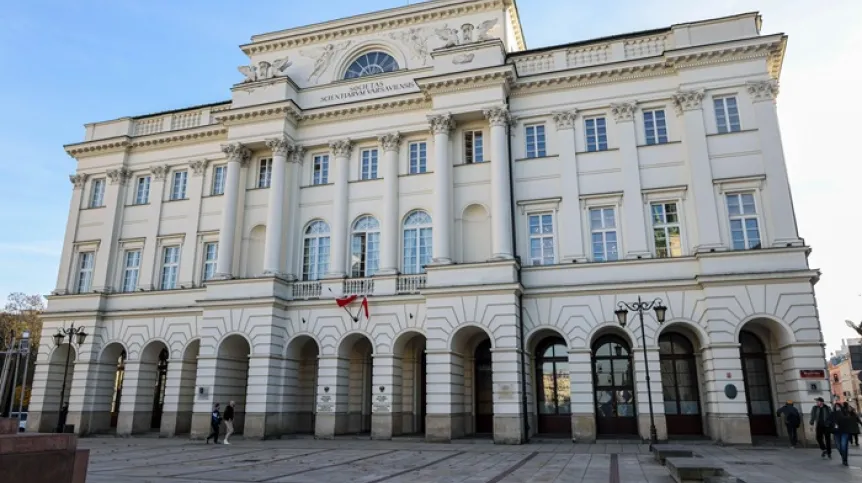
The discussion took place during a joint conference of the European Federation of Academies of Sciences and Humanities (ALLEA) and the European Network of Young Academies (ENYA), hosted by the Polish Academy of Sciences together with the Institute of Geophysics of the Polish Academy of Sciences. The Academy of Young Scientists of the Polish Academy of Sciences was a co-organizer.
Participants said concerns about academic freedom have emerged in a range of countries, including Italy, Norway, Sweden and Latvia.
“Academic freedom is limited not only by open censorship, but also by things such as personnel policies and specific funding mechanisms that discourage carrying out certain types of projects,” said Professor Andrzej Katunin of the Silesian University of Technology, vice-president of the Polish Young Academy of the Polish Academy of Sciences.
Researchers said restrictions can also take more indirect forms, including cultural and intellectual pressures that influence what topics are considered acceptable or attractive to pursue.
“Research freedom is also subtly restricted by cultural and intellectual trends, such as those related to artificial intelligence, which create pressure on researchers and lead to shifts in their research areas. Another type of pressure, often internalised by researchers themselves, comes from public opinion: if social research results are critical of certain attitudes, for example, they expose prejudices that we as a group or nation are unwilling to acknowledge, the potential social resistance discourages such research. This also happens because, in the age of social media, such researchers suffer the personal costs of such a voice,” said Dawid Rogacz of Adam Mickiewicz University in Poznań, a member of the Polish Young Academy.
In some cases, participants said, funding decisions themselves can limit research topics considered politically or socially sensitive.
“Cases of restrictions concern research topics that can be politically inconvenient. At one Latvian university, funding for planned research on migrant employment in the Bolt and Volt networks, i.e., passenger transport and food delivery, proved problematic. In Latvia, this remains a partially grey area,” Katunin said.
Despite these concerns, participants stressed that academic freedom is under increasing scrutiny and must be actively protected.
They pointed to international organisations such as UNESCO, Scholars at Risk and the European University Association as possible actors in monitoring violations, supporting affected researchers and promoting shared standards across countries.
Researchers also discussed internal university strategies, including building stronger institutional networks and improving communication to resist external pressure.
“To defend ourselves against attempts at political influence on academic freedom, we must create a two-pronged approach. We must seek solutions to diversify funding sources, and above all, build transparent channels of communication within the university and engage in discussions. Threats to freedom cannot be a taboo subject. If a problem arises, the university should make it clear that it is recognised and that scientists do not accept it,” Katunin said.
Speakers at the meeting said cooperation between institutions could help reduce the vulnerability of individual universities to political or financial pressure.
“The scale of these disturbing phenomena is significant, representatives of the European Network of Young Academies believe,” participants noted during the discussions.
Maria Leptin, president of the European Research Council, said authoritarian systems often struggle with independent science because of its openness to criticism and international collaboration.
“Not so much because research results can be inconvenient, but because science is open to criticism, including self-criticism, and also because science embraces international contacts and is loyal to standards and norms,” Leptin said.
“If Europe wants to value academic freedom, it must act where it is attacked,” she added.
Earlier, at a December meeting of young academies titled “Academic Freedom in Times of Crisis,” researchers from Latin America also raised concerns about centralised funding systems that concentrate resources in specific cities and institutions, leaving others at a disadvantage.
PAP - Science in Poland
zan/ agt
tr. RL

















