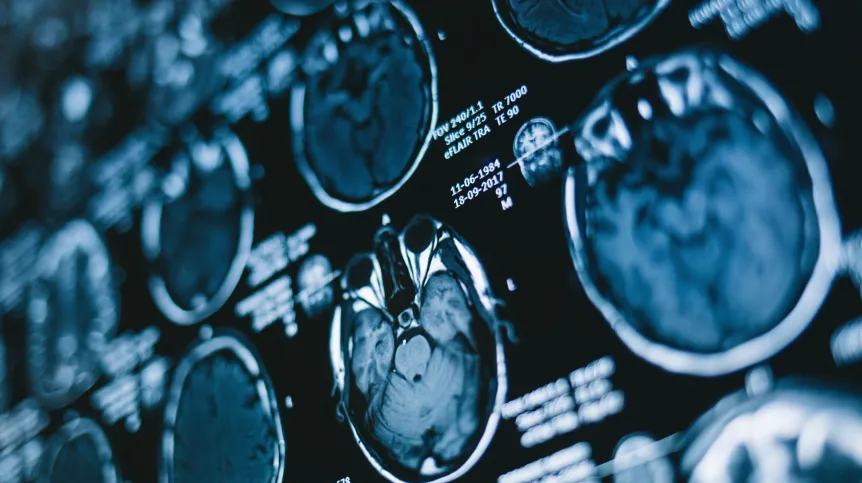
The ability to control impulses, such as the decision to gamble, is linked to specific neurobiological processes that can be modified, according to a new study involving researchers from the Jagiellonian University. After stimulation of a specific brain region, participants made more rational decisions, suggesting that neuromodulation techniques could in the future complement psychotherapy.
Social media, online shopping, computer games and online gambling all use reward mechanisms deeply rooted in the brain. In some people, these mechanisms can lead to a loss of control over behaviour and the development of behavioural addictions.
Scientists have been trying for years to understand why some people can resist such impulsive decisions, while others repeatedly engage in harmful activities despite negative consequences.
In a publication in the journal Psychophysiology (DOI:10.1111/psyp.70227), researchers analysed the role of the ventromedial prefrontal cortex (vmPFC) in this process. This structure, located in the front of the brain, plays an important role in assessing the value of rewards, predicting the consequences of actions and inhibiting unfavourable impulses.
Previous neurological research has shown that people with damage to this area have difficulty predicting the consequences of their decisions and are more likely to engage in risky behaviour. Similar disorders of vmPFC activity are observed in people suffering from gambling addiction and other behavioural addictions.
Research by an international team of scientists, including Professor Mirosław Wyczesany from the Institute of Psychology of the Jagiellonian University, Professor Markus Junghöfer and Thomas Kroker, PhD, from the University of Münster, shows that non-invasive stimulation of a specific area of the brain can improve the ability to make rational decisions and increase control over risky behaviours.
Professor Mirosław Wyczesany explained that the method used in the study involves passing a very weak electric current through selected areas of the brain using electrodes placed on the scalp.
"It does not cause pain or tissue changes, but may temporarily increase or decrease the excitability of neurons," Wyczesany said, quoted in a Jagiellonian University press release.
In the experiment, researchers used three types of stimulation: excitatory (anodal), inhibitory (cathodal) and sham stimulation, which acted as a placebo.
The study involved 72 healthy people. After the stimulation ended, they performed a task resembling a gambling game. In each round, participants received information about the probability of winning and then decided how much they wanted to bet. After making their choice, they learned the result — a gain or a loss.
At the same time, their brain activity was recorded using electroencephalography (EEG), allowing researchers to track processes occurring in fractions of a second during decision-making and when participants assessed the results.
The study took into account both favourable and unfavourable situations from a mathematical point of view. In some trials, participants could statistically gain. In other trials, the risk of loss outweighed the chance of winning.
The results showed that people subjected to excitatory stimulation of the vmPFC region made more rational decisions. When the chance of winning was high, they bet larger amounts. However, when the risk of loss increased, they limited the amount of their bets.
Participants exposed to inhibitory stimulation showed the opposite tendency — they were more likely to take excessive risks.
The researchers found particularly important results in trials where the risk of loss was higher than the chance of winning. In these situations, people after excitatory stimulation lost significantly less money than participants in the control group, who did not receive actual stimulation.
This effect appeared from the beginning of the experiment, suggesting that the stimulation not only improved learning, but above all strengthened the ability to inhibit impulsive decisions.
Researchers also observed an interesting effect regarding feedback processing. After excitatory stimulation, participants more accurately predicted expected outcomes. When the outcome was as expected, they reacted more calmly and assessed it less emotionally.
In contrast, unexpected events, especially unexpected gains or losses, triggered stronger reactions. According to the authors, this indicates deeper processing of information and more effective learning based on one's own experiences.
The brain better recognised situations in which reality differed from predictions, allowing participants to update their action strategies more quickly.
From the perspective of psychology, this is important because one of the main features of behavioural addictions is difficulty in drawing conclusions from negative consequences. A person with a gambling addiction may lose money repeatedly and still continue to gamble.
If stimulation of the vmPFC does indeed improve the ability to predict the consequences of actions and learn from errors, it could support the treatment of such disorders in the future.
The authors emphasise, however, that the study was conducted on healthy participants, not patients. Therefore, it cannot be automatically assumed that similar effects will occur in people suffering from pathological gambling or other addictions.
Furthermore, the tDCS technique does not act solely on a single point in the brain but also affects neighbouring areas, making it difficult to precisely determine the source of the observed effects.
The researchers have replicated similar results in other studies, but further clinical work is necessary to verify the effectiveness of this method in therapeutic practice.
"Although we are still a long way from a routine use of brain stimulation in the treatment of gambling addiction, the results suggest that in the future, non-invasive neuromodulation techniques may become a valuable complementary tool to psychotherapy," Wyczesany said.
PAP - Science in Poland
ekr/ agt/
tr. RL