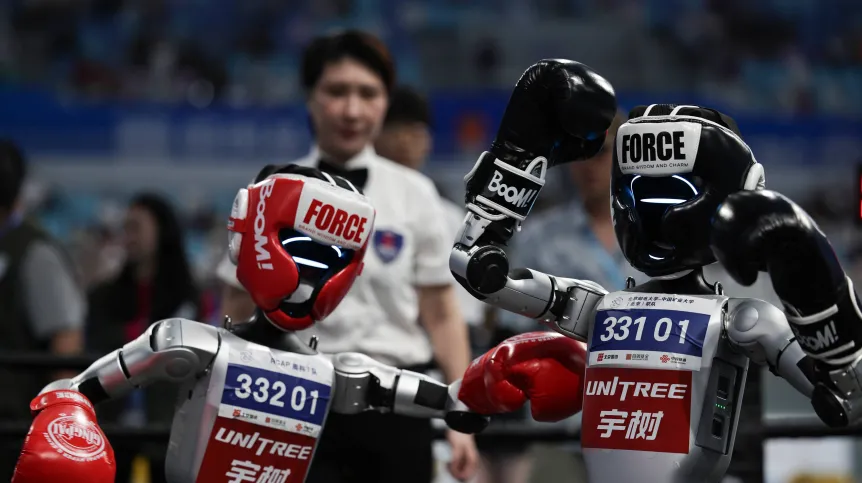
A seven-member Polish team has taken fourth place among 200 teams in the qualifying rounds of the URKL 2026 humanoid robot tournament, achieving the best result by a European team.
The Brave Mind Fighters team will compete in the next stage of the tournament in Shenzhen, China, in August, when the robots will fight in the ring.
URKL 2026, or Ultimate Robot Knock-out Legend, is an international humanoid robot fighting league initiated and organised in Shenzhen by Chinese humanoid robot manufacturer EngineAI. Teams taking part prepare robots to fight in the ring, developing their own AI models to give the machines skills in mixed fighting styles, movement coordination and balance.
The tournament is also a test of how well humanoid robots can control their bodies and respond to changing conditions in real time.
‘Robot fights are spectacular, but above all they are a demanding test of Embodied AI. The humanoid must maintain balance, coordinate multiple joints, respond to contact and kinetic disturbances, regain stability, and make decisions in real time. Movement control, balance, robot perception and decisions, power supply and structure protection will be assessed’, says Arkadiusz Cybulski, manager of Brave Mind Fighters.
Cybulski says similar training methods are also used for robots intended for industry, logistics, rescue and critical infrastructure, although success in the ring does not by itself prove that a robot is ready to work in a factory.
‘In the tournament, the most important factors will be dynamics and impact resistance, while the use of robots in industry requires, above all, reliable manipulation, safety, long operation, and a measurable return on investment. Therefore, we treat the URKL tournament as a practical laboratory and a test of selected humanoid training methods, and not a full test of commercial possibilities’, Cybulski says.
The first stage of the Polish team's work was to collect data on a boxer's movements.
The team used motion capture technology, which tracks human movement with a system of depth cameras that precisely records distances to surrounding objects and converts the movements into digital data.
‘We used the help of a fighting techniques expert who performed various punches, combinations and guards. We translated his movements into a digital form, which served as reference material for +training+ the robot. We have created an AI model whose goal is to replicate human movement as faithfully as possible, which means appropriate control of all robot mechanisms, including joints powered by 29 motors. This is a complicated task, because when the robot performs, for example, a hook punch, it must turn its torso like a real boxer, and at the same time not fall over itself. In addition, there are reactions to blows dealt by the opponent, to which it must respond by dodging or guarding’, says Piotr Gerke, the team's technical leader.
The team trained the robot using PPO, or Proximal Policy Optimization, an algorithm that teaches a robot a strategy by rewarding desired behaviour such as stability, following the reference movement, smoothness and completing a task.
Penalties were applied for falls, shaking, loss of balance and exceeding set limits.
The training took place in a virtual environment, allowing the team to carry out a large number of tests in a much shorter time than would have been possible with a physical robot.
Cybulski says that although URKL is a sporting event, the experience gained through the competition could eventually be used in the economy.
‘The simplest application of humanoid robots, known for years, is customer service. The machine can provide information and answer questions. But in industry or logistics, robots can now replace health and safety inspectors. Thanks to their mobility, they can look everywhere, and at the same time, they are more meticulous than humans and, if necessary, they can work non-stop, day and night, without getting bored or losing efficiency’, Cybulski says.
The expert says the most advanced robotic technology currently concerns the precise operation of robotic limbs. Companies in China and Germany are conducting pilot implementations of humanoid robots in logistics, including for moving various items.
‘The greatest challenge facing robotics worldwide is developing robot control that will handle with the +human environment+. For example, you could show it an action, and it would quickly learn and repeat it. This would ensure flexibility and speed of implementation. Such humanoid robots would not need to be retooled every time, as is the case with industrial robots. A humanoid could immediately take over the human's position and begin working. Major companies are working on this technology. The tournament is a part of this technological race’, Gerke says.
Brave Mind Fighters is a team of seven engineers and students representing several scientific disciplines.
‘It was created at the intersection of several communities: the engineering and entrepreneurial community from Śniadania Robotyczne, the HumanTech Center at SWPS University, students from Warsaw University of Technology, and people involved in the Polish language model project, Bielik AI. We combine expertise in AI, robotics, simulation, motion control, mechatronics, electronics, and software engineering’, Gerke says.
Cybulski says the team members invested their own time — thousands of man-hours in total — to prepare for the tournament and did not use external funding.
The team is also in talks with companies in Poland that could potentially be interested in piloting humanoid robots in their operations. Cybulski says such projects could help companies develop robotics strategies for the future.
‘Of course, we are technologically ahead of the curve on the Polish market. But in China, this is already happening now’, he says.
Cybulski says pilot programmes and audits of robotic solutions should be a natural next step for companies preparing for the wider economic use of Physical AI solutions, which combine a virtual AI ‘brain' with the physical ‘body’ of a machine.
‘Our tournament results show that Poland does not have to be solely a recipient of Chinese robots or American AI models. We can develop our own solutions, training tools, integration competencies, and methods for assessing robot applications in enterprises’, Cybulski says.
He adds that this requires investment in well-equipped robotics laboratories and greater access to the high computing power provided by supercomputers.
The best teams from the qualifying rounds will compete in the group stage, with the finalists due to fight for the title in December. (PAP)
gkc/ mick/
tr. RL