
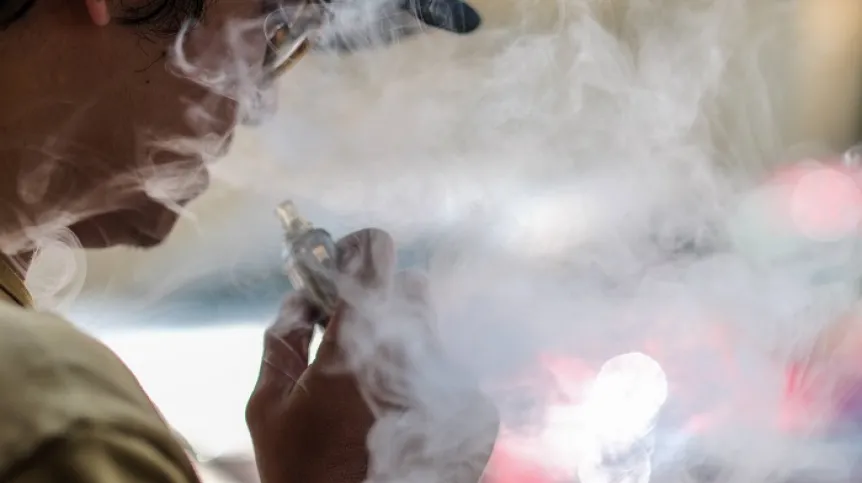
Unconsciously copying another smoker’s behaviour, from the way they hold a cigarette to the timing of their inhalations, could make it harder to quit, according to psychologists from SWPS University.
In a study published in the International Journal of Psychology, smokers whose behaviour was subtly imitated smoked, on average, twice as many cigarettes as those whose behaviour was not copied.
The researchers also found that smokers whose behaviour was imitated reported significantly less willingness to quit within the next five years.
Despite extensive knowledge of the health risks of smoking, millions of people continue to smoke, while quitting remains a significant challenge. The influence of the social environment, including other smokers, is estimated to account for up to 35% of long-term cigarette smoking behaviours.
A team of psychologists from SWPS University examined a specific social mechanism that has received relatively little attention in the context of addiction: mimicry, or the unconscious imitation of another person’s behaviour.
Psychologists have long known that people spontaneously copy each other’s body posture, gestures, facial expressions and even speech patterns during conversations. This phenomenon is also known as the ‘chameleon effect’.
‘Such imitation occurs automatically, and we are usually unaware of it. People who unconsciously imitate another person’s behaviour are perceived as more likeable, trustworthy, and easier to work with. This allows them to build a bond with the other person more quickly’, explains Paweł Muniak, PhD, from the Institute of Psychology at SWPS University.
The researchers wanted to find out whether the same mechanism could make quitting smoking more difficult.
Previous studies have shown that people are more likely to start smoking if their friends or family members smoke. Smokers are also more likely to form social networks with other smokers, something that can be seen, for example, during shared breaks at work.
Going out for a cigarette provides an opportunity to talk, relax and build relationships. The researchers hypothesised that mimicry occurs during these interactions, with smokers unconsciously synchronising their behaviour and strengthening their sense of closeness and belonging to a group.
To test the hypothesis, the researchers conducted two experiments.
In the first, 40 adult smokers took part in a laboratory experiment. Each participant spoke with an experimenter for several minutes about a healthy lifestyle.
In one group, the experimenter subtly imitated the participant’s movements, including their sitting position, gestures and body position. In the other group, the experimenter behaved neutrally.
After the conversation, participants were given a break during which they could light a cigarette.
Those whose behaviour had been imitated smoked, on average, twice as many cigarettes as participants in the control group.
They also developed a significantly stronger liking for the experimenter.
Statistical analysis showed that increased liking mediated the increased number of cigarettes smoked. In other words, the stronger the social bond between the participants and the experimenter, the greater the tendency to smoke.
The researchers then tested the effect in a natural setting.
The second experiment involved 120 people in smoking areas at restaurants, pubs and clubs. The researchers compared three situations: the experimenter did not smoke; the experimenter smoked but did not imitate the participant; and the experimenter smoked while synchronising movements with the participant.
In the third situation, the experimenter held the cigarette in a similar way, took a drag shortly afterwards and exhaled the smoke in a similar manner.
After the interview, participants answered questions about their plans to quit smoking.
Those whose smoking behaviour had been imitated reported significantly less willingness to quit within the next five years than participants in the other two groups.
Simply talking to another smoker also reduced participants’ motivation to quit, but the effect was significantly weaker than when mimicry occurred.
‘Movement synchronization increases the sense of similarity and belonging to a group. The stronger the relationship, the more difficult it is to give up the behaviour that contributes to this relationship, in this case, smoking cigarettes. This may partially explain why many people relapse after socializing with other smokers, even if they have not smoked for some time before’, the psychologist from SWPS University points out.
The findings could have implications for nicotine addiction treatment programmes.
Most therapies have focused on biological aspects of addiction, such as reducing cravings and withdrawal symptoms. The researchers suggest that the social rituals surrounding smoking may also be important.
One possible approach could be to educate patients about the effect of mimicry during shared smoking. Simply being aware of the mechanism could weaken its influence.
The researchers also suggest limiting situations that reinforce smoking socially, such as designing smoking areas in ways that discourage long gatherings.
Reducing this social reinforcement, they suggest, could make attempts to quit easier.
Ewelina Krajczyńska-Wujec (PAP)
ekr/ agt/
tr. RL