
A method developed by a Polish scientist to measure how cement-based materials shrink has been verified by American scientists and approved by the American Association of State Highway and Transportation Officials (AASHTO).
The Plastic-Sleeve Test (PST) was developed and patented by Adam Zieliński, PhD, Eng., of the West Pomeranian University of Technology in Szczecin. The method can be used to measure shrinkage deformation in cement mixtures, mortars and grouts.
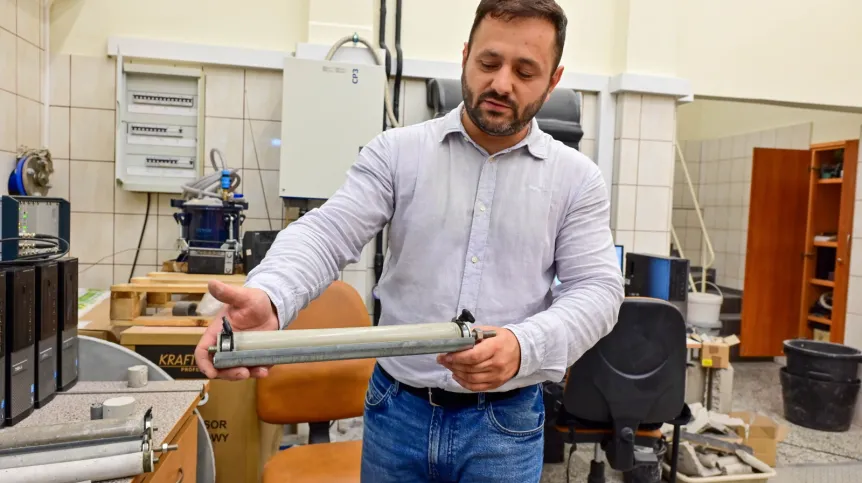
'The PST method measures the deformation of all cementitious composites. It is comprehensive and universal', Zieliński said while demonstrating the method for the Polish Press Agency (PAP) at the university's Shrinkage Deformation and Crack Susceptibility Laboratory.
Zieliński said the research could help develop more durable, crack-resistant concrete mixtures for use in roads, bridges and skyscrapers.
American universities and construction associations spent two years verifying the accuracy, reliability and repeatability of the PST method before it was approved by AASHTO last week.
'AASHTO standards are used not only in the US but also in Canada, Latin America, and for projects in Europe. The Polish General Directorate for National Roads and Motorways (GDDKiA) also uses AASHTO standards', Zieliński explained.
The method involves placing a concrete mixture in a plastic sleeve, stabilising the sample in a support channel and then placing it in a dilatometer, which measures changes in length or volume. A deformation sensor installed at one end of the sample can transmit data for analysis every five minutes, for example.
'Due to the high functionality, it is possible to control various processes, such as the sample diameter and the measurement process. A major advantage of this method is that we can test new-generation composites, characterized by high autogenous shrinkage. This type of concrete is used, for example, in tall buildings and skyscrapers', Zieliński explained.
The PST method enables simultaneous but separate monitoring of autogenous shrinkage and drying shrinkage. This makes it possible to assess the influence of factors including binder type, chemical admixtures, aggregates, fibres and water content on the course and kinetics of shrinkage deformation.
After months of research, Zieliński proposed three sample diameters – 25 mm, 40 mm and 65 mm – while their length remains constant at 30 cm.
A polyethylene sleeve shapes the mixture and limits moisture exchange with the surrounding environment. The form can also be easily removed, for example after three or seven days, allowing total shrinkage to be measured.
'We cut it with a knife and get a very nice effect of uniform, radial drying on the lateral surface of the sample', Zieliński described.
The circular cross-section increases the precision of drying-shrinkage measurements compared with rectangular samples.
Measuring autogenous shrinkage is particularly challenging in high-quality concrete mixes, which can produce concrete with compressive strength of up to 160 MPa. Such mixes contain little water and can develop micro-cracks, reducing the durability and safety of structures.
'Currently used methods in the US and Europe do not allow for the full recording of autogenous deformation. This method is the only one that allows for the uninterrupted examination of the entire deformation process', he said.
The PST method is also cheaper than other forms of measurement. Zieliński said a plastic sleeve costs about 10 cents, compared with $10 for a plastic tube used for similar tests.
The method can also be used to assess the effectiveness of concrete maintenance treatments, including water spraying and covering with mats or foil, as well as to help optimise expansion joints in floors, road surfaces and airport aprons.
Zieliński illustrated this with the example of expanded clay (LECA), a component of concrete mixtures. Its water absorption is approximately 15 per cent, but when the mixture is mixed under negative pressure, absorption can increase to 45–50 per cent.
'The result is that maintenance is significantly more efficient; it occurs from the centre of the concrete structure, meaning there is no need to condense it from the outside', Zieliński explained.
The method has also been patented under the name Polish Shrinkage Test. Its standardisation process in the US began in 2024 in collaboration with scientists from Auburn University and the University of Texas at Austin.
The research was initially funded by the West Pomeranian University of Technology and later also by US research grants.
Tomasz Maciejewski (PAP)
tma/ zan/
tr. RL