
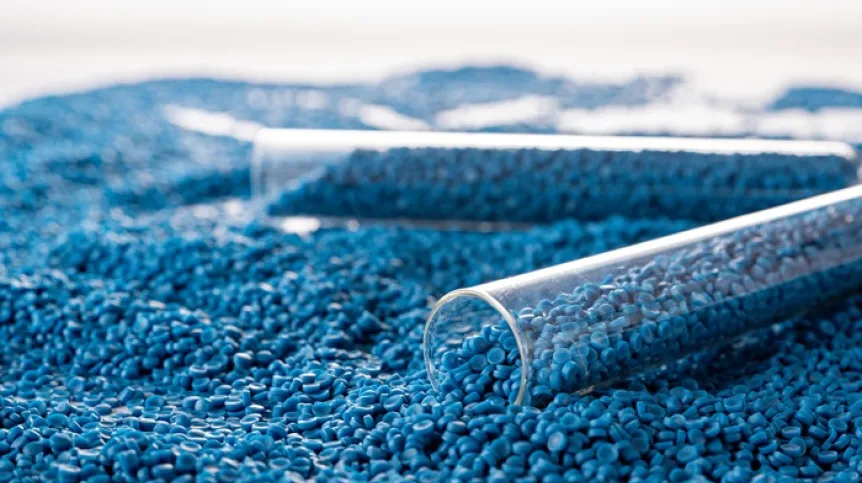
Polish researchers have developed a recycled plastic composite that conducts heat more than four times better than the original material after being mixed with carbon nanoplatelets.
Its tensile strength also increased by 43 percent, although the material became far more brittle.
Plastics are lightweight and easy to mould, but they typically conduct heat poorly. This limits their use in applications where heat needs to be dissipated, such as electronic devices.
Researchers from the Military University of Technology and the Warsaw University of Technology set out to see whether recycled plastic could be turned into a lightweight material capable of helping with cooling.
They used a mixture containing 90 percent recovered high-density polyethylene (HDPE) and 10 percent rubber from recycled tyres. The raw material also contained a small amount of polypropylene, typical of imperfectly sorted waste.
The mixture was therefore closer to the recycled materials found in industrial practice than to the pure polymers commonly prepared in laboratories.
The researchers added between 5 and 20 percent of one of three carbon-based materials: synthetic graphite nanoplatelets, expanded graphite or shungite, a natural rock containing carbon and minerals. The carbon-based materials were not recycled; they were added to give the recycled plastic new properties.
After melting and mixing the ingredients twice, the researchers moulded samples and tested their thermal conductivity, strength and flexibility. They also examined their structure using an electron microscope.
The untreated material had a thermal conductivity of 0.421 watts per metre-kelvin. Adding 20 percent shungite increased this to 0.516, while expanded graphite raised it to 1.019 watts per metre-kelvin.
The best results came from graphite nanoplatelets. At a 20 percent concentration, thermal conductivity reached 1.803 watts per metre-kelvin – more than four times that of the base material. The rate at which heat spread through the material also increased approximately fourfold.
Microscopic images showed why the nanoplatelets performed best. Their flat particles were well dispersed throughout the plastic and made contact with one another in places, creating pathways for heat to flow.
Expanded graphite left more gaps where it met the plastic, while shungite formed isolated clusters and contained less highly conductive carbon. This made its network of heat-conducting connections less continuous.
The nanoplatelets also increased tensile strength by 43 percent at the highest concentration. However, the material became much less flexible.
The composite without the additive could be stretched by about 77 percent before breaking. The material with the highest thermal conductivity fractured after being stretched by only around 8 percent.
Even with the improvement, the composite conducts heat about 130 times less effectively than aluminium, meaning it is unlikely to replace metal heat sinks in high-energy devices.
The researchers say it could nevertheless be used in lightweight casings, shields and other components currently made from standard plastic where some heat dissipation is needed.
Before the material can be used industrially, its durability and aging characteristics will need to be assessed, along with the consistency of properties between batches of recycled raw material.
The high concentration of nanoplatelets also made the composite difficult to mould. The study did not include a full environmental analysis, so it remains unclear whether using waste materials offsets the energy and resources needed to produce the additives and recycle the material.
The findings were published in Materials Today Communications.
kmp/ zan/
tr. RL