
Two powerful black hole collisions have allowed scientists to work out how a miscalibrated LIGO detector in Hanford, Washington, was distorting gravitational-wave signals – and use the signals themselves to correct the data.
The technique, known as astrophysical calibration, allowed researchers to recover useful data from the detector and, in one case, reduce the area of sky where the source was likely to be located by a factor of 40.
For the first time, scientists were able to use gravitational-wave signals themselves to make informative measurements of a detector’s calibration. The results were published in Physical Review Letters.
Imagine three microphones recording the same familiar melody. One amplifies certain tones while delaying others; comparing the recordings reveals these distortions. In this study, gravitational waves played the role of the melody, while three observatories acted as the microphones.
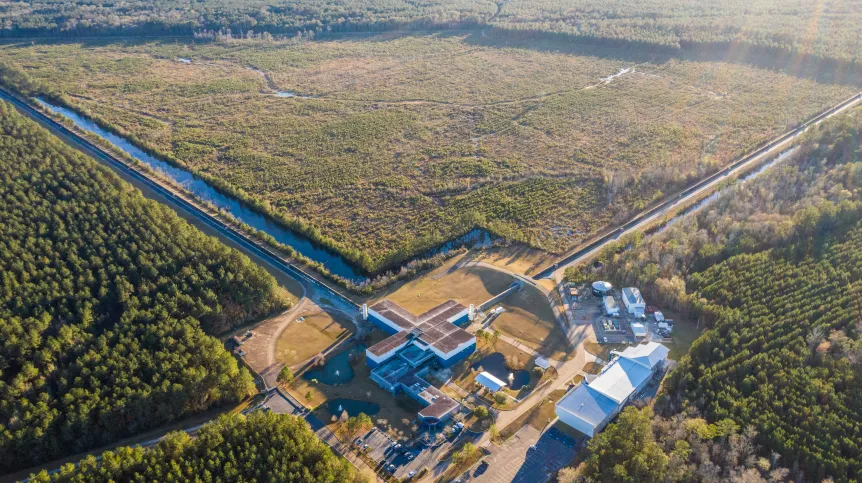
Hanford is one of two LIGO detectors in the United States. It has two four-kilometre-long arms and is located in Washington state. The other LIGO detector is in Livingston, Louisiana, while the European Virgo detector is in Italy.
The detectors measure incredibly small changes in the lengths of their arms. The raw electrical signal must then be converted into a measurement of spacetime strain, a process known as calibration.
Normally, laser light exerts a precisely measured pressure on the detector’s mirrors, allowing scientists to determine how the instrument responds. Astrophysical calibration instead uses the gravitational-wave signal itself. Because the expected waveform is known, signals recorded by several observatories can reveal how an individual detector has altered the amplitude and phase of the signal.
This provides an independent way to check the detector’s performance at the exact time and frequencies of an observation. It can reveal errors in standard calibration and, when that calibration is incomplete, allow data that might otherwise have been discarded to be used.
When two black holes orbit each other, they lose energy, move closer together and orbit increasingly quickly. The gravitational waves they produce grow stronger and rise in frequency. When converted into sound, the signal resembles a tone rapidly sweeping from low to high frequencies – a pattern known as a chirp.
The sound is not an actual noise travelling through space but an acoustic representation of the measurement. The shape of the gravitational-wave signal is predicted by general relativity. When several observatories detect the same event, genuine features of the signal can be distinguished from distortions affecting an individual detector.
The first signal, GW240925, came from the merger of black holes with masses of approximately nine and seven times that of the Sun.
At the time, Hanford had an inconsistency in its calibration configuration: a parameter used by the detector’s control system had a different value from the one assumed by the model used to process the data. The resulting error altered the signal amplitude by as much as about 20 percent at some frequencies.
Scientists used recordings from Hanford, Livingston and Virgo to infer the calibration error and then compared the result with independent measurements made directly at the detector. The two agreed, providing a cross-check of the astrophysical calibration method.
Hanford was not inherently less accurate than Livingston or Virgo. But the second signal, GW250207, arrived at another unusual moment.
The detector had only just been switched on and was still settling into its normal operating state. Its control systems were maintaining the lasers and mirrors in the correct configuration, and noise levels were low enough to detect gravitational waves. However, the detector’s response was still changing as the mirrors gradually warmed under the laser light, while the signals normally used to monitor calibration had not yet stabilised.
The data were therefore good enough to contain a gravitational-wave signal, but scientists could not accurately determine how the detector had altered its amplitude and phase. LIGO describes Hanford as being in an “unsettled state” during the event, with some auxiliary sensors not collecting the information needed to calculate the calibration error.
GW250207 came from the merger of black holes with masses of approximately 35 and 31 times that of the Sun. It was one of the strongest gravitational-wave signals recorded, with a network signal-to-noise ratio of about 69.
By combining observations from all three detectors, scientists were able to determine how Hanford’s uncertain response had affected the recording. Including the astrophysical calibration allowed the data to be reliably used in the analysis.
The third detector also provided an additional measurement of when and how the signal reached Earth. Comparing the arrival times and waveforms from the three observatories allowed scientists to determine the signal’s direction more precisely.
As a result, the area of sky in which the source was likely to be located shrank from about 800 to 20 square degrees.
Accurate calibration is also important because detector distortions can be mistaken for real properties of the black holes. For example, the distortion in GW250207 could have been interpreted as evidence that the black holes’ spin axes were changing.
Calibration errors can also affect estimates of black-hole masses and distances, or potentially mimic departures from the predictions of general relativity.
The study was carried out by members of the LIGO, Virgo and KAGRA scientific collaborations, including researchers affiliated with the Nicolaus Copernicus Astronomical Centre of the Polish Academy of Sciences, the University of Warsaw, the National Centre for Nuclear Research, the University of Białystok, the Institute of Mathematics of the Polish Academy of Sciences and Jagiellonian University.
Astrophysical calibration cannot replace measurements carried out at the observatories. It is less precise, requires an exceptionally strong and well-characterised signal, and works best when several detectors observe the same event.
However, it provides an independent check on standard calibration and can rescue valuable data when the normal calibration is incomplete. As detector sensitivity improves, the technique could become an increasingly useful complement to conventional calibration. (PAP)
kmp/ agt/
tr. RL