
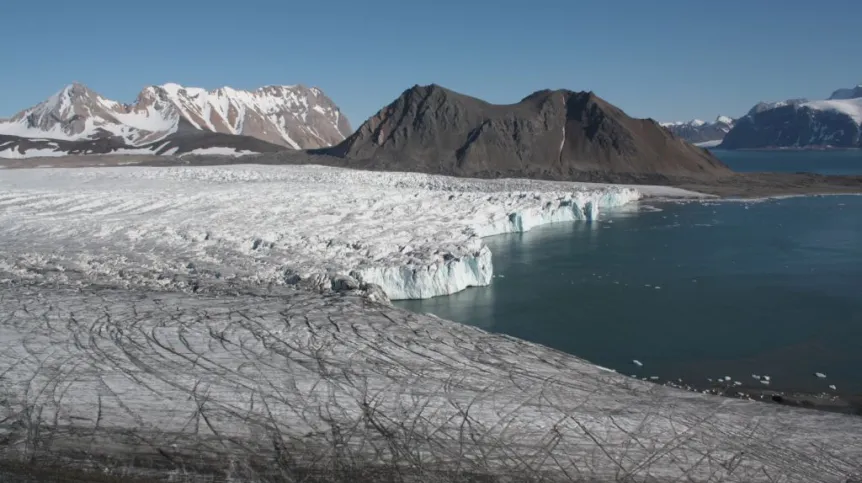
Glaciers do not sleep during the polar night, as previously thought, but show some activity, which depends, among others, on the activity of the ocean. Polish scientists studied the glacier behaviour during winter by analysing the unique glacier photographs taken during the polar night.
Teams from the University of Silesia, and the Institute of Geophysics PAS in Warsaw, have been conducting research for four years, as part of an international EU project ice2sea. The researchers want to examine the contribution of glaciers to raising the sea level.
The role of the team from the University of Silesia was to collect and process field data from glaciers that terminate in the sea. The glaciologists investigated the Hans Glacier on the Norwegian Spitsbergen.
Until now, little was known about what was happening to the glaciers during the polar night. "Conclusions could be drawn only from radar satellite images, whose resolution was very limited, just 30x30 m" - said in an interview with PAP Prof. Jacek Jania of the Department of Earth Sciences at the University of Silesia.
For the first time in the history of study of glaciers, Polish researchers were able to conduct a full, year-round glacier photographic documentation. The photographs were taken not only in summer but also throughout the winter, during the polar night. With a series of thousands unique images, they could determine what was happening with glaciers during the polar night.
Polish researchers set up cameras on the side of the mountain so that they looked at the glacier face. Pictures were taken automatically every three hours, and the exposure time automatically adjusted to the existing conditions: some photographs showed aurora, others were taken by starlight or light of the moon. Scientists had to get back to the place of observation once in a while and replace the batteries.
Until now it was thought that the glaciers during the polar night were dormant, and their movement very slow. But glaciers are flowing faster than thought, especially during winter rainfall instead of snow. It turned out that in winter cracks in the glacier ice widen and the structure relaxes. It can be said that in the winter glaciers are preparing for summer calving (calving is the process of breaking off fragments of the glacier, which produces icebergs). According to Prof. Jania, melted water gets to the bottom of the ice tongue through cracks in the ice. This reduced the friction of the ground and glacier ice mass flows off into the ocean faster.
This makes the icebergs begin to break off in the beginning of summer. The study also showed, however, that icebergs occasionally also break off in the winter. Polish researchers believe that the ocean has impact on this phenomenon.
Until now, glaciologists believed that the process of glaciers calving could be inhibited by the presence of sea ice (ice on the surface of the water) before glacier front. It turns out that this is not necessarily true. "The presence or lack of sea ice does not affect breaking off icebergs - says Prof. Jania. - But there are indications that the process of glaciers calving largely depends on the temperature of the ocean. Ice cliff is whipped by warm waves and its stability is disrupted".
"We will continue to monitor the glacier. We want to obtain more information on winter behaviour of glaciers" - concluded the researcher.
PAP - Science and Scholarship in Poland, Ludwika Tomala
lt/ agt/
tr. RL