
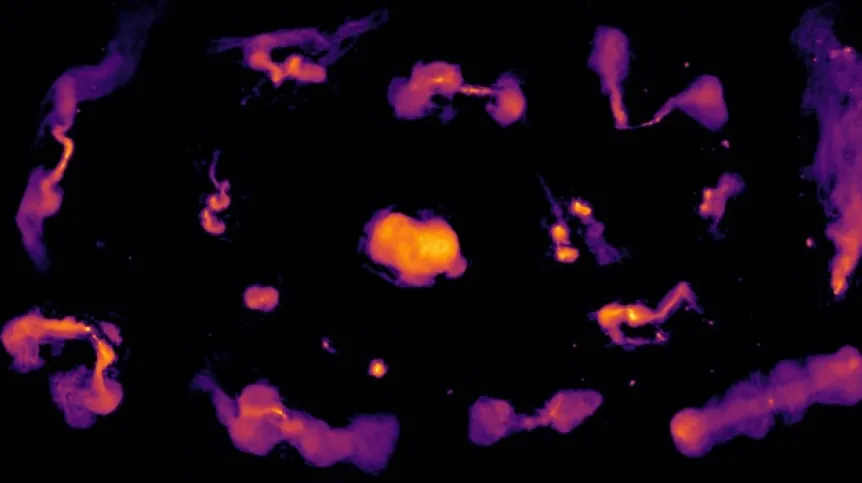
An international team of scientists has produced the largest and most detailed radio map of the Universe to date, revealing 13.7 million active galaxies and pinpointing the locations of supermassive black holes.
The map, known as LoTSS-DR3, was created using the Low Frequency Array (LOFAR) radio telescope. A paper describing the survey was published in the journal Astronomy & Astrophysics.
Researchers involved in the project represent institutions from Poland, the Netherlands, Germany, France, the United Kingdom, Italy, Sweden, Ireland, Latvia and Bulgaria.
“This data release brings together more than a decade of observations, large-scale data processing and scientific analysis by an international research team,” said Timothy Shimwell, lead author of the study and researcher at the Netherlands Institute for Radio Astronomy (ASTRON) and Leiden University.
Observations at low radio frequencies reveal a very different picture of the Universe from that visible to the human eye. Radio astronomy makes it possible to study highly energetic phenomena such as turbulent star formation processes occurring in galaxies at different cosmological epochs.
According to the researchers, the new radio maps have already enabled hundreds of analyses providing insights into the formation and evolution of cosmic structures, the acceleration of particles to extreme energies and the structure of cosmic magnetic fields.
“LOFAR maps allow for a detailed analysis of the interstellar medium in galaxies. They reveal the configuration and strength of the magnetic field and the presence of relativistic cosmic ray particles,” said Krzysztof Chyży of the Jagiellonian University.
Scientists are now examining the data for rare astrophysical phenomena. The research team has already identified several new radio sources, including sporadic and variable sources, previously unknown supernova remnants, some of the largest and oldest known radio galaxies and radio emission produced by interactions between extrasolar planets and their parent stars.
The survey was conducted within the LOFAR ERIC collaboration. The LOFAR interferometer consists of 38 stations in the Netherlands and 14 international stations distributed across Europe, with the most distant stations separated by nearly 2,000 kilometres. Together they form one of the largest and most sensitive radio telescope systems in the world.
“Three LOFAR interferometer stations operate in Poland: in Borówiec near Poznań, operated by the Space Research Centre of the Polish Academy of Sciences; in Bałdy near Olsztyn, operated by the University of Warmia and Mazury; and in Łazy near Bochnia, operated by the Jagiellonian University,” said Marek Jamrozy of the Jagiellonian University.
Processing the observational data required the development of new techniques to correct distortions in radio signals caused by charged particles in the Earth’s upper atmosphere. Analysing 13,000 hours of observations also required highly automated and optimised data processing.
“It took years to design, refine and optimise the algorithms, but they now allow us to routinely produce extremely sharp and detailed images of the low-frequency radio sky, and hunt for time-variable signals from stars and exoplanets,” said Cyril Tasse, who led the development of the data-processing algorithms at the Paris Observatory.
The consortium is currently upgrading the telescope to LOFAR2.0. Researchers plan to use results from LoTSS-DR3 and improved processing techniques to double data-processing speed and enable higher-resolution radio maps.
“LoTSS-DR3 is not an endpoint, but a major milestone. New facilities such as LOFAR2.0 will allow us to map the radio universe with even greater sensitivity and resolution, extending the legacy of this survey well into the future,” said Wendy Williams of the Square Kilometre Array Observatory.
ekr/ agt/
tr. RL