
Space

Polish mobile augmented reality application for ESO

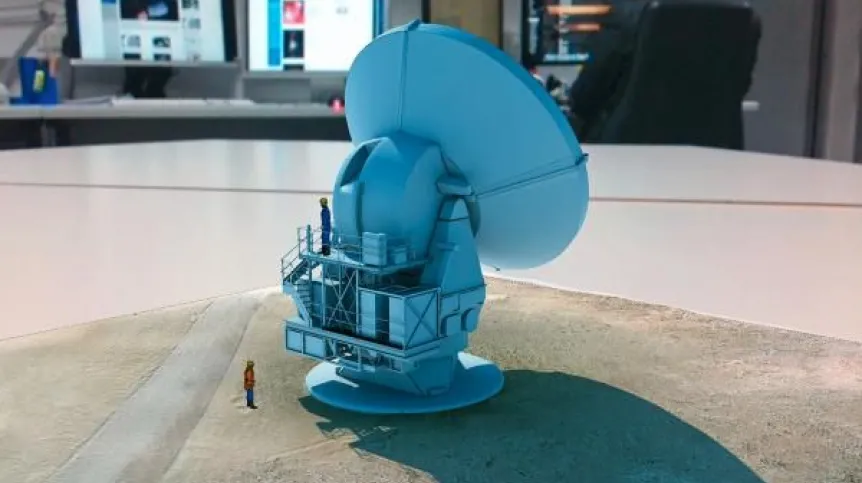
Polish design firm Bridge in collaboration with the European Southern Observatory (ESO) created an educational app presenting ALMA radio telescope network in 3D in the form of augmented reality. The application runs on smartphones and tablets.

The application allows the user to watch a 3D visualization of the network of 66 ALMA antennas. For the 3D effect, the user also needs a print-out of a special PDF file, so-called "tracker".

ALMA Augmented Reality application can be downloaded for free from Google Play and iTunes AppStore. The PDF file is available on the ESO website (www.eso.org/public/poland).

ALMA, the Atacama Large Millimeter/submillimeter Array, is a network of radio telescopes operating at millimeter and sub-millimeter wavelengths. The observatory was launched in March 2013. It is located in the Chajnantor plateau in Chile, at 5000 meters altitude.

The European Southern Observatory represents Europe in the ALMA project. In turn, the company Bridge is a Polish design and technical company, which develops technologies for augmented reality. The term "augmented reality" refers to systems that combine the real world with computer-generated real-time 3D graphics. (PAP)

cza/ krf/

tr. RL

The PAP Foundation allows free reprinting of articles from the Nauka w Polsce portal provided that we are notified once a month by e-mail about the fact of using the portal and that the source of the article is indicated. On the websites and Internet portals, please provide the following address: Source: www.scienceinpoland.pl, while in journals – the annotation: Source: Nauka w Polsce - www.scienceinpoland.pl. In case of social networking websites, please provide only the title and the lead of our agency dispatch with the link directing to the article text on our web page, as it is on our Facebook profile.

More on this topic

  • Kraków, 16.08.2026. Radio astronomer and co-discoverer of the first extrasolar planets, Professor Aleksander Wolszczan, during an interview with the Polish Press Agency in Kraków..  PAP/Łukasz Gągulski

    ‘6,000 planets found but where is everybody?’ asks Polish astronomer who discovered the first extrasolar planet

  • The elliptical galaxy M87 emitting a jet, in an image from the Hubble telescope (due to the large angle between the jet and the line of sight, the centre is not classified as a blazar!) Wikipedia, public domain

    The Astronomer’s Guide to the Galaxy: 20 years of observations reveal blazar’s secrets

Before adding a comment, please read the Terms and Conditions of the Science in Poland forum.