Bears are adapting their diets in response to global environmental changes, according to a new study by an international team of researchers, including scientists from Poland.
The research, published in Nature Communications, analysed bone samples from seven bear species using museum and palaeontological collections across Europe.
The study shows that most bears can flexibly adjust their diets according to climate and food availability, effectively changing their ecological roles. This adaptability, researchers say, could strengthen ecosystems’ resilience to global environmental changes.
“Omnivores can play a dynamic and stabilizing role in ecosystems when environmental conditions change. Although they exist in almost all habitats and on all levels of food webs, we still know surprisingly little about their response to changes in their ecosystems,” said Jörg Albrecht, PhD, from the Senckenberg Biodiversity and Climate Research Centre in Frankfurt.
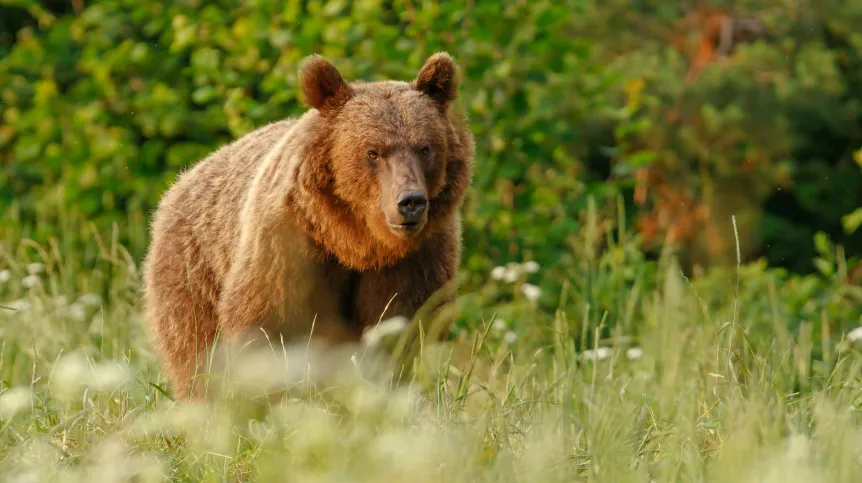
Bears’ diets include berries, roots, nuts, grasses, insects, fish and mammals, varying by species and season. Brown bears, for example, feed mainly on blueberries or nuts in summer and autumn, while their spring diet consists largely of grasses, herbs and carrion.
“Unlike most large carnivore species, bears are omnivores with a low-protein macronutrient profile, and we observe relatively few anatomical and physiological adaptations to meat consumption. This flexibility allows them to have an exceptionally diverse diet,” said Agnieszka Sergiel, PhD, from the Institute of Nature Conservation of the Polish Academy of Sciences.
Sergiel added that bears simultaneously fulfil multiple ecological roles. “They thus influence prey abundance, plant growth and distribution, and nutrient and energy cycling – in both terrestrial and aquatic ecosystems,” she said.
The team combined macroecological and palaeoecological methods to show that bears can adjust their position in the food web according to climatic conditions and resource availability. In areas with limited food and short growing seasons, their diet shifts toward carnivory, while in fertile regions with long growing seasons, plant-based foods dominate.
“Our isotope analyses of fossil bones from the late Pleistocene and Holocene also show that the European brown bear progressively switched to a plant-based diet in the course of increasing primary production and longer vegetation periods following the last ice age around 12,000 years ago,” said study co-author Professor Hervé Bocherens from the Senckenberg Centre for Human Evolution and Palaeoenvironment at the University of Tübingen.
The research also highlights the value of museum collections in studying environmental change. The team analysed bones from brown bears and red deer from 14 collections across Europe. Red deer, as herbivores, served as a control to measure bears’ positions in the food web.
“Working with the collection objects is like detective work: isotope analyses provide a window into the past, allowing us to reconstruct what these animals ate thousands of years ago during the last Ice Age – a time when the world was very different from today,” said co-author Nuria Selva, PhD, from the Doñana Biological Station (CSIC) in Spain and the Institute of Nature Conservation of the Polish Academy of Sciences.
The study finds that large omnivores are undergoing a “trophic rewiring,” changing their ecological roles. “Our results highlight the crucial role that omnivorous representatives of megafauna, including many large carnivores, play in ecosystems. They can help to ensure that food webs remain stable despite global pressures such as climate change. In this way, large carnivores contribute to ecosystem resilience and stability, which is essential in a rapidly changing world,” Selva said.
“Large omnivorous species, located at the top of the food web, are particularly interesting. They utilize a wide range of food sources, they are highly adaptable, and usually respond quickly to environmental changes. If their role shifts – for example, from predators to plant feeders – this can reorganize entire food webs. The way omnivores respond to environmental changes may therefore provide an early indication of major ecosystem transformations,” the researchers concluded. (PAP)
zan/ bar/
tr. RL