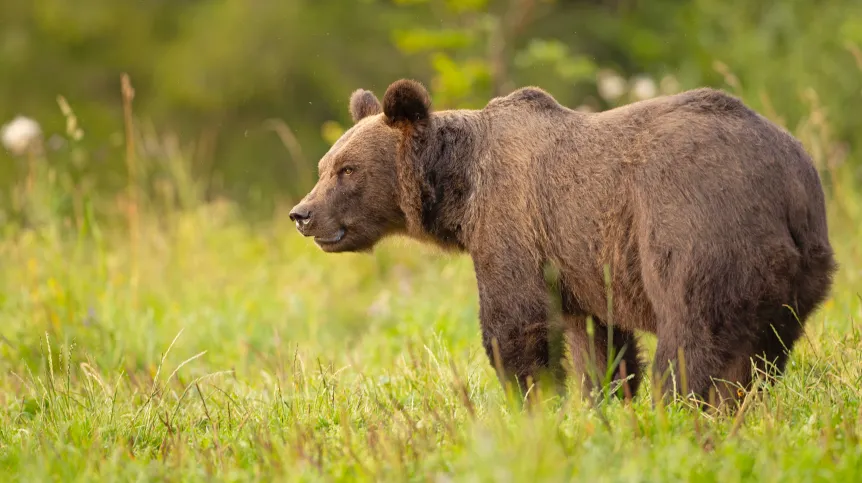
Contemporary opportunities for brown bear migration in the Polish Carpathian Mountains are largely the result of long-term land-use changes, particularly forest expansion on former farmland, according to new research from the Jagiellonian University.
The study, published in PeerJ, examines how historical shifts in land use have shaped habitat connectivity for brown bears. The authors include Anna Szwagierczak, a doctoral candidate at the university’s Institute of Geography and Spatial Management; Elżbieta Ziółkowska, PhD; Michał Jakiel, PhD; Dominik Kaim, PhD; and Joanna Wąs of the Institute of Geography and Spatial Organisation at the Polish Academy of Sciences.
The team reports that long-term land use change and depopulation have been major drivers behind rising numbers and expanding ranges of large carnivores in the Carpathians.
“Our research shows that the current possibilities for brown bear migration in the Polish Carpathians largely result from long-term land use changes. Similar relationships may also apply to other large carnivores,” Szwagierczak said in a statement by the university.
She said improvements in habitat quality and connectivity for large mammals are closely linked to depopulation in rural parts of Europe. “A specific example of this process in Poland is the Low Beskid, which, due to its unique and dramatic history of resettlements and intensive landscape transformations, allowed us to assess the environmental effects of depopulation over time,” she said.
According to the researchers, these processes have triggered rewilding, a return to more natural conditions, that began as woody vegetation spread across abandoned farmland and later accelerated with expanding forest cover. Forest growth in the Low Beskid continues today and has substantially improved conditions for the restoration of large mammal habitats.
To quantify these effects, the team modelled habitat connectivity using a least-cost approach to identify potential migration corridors across the Low Beskid. “This area connects eastern and western Carpathian subpopulations of brown bears, whose source areas were identified as the Bieszczady Mountains and the Beskid Sądecki. Additionally, the adopted method allowed us to estimate the quality of the designated corridors from a habitat perspective,” Szwagierczak said.
The analysis incorporated topography, levels of human pressure — including distance from settlements and transport routes — and the distribution and age of forests. The researchers used both contemporary spatial data and historical maps, enabling them to track landscape changes from the 1860s to the present.
They found that forest expansion played a decisive role in improving habitat quality and connectivity for brown bears throughout this period. The process accelerated after mass resettlements in the mid-20th century and continues to shape the landscape. As forest cover increased, habitat suitability for brown bears rose significantly.
“Currently, we observe depopulation processes in various parts of Europe. Although they proceed at different rates, have different causes and different consequences, our research shows that their long-term impact on the natural environment can be positive,” Szwagierczak said.
The authors say a deeper understanding of these long-term social and environmental dynamics could help inform EU rewilding policy, including implementation of the Nature Restoration Law. (PAP)
rgr/ agt/
tr. RL