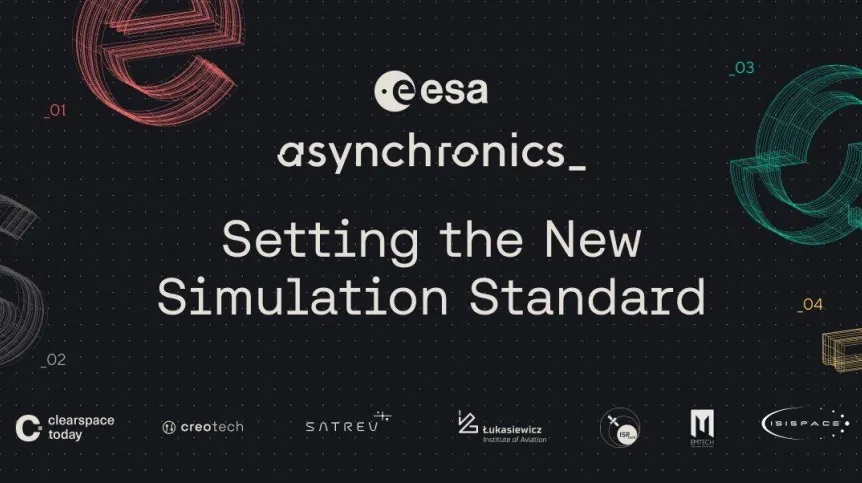
The European Space Agency (ESA) has launched a new project called the ASCEND programme to create accurate digital copies of space technology components, with a Polish company providing participating enterprises free access to technologies enabling the development of “digital twins.”
ASCEND (Accelerating the Space Commercial Ecosystem with Next-generation Digital Twins) is designed to accelerate the use of advanced simulations and virtual models in the space sector.
According to Asynchronics, as part of the initiative the Polish company provides selected European enterprises with free access to technologies, tools and engineering support enabling the transfer of key stages of testing and validation of satellite subsystems to a virtual environment.
The release highlights the growing complexity of modern space missions. “Validation of onboard computer software and subsystem integration often begins only after physical hardware is delivered. This traditional workflow leads to late error detection (…) and an increased risk of delays or mission failure. The industry is actively seeking tools that allow for earlier testing, better predictability, and reduced technical risk,” the release states.
Funded by ESA with €75,000, ASCEND uses two core tools: NeXosim, an open platform for creating and running space system simulations, and NeXosim.io, an online marketplace of ready-made digital models that companies can use to design and test solutions. The programme allows users to build accurate digital twins of components and entire satellite systems, enabling earlier testing and validation in the project lifecycle.
“From the beginning, we assumed that ASCEND was not meant to be just a technology demonstrator, but a real tool for changing how we work in space projects. We wanted to give companies the opportunity to safely test digital twins in practice—on their own use cases—without cost or licensing barriers,” said Adam Chikha, COO of Asynchronics.
The first edition of ASCEND includes seven leading European space entities: ClearSpace, Creotech Instruments, InSpace Propulsion Technologies (ISPTech), ISISpace, Łukasiewicz-ILOT, and SatRev.
Selected through a competition, these participants receive 17 months of free access to the NeXosim.io commercial library of digital models, along with an engineering support package.
Participation requires engagement from at least one engineer and a commitment to provide feedback, which will help develop the European digital twin ecosystem further.
“Participation in the ASCEND project and detailed knowledge of the NeXosim software allows us to better utilize the potential of ‘digital twins’ in streamlining work on both individual subsystems and entire satellites. The dynamic development of digital modelling for satellite components simplifies mission planning and enables fuller utilization of Creotech’s HyperSat platform capabilities,” said Przemysław Kaźmierczak, Systems Engineer at Creotech Instruments.
ASCEND is the first step in a long-term effort to popularize system simulations in Europe’s space sector. In the coming months, the programme aims to generate production-grade applications of NeXosim in participant projects and expand the shared model library available to the wider market.
In the longer term, ASCEND is expected to reduce mission costs, shorten integration times, and improve the reliability of European space systems. (PAP)
abu/ bar/
tr. RL