Fossils of three-clawed turtles dating to about 12 million years ago have been discovered at three sites in southern Poland, significantly extending the known northern range of the group.
The fossils - a skull and fragments of a carapace - were recovered from areas south of Kielce, near Busko-Zdrój, in sand deposits linked to the ancient Paratethys Sea.
“In those areas, there is sand-covered terrain, which is not always the result of glaciers. Sometimes, there is sand that was deposited much earlier, from the sea called the Paratethys, several million years ago,” said Mateusz Tałanda, PhD, a palaeobiologist at the Faculty of Biology of the University of Warsaw and one of the study’s authors.
“While examining these sediments, Marcin Górka from the Faculty of Geology of the University of Warsaw accidentally came across turtle bones. Although they were badly broken, he managed to glue together the upper jaws and the roof of the skull. The latter measures a few centimetres in length, but the entire turtle must have been quite large. We were then able to determine that the turtle belonged to the family Trionychidae, specifically the genus Trionyx,” he said.
Members of the family Trionychidae are aquatic and carnivorous.
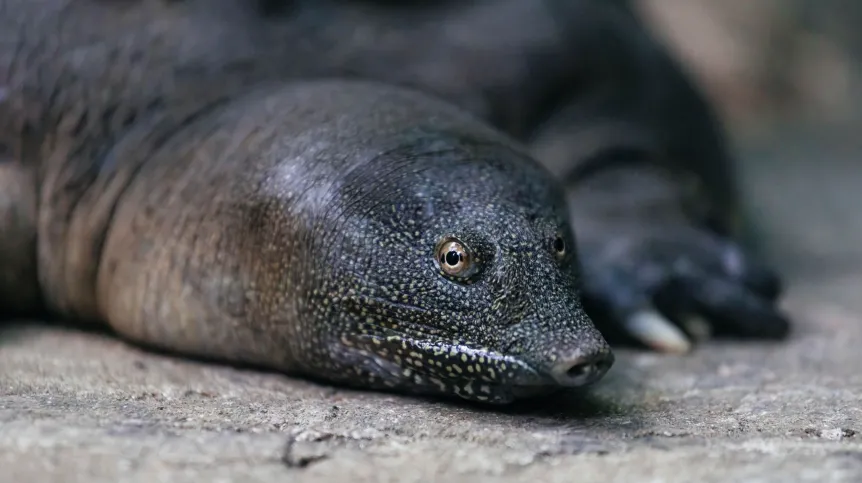
“These turtles have fortunately survived to this day. They have a very unusual appearance, like a cross between a turtle and a mattress. They have flat bodies and reduced shells. They have elongated, pointed snouts, resembling a pig's snout. And, of course, three claws, hence the name. Some reach almost a meter in length,” Tałanda said.
The newly described turtle lived during the middle Miocene, about 12 million years ago, when the climate in present-day Poland was significantly warmer.
“The climate in what is now Poland was very warm back then, and large areas were covered by swampy forests, which left behind deposits of lignite, mined in Konin, Turów, and Bełchatów. To the southeast was the shore of the vast, warm Paratethys Sea. This is where these animals lived. However, our research shows that they were capable of inhabiting not only the southern but also the northern shores of that sea,” Tałanda said.
Miocene turtles have previously been found in Poland, including in Przeworno and Opole, but they belonged to other families.
“However, they belonged to different families, which raised doubts as to whether three-clawed turtles had even reached Poland. Those finds represented a different, more terrestrial environment, which partially explains why three-clawed turtles have not been found until now,” he said.
He added that three-clawed turtles are now virtually absent from Europe, even in the south.
The new findings also challenge previous assumptions about the distribution of genera in Europe during the Miocene.
“The Czech finds belong to the genus Rafetus, and the French ones to Trionyx. It was believed that Europe was divided – Trionyx was believed to occupy the west, and Rafetus the east. Meanwhile, we found Trionyx further north and east than Rafetus from Czechia. This suggests the gradual displacement of one genus by another, already during the Miocene,” Tałanda said.
The finds were described in the Journal of Anatomy. The first author is Yohan Pochat-Cottilloux, PhD, from the University of Warsaw. The co-authors are researchers from the University of Warsaw, the Institute of Palaeobiology of the Polish Academy of Sciences and the Institute of Systematics and Evolution of Animals of the Polish Academy of Sciences. (PAP)
PAP - Science in Poland
akp/ agt/
tr. RL