An international team of astronomers, including researchers from Poland, has discovered a free-floating, or rogue, planet and precisely measured its mass for the first time, providing direct proof that such objects exist, according to a study reported by the journal Science.
The discovery was made using gravitational microlensing observations from ground-based telescopes and the European Space Agency’s Gaia satellite. The object has a mass of about 0.22 times that of Jupiter, placing it firmly in the planetary category and making it the first rogue planet with a directly measured mass.
“This is the ‘discovery of the decade’, comparable to the discovery of the first documented extrasolar planets in the 1990s. Astronomers finally have certainty that such objects exist in the Universe,” said Professor Andrzej Udalski, leader of the OGLE project at the Astronomical Observatory of the University of Warsaw.
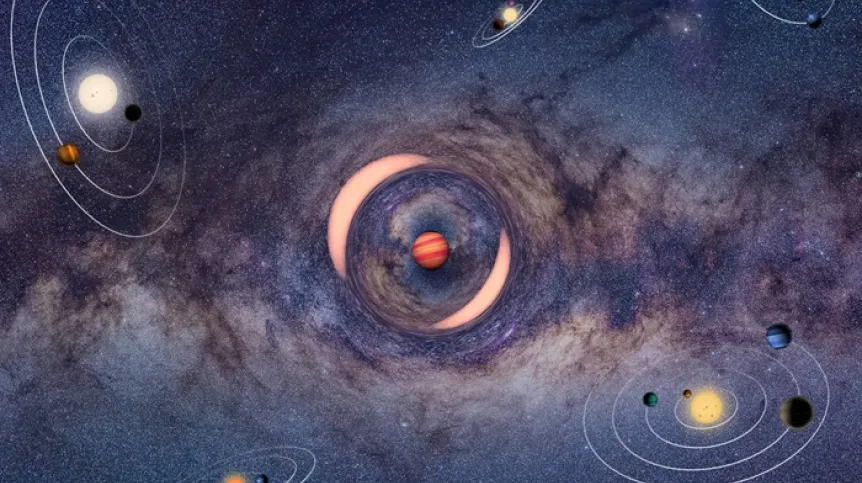
Most known planets orbit stars, but astronomers have long suspected that some planets are ejected from their planetary systems through gravitational interactions and drift through the Milky Way alone. These objects, known as free-floating or rogue planets, do not emit light of their own and cannot be detected using standard planet-hunting techniques such as transits or radial-velocity measurements.
Instead, astronomers rely on gravitational microlensing, a phenomenon in which light from a distant star is bent and temporarily amplified by the gravity of an intervening object. For planetary-mass lenses, such events typically last only a few hours.
More than a dozen rogue planet candidates have been reported previously, but their masses remained uncertain. “In all these cases, the masses of these objects were only statistically estimated,” Udalski said, noting that microlensing observations usually suffer from a mass–distance degeneracy.
The newly identified object was first detected on May 3, 2024, during a short-lived microlensing event involving a bright star near the centre of the Galaxy. The event, designated KMT-2024-BLG-0792/OGLE-2024-BLG-0516, was observed by the Korean KMTNet telescope network in Australia, South Africa and Chile, as well as by the Polish OGLE telescope at the Las Campanas Observatory in Chile.
Astronomers quickly recognised that the shape of the light curve matched predictions for a rogue planet. Soon after, they realised that the same region of the sky was being monitored by ESA’s Gaia satellite, which measures the brightness of stars from its orbit around the Earth–Sun L2 point, nearly two million kilometres from Earth.
The timing proved crucial. Gaia recorded six photometric measurements during the most important 15 hours of the event, capturing the peak of the light amplification. Combined observations from Earth and space allowed scientists to measure the microlens parallax and determine the distance to the lens, and therefore its mass.
Data from Gaia reached Earth in July 2024, when the event was issued as an alert called Gaia24cdn. Analysis showed that Gaia detected the microlensing signal about two hours later than ground-based telescopes. From this offset, researchers calculated the object’s mass as about 70 Earth masses, slightly less than Saturn’s.
No evidence of a host star was found within 20 astronomical units of the planet. This makes the object “very likely the first free-floating planet for which its mass has been precisely measured,” according to the researchers.
“Determining the planet’s mass by direct measurement is definitive proof that we are dealing with a planet, and not a heavier object, such as a low-mass brown dwarf,” Udalski said. “This unique case, where this degeneracy was successfully eliminated, is our discovery. Now we know for sure that free-floating planets exist and indeed have planetary masses. This is therefore a new category of extrasolar planets.”
Astronomers expect many more such discoveries in the coming years. NASA’s Roman Space Telescope, scheduled for launch in 2026, has the detection of rogue planets among its main scientific goals. China is also preparing a similar mission, Earth 2.0, planned for 2028.
Udalski said most rogue planets likely form within planetary systems and are later ejected. “In a still highly unstable planetary system, planets migrate, and it may happen that, due to close encounters and gravitational interactions, they can be ejected from the system,” he said. Close encounters between stars, which are more common toward the centre of the Milky Way, may also strip planets from their parent systems.
The first author of the Science paper is Subo Dong. The author list includes numerous Polish researchers affiliated with the OGLE project, which is co-financed by the Polish Ministry of Science and Higher Education, the Polish National Science Centre and the Foundation for Polish Science.
Krzysztof Czart (PAP)
cza/ zan/
tr. RL