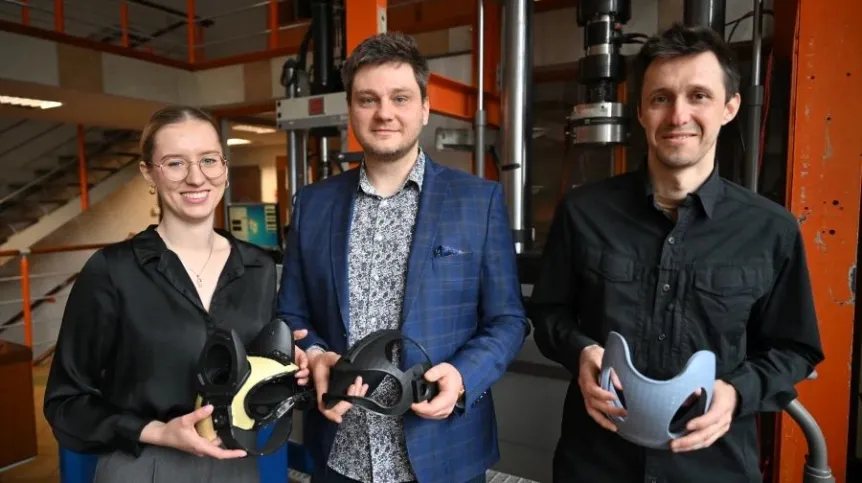
Scientists at the Wrocław University of Science and Technology are developing protective helmets and vests for service dogs used in military, police and rescue operations, with the first helmets set to enter the market this month.
Researchers from the university's Faculty of Mechanical Engineering have spent the past two years designing ballistic protection systems through their startup, Astriva. After initially developing protective vests for service animals at the request of uniformed services, the team expanded the project to include specialised dog helmets, according to a university press release.
The tested helmet prototypes are scheduled for official launch in June 2026. The project is being supported by the Wroclaw Centre for Technology Transfer, which is assisting with implementation, licensing and commercialisation.
Researchers said growing demand for protective equipment reflects increasing concern for the welfare of service animals operating in hazardous environments.
"This has both ethical and economic significance, as training such dogs costs tens of thousands and require many months of work for the handler," the scientists explain.
The equipment is custom-designed for each animal based on its build and operational requirements.
"We select materials and solutions depending on whether the dog is exposed to contact with sharp objects, knife or firearm attacks, or long swimming sessions," said Karina Krawiec, who founded Astriva with Dariusz Pyka, PhD, and Jakub Słowiński, PhD.
Krawiec said the vest is designed as a harness and can be fitted with different protective inserts depending on the dog's role.
"She added that the vest is designed as a harness, and the handler can choose a protective insert against sharp objects, a ballistic insert, or a buoyancy insert."
The researchers said custom fitting is essential to ensure both protection and freedom of movement.
"The best fitting method is to give the finished prototype to the dog's handler for a month or two of testing. The prototype returns to us with comments on any elements that require corrections, and after the corrections, there are another two to three months of final testing, so that the finished product meets its requirements for several years of the dog's service," Pyka explains.
One of the project evaluators is Senior Warrant Officer (Reserve) Paweł "Domel" Domański, a former operator in Poland's Military Commando Unit who spent six years handling combat dogs.
"As experienced dog handlers, we know what threats to expect and what is needed. And the researchers take our experience into account and translate it into specific solutions," Domański emphasises.
He said equipment requirements vary depending on the dog's mission.
"A military dog often has to cover many kilometres in difficult terrain before performing its task. Therefore, its equipment, including ballistic vests, should be as lightweight as possible, ensuring freedom of movement and durability during prolonged exertion. A police dog, on the other hand, typically arrives at the scene by vehicle and performs tasks over a shorter distance and in a shorter time, so it can use a heavier vest that provides better protection."
Astriva was founded in 2024 with support from the Academic Business Incubator of the Wrocław University of Science and Technology. (PAP)
kak/ zan/
tr. RL