
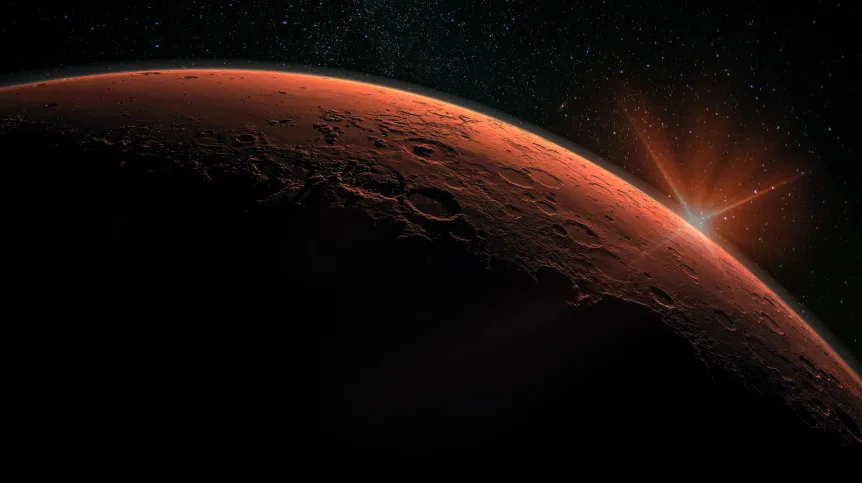
Scientists in Poland have identified where the first tree could grow on Mars - and it is not where many researchers expected.
Computer simulations suggest that Hellas Crater, one of the largest impact basins in the Solar System, would be the most promising location for the first Martian forest if the planet were ever warmed enough to support Earth-like life.
The study, published in PLOS One, was carried out by researchers from Warsaw University of Technology in collaboration with scientists from NASA Ames Research Center, the University of Basel in Switzerland and San Jose State University in the United States.
The team set out to calculate where a tree could theoretically survive on Mars and what minimum climatic conditions would be needed for more complex organisms to grow on the Red Planet.
Today, Mars is far too hostile for trees, with an average surface temperature of around -63°C and an atmosphere roughly 100 times thinner than Earth's. The planet's atmosphere is also composed almost entirely of carbon dioxide, while temperatures can swing from around 20°C near the equator to -150°C at the poles.
To determine the limits of plant survival, the researchers used the Siberian pine as a model species. This cold-resistant conifer can survive harsh mountain environments on Earth and was chosen as an example of a tree capable of tolerating extreme conditions.
The researchers calculated that a Martian growing season would need to last at least 110 days, with average daily temperatures above 6°C. Minimum temperatures would need to remain above -6°C, while maximum temperatures could not exceed 40°C for prolonged periods.
To reach their conclusions, the team created an energy-balance model of Mars, dividing the planet into more than 4,000 sections. The simulations included topography, seasonal changes in sunlight and heat exchange between the atmosphere and the ground.
The researchers then modelled gradual warming of Mars through an enhanced greenhouse effect to determine when and where conditions suitable for tree growth could appear.
The result was unexpected. Instead of the equatorial regions, where sunlight is strongest, the model identified Hellas Crater in the southern hemisphere as the first potential location for a Martian forest.
"Most researchers thought it would be Mars' equatorial zone, where solar radiation is greatest. Our model, however, shows that this location would be the huge Hellas crater in the southern hemisphere of Mars," said Prof. Robert Olszewski from the Faculty of Geodesy and Cartography at Warsaw University of Technology.
The crater's advantage comes from its unique geography. Located several kilometres below the average Martian surface level, Hellas has higher atmospheric pressure than the surrounding highlands. Its southern hemisphere summers also occur when Mars is closest to the Sun, creating a combination of warmer temperatures and thicker air.
The simulations showed that there would be an optimal warming range. As Mars becomes warmer, more areas would initially become suitable for trees. But beyond a certain point, some regions — particularly in the southern hemisphere — would become too hot during summer for tree growth.
The researchers estimate that an artificially enhanced greenhouse effect could eventually raise Mars' temperature by around 60°C, causing polar ice to melt and releasing frozen carbon dioxide into the atmosphere. This process would take hundreds of years.
However, even a warmer and denser atmosphere would not make Mars suitable for humans. The planet lacks a global magnetic field, meaning its atmosphere would remain vulnerable to being lost into space through interactions with solar radiation and the solar wind.
The researchers stress that the study is not a blueprint for transforming Mars, but a way of understanding the limits of life and the challenges of making another planet more Earth-like.
"If we were to undertake planetary engineering in this way, we would completely disrupt the biological processes that may have once occurred on Mars. Therefore, before we begin physically transforming this planet, we should first ensure that no forms of even primitive life exist there," Prof. Olszewski said.
The study highlights the extreme conditions that would be required for Earth-like organisms to survive on Mars — while raising a fundamental question for any future exploration of the Red Planet: whether humanity should alter another world before knowing what secrets it may already contain.
Ewelina Krajczyńska-Wujec (PAP)
ekr/ agt/
tr. RL