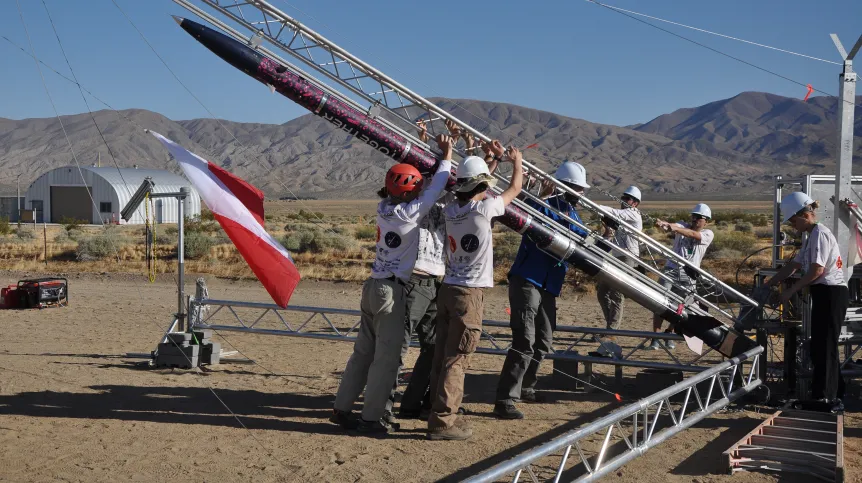
Student teams from Poland have won a slew of awards at an international rocket engineering competition in the United States, with a team from Wrocław University of Science and Technology among the event's top performers.
The PWr in Space team took second place in a flight category at the FAR-OUT competition, held in California's Mojave Desert, and received four additional awards.
The SKA Rocketry team from Warsaw University of Technology won the prize for Best Technical Report.
The FAR-OUT competition is organised by the Friends of Amateur Rocketry association and focuses on rockets powered by hybrid and liquid-fuel engines. Teams are judged on how accurately their rockets reach a declared altitude and can also demonstrate engine performance through static firing tests.
This year's competition attracted 12 teams from the United States, Poland and Mexico.
Five Polish university teams took part: SimLE SimBa from Gdańsk University of Technology, PUT Rocketlab from Poznań University of Technology, AGH Space Systems from AGH University of Science and Technology, PWr in Space from Wrocław University of Science and Technology, and SKA Rocketry from Warsaw University of Technology.
PWr in Space finished second in the category for launches between 3,000 and 15,000 feet. The category was won by the Wildcat Rocket Engineering Club from the University of Arizona. SimLE SimBa placed fourth with its R7 Orzeł rocket.
The Wrocław team also received the Most Efficient Engine - Liquid Award, which recognises the most efficient liquid-fuel engine in the competition. It was further honoured with the Best Launch Operations Award and the Best Ground Support Equipment Award.
The team competed with its R7 Together rocket.
"This is a huge moment for us. It is the result of many months of work by the entire PWr in Space team, operating at Wrocław University of Science and Technology as part of the PoliWRocket project, in which we design and build experimental sounding rockets," team representatives said.
PUT Rocketlab and AGH Space Systems also competed in the 3,000-15,000-foot category.
In a post on social media, PUT Rocketlab said: "The PUT Rocketlab team successfully built and launched a rocket equipped with an advanced hydraulic system, reaching an apogee of 11,460 feet during this year's competition - the highest result of any participating team. The launch damaged the commercial computer responsible for the recovery system. Nevertheless, we managed to recover the avionics computers and partially damaged propulsion components. Thanks to the data obtained, we are beginning work on improving our largest project."
SKA Rocketry received the award for Best Technical Report.
Alongside the competition, students attended talks by representatives from organisations and companies including Mojave Air & Space Port, Muon Space, SpaceX and Boeing.
Detailed competition results are available at: https://www.faroutlaunch.org/results
PAP - Science in Poland
ekr/ agt/
tr. RL