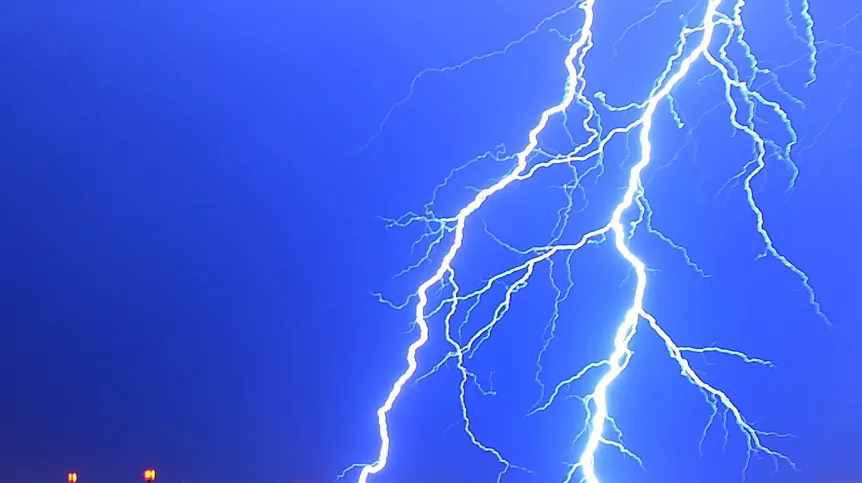
A lightning can be more than just a flash of light and a sudden flow of electricity. An international team of scientists, including researchers from the University of Łódź and the National Centre for Nuclear Research, recorded a burst of gamma radiation directed toward Earth, formed just before one of the lightning strikes.
The study was published in the Journal of Geophysical Research: Atmospheres.
Terrestrial gamma-ray flashes (TGFs) occur in strong electric fields within storm clouds, where electrons can be accelerated to enormous speeds. When they collide with air molecules, they can produce X-rays and sometimes gamma rays.
These very short bursts of radiation last only millionths of a second and were for a long time detected primarily from space, by satellites observing the atmosphere from above.
Later, it became clear that some of these flashes could be directed downward toward Earth and recorded from ground level. This is difficult because it requires simultaneously capturing a very short pulse of radiation and knowing precisely what was happening within the lightning itself at the same time.
A paper by a large international team of scientists, including researchers from the University of Łódź and the National Centre for Nuclear Research, describes such an observation. The scientists recorded a gamma-ray burst directed toward the ground, associated with negative cloud-to-ground lightning. Negative means one in which a negative charge is transferred to the ground.
The lightning discharge consisted of nine successive strikes to the ground, with three different impact points. The gamma-ray burst occurred just before the fifth strike.
Subsequent strikes in the same lightning flash do not start from scratch. The first part of the discharge clears a path through the air, creating a conductive channel. Later pulses can use an already partially ionised path, meaning air in which free charges have previously formed.
A key stage is the so-called leader. This is a developing discharge channel that precedes the actual current strike to the ground. In the first strike, the leader often moves in steps through still unprepared air. In subsequent strikes, a dart leader can appear, following the path of the earlier channel more rapidly. The described gamma-ray burst was linked to such a dart leader.
This makes the observation particularly interesting. Previously, X-ray radiation has been observed with both stepped and dart leaders. However, downward terrestrial gamma-ray flashes have most often been associated with the initial stages of discharge development or with the first strike. In this case, the gamma-ray burst occurred during a later dart leader in a negative cloud-to-ground lightning discharge.
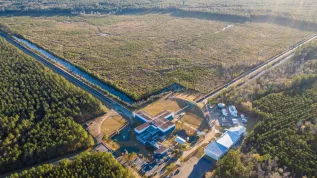
The observations were made with the Telescope Array Surface Detector in Utah, USA. This is a large network of detectors originally built for cosmic ray research. The detectors, distributed over a large area, can detect particles and radiation reaching the Earth's surface. In this case, six adjacent detectors detected the gamma-ray burst.
The gamma-ray burst lasted about 68 microseconds (68 millionths of a second). The total energy deposited in the detectors was 1,352 MeV. Other instruments simultaneously tracked the lightning itself. A radio discharge mapping system allowed reconstruction of the position of the signal sources over time, a radio interferometer showed the direction from which the pulses were coming, a high-speed antenna measured changes in the electric field, and cameras recorded optical images. This allowed linking the gamma-ray burst to a specific moment in the leader’s development, not just the general presence of the storm.
It turned out that the leader preceding the fifth strike was the fastest in the entire sequence, at about 23 million meters per second. This is less than the speed of light, but on the scale of atmospheric phenomena, it is extremely fast. The fifth strike also had the highest peak current of all nine strikes in this lightning bolt.
The electric field near the lightning leader can locally accelerate electrons. Some of them gain so much energy that they trigger a cascade of subsequent particles and photons. A very brief moment and a small area in the air is enough for an ordinary thunderstorm to become a natural particle accelerator. The source of the gamma-ray burst was estimated at about 1.45 km above the ground. According to the researchers, the emission lasted almost until the actual return stroke, a sudden current flow visible as a bright lightning flash.
Physicists point out that in this case, several factors may have been at play: a fast leader, a high current from the next strike, residual charge from previous strikes, and disturbances in the air ahead of the leader front. This likely created conditions favourable to the generation of a gamma-ray burst during the later stage of the multiple lightning strike.
Is this radiation something to be afraid of? Gamma radiation is penetrating, so the walls of a building or a car do not block it as effectively as they protect us from lightning itself. However, the scale of the phenomenon is important. We already live in a weak natural background of ionising radiation: cosmic rays reach us, and a small contribution also comes from natural radioactive elements in the ground and rocks. The gamma-ray burst associated with lightning is a very short, localised pulse, produced only under specific conditions near the discharge.
The researchers measured the radiation in detectors but did not convert it into a dose for a person standing nearby. The main threat during a thunderstorm remains the lightning itself, not the additional gamma-ray burst.
Krzysztof Petelczyc (PAP)
kmp/ zan/
tr. RL