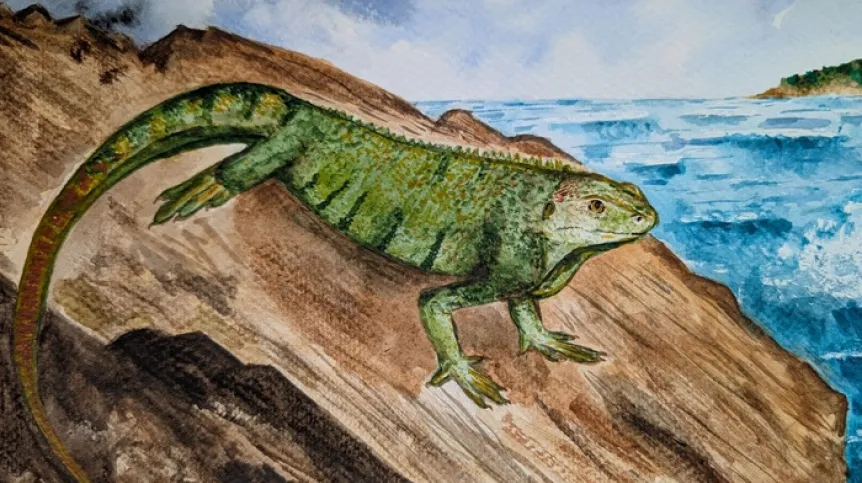
A 44-million-year-old iguana fossil discovered in Turkey suggests the reptiles may have reached Europe by sea, possibly drifting on tree trunks after a tsunami, an international team of palaeontologists has found.
The jaw fragment provides the first evidence of Eocene reptiles in the region known as Balkanatolia and offers new clues about how iguanas may have reached distant lands and islands during their evolutionary history.
‘For most of the Palaeocene and Eocene (from 66 to 34 million years ago), the region of present-day Anatolia and the Balkan Peninsula formed an isolated archipelago of large and small islands, resembling modern-day Indonesia. This exotic land, called Balkanatolia, was previously famous solely for its peculiar and diverse island mammal fauna, including unique forms of primates, bats, marsupials, and other specific species. The contemporary reptile fauna of this area remained completely unknown until now’, Georgalis said.
Georgalis is from the Institute of Systematics and Evolution of Animals of the Polish Academy of Sciences.
Scientists from Poland, Germany, the USA, Turkey and France have described the first lizard from Balkanatolia in a paper published in the journal Scientific Reports.
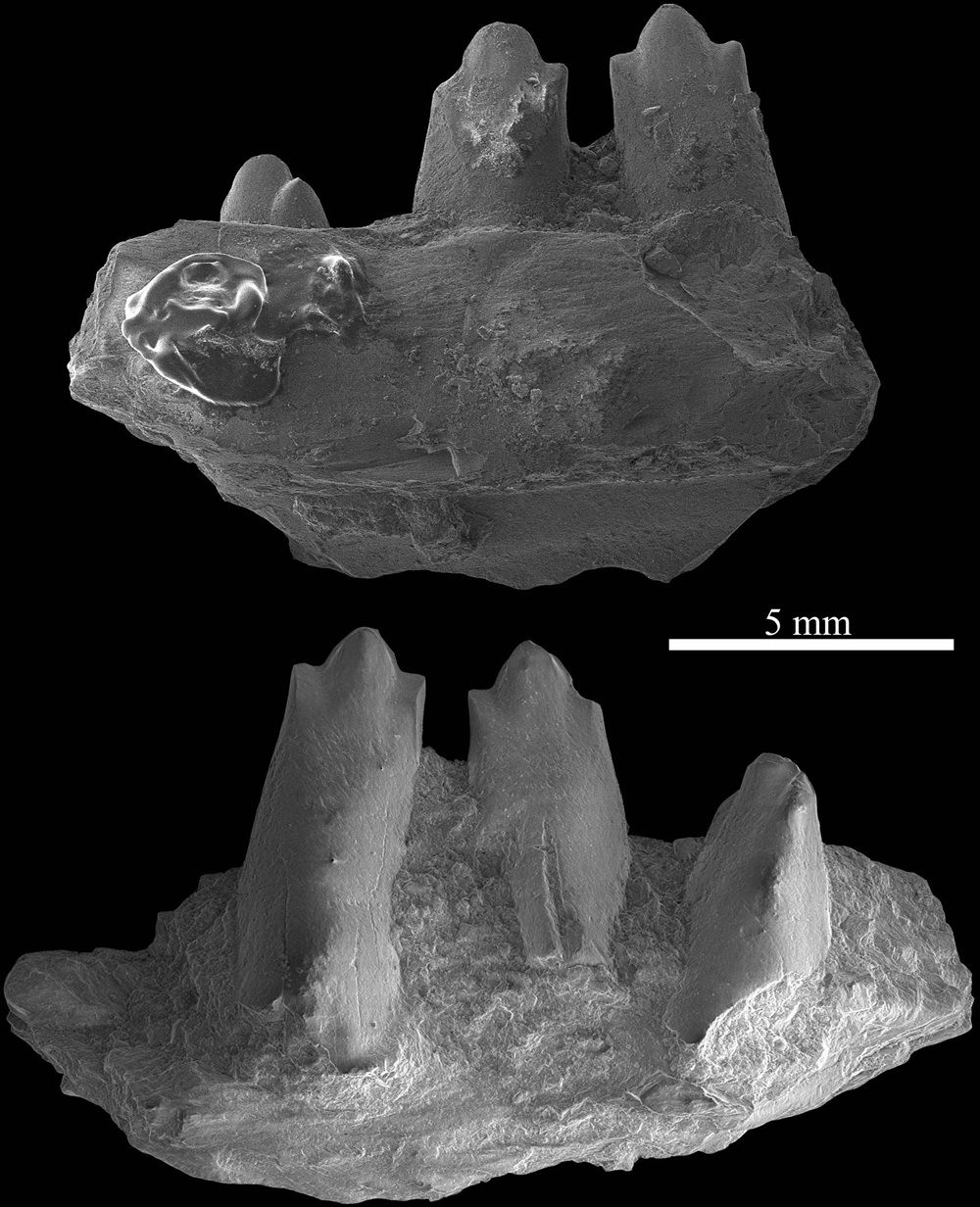
‘To our great surprise, it belonged to iguanas, a group that currently has a fairly extensive range but is not found in the wider Anatolian region. Iguanas are also absent from Europe today, but fossil records clearly indicate that they were present on that continent during the Eocene. Therefore, the new iguana find from Balkanatolia is interpreted as the result of +maritime dispersal+ from Europe, likely facilitated by the animals drifting on tree trunks after a tsunami’, Georgalis said.
The fossil material is fragmentary, preventing more precise identification of the species and the animal’s external morphology.
‘Nevertheless, iguana teeth are characterized by a specific dentition (they have three distinct cusps on the top). Therefore, even this small fossil fragment is the first clear indication of the presence of an iguana in the Balkans’, Georgalis said.
He said the three-cusp tooth structure was extremely rare and almost entirely absent in other iguanas. According to Georgalis, it occurs only in some extinct and living iguana groups from France and the Americas.
The finding suggests that the palaeobiogeography of iguanas during the Eocene was more complex than previously thought.
‘We expect that ongoing fieldwork in this region will uncover more complete fossil remains of the Anatolian iguana, which will allow for more precise interpretations of its anatomy and taxonomy’, Georgalis said.
The researchers also point to a possible modern parallel for the proposed migration scenario.
According to Georgalis, the same explanation involving animals drifting on tree trunks is currently used to account for the geographical distribution of living iguanas on remote islands in the Pacific Ocean and the Caribbean Sea.
‘The new discovery from Turkey provides further evidence of iguanas' extraordinary ability to successfully migrate overseas and colonize distant lands and oceanic islands throughout their evolutionary history’, Georgalis said.
The research was conducted as part of a grant funded by the Polish National Science Center. (PAP)
akp/ zan/
tr. RL