
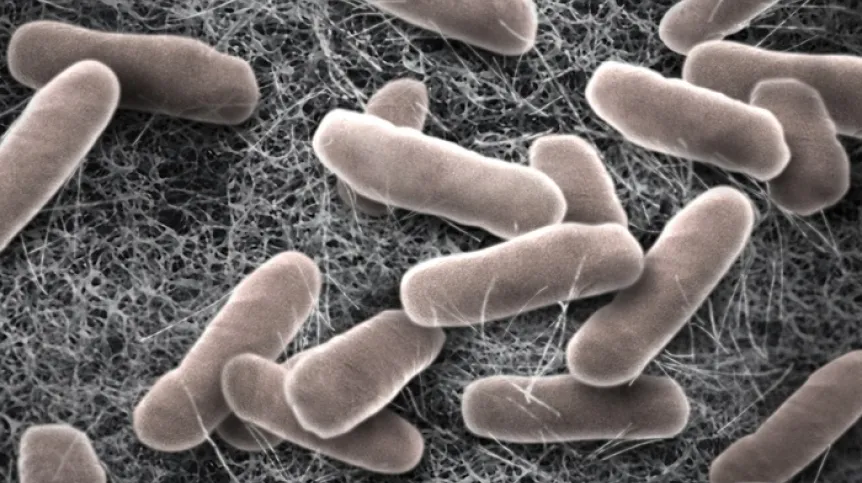
Polish scientists have modified a probiotic bacterium so that it more effectively protects against Salmonella infection. In experiments on mice, they showed that the modification improved the probiotic’s ability to compete with the pathogen for space in the intestine while also strengthening the immune response.
The study was conducted by scientists from the Wrocław University of Environmental and Life Sciences. Its results were published in the journal npj Biofilms and Microbiomes.
The idea of improving probiotic bacteria so that they protect the host more effectively against pathogens emerged several years ago in the team led by Krzysztof Grzymajło, PhD, a professor at the Wrocław University of Environmental and Life Sciences.
'I have been dealing with adhesion, i.e. the attachment of bacteria to cells, especially in the case of pathogens like Salmonella. At some point, however, I decided that the host-pathogen system itself was too simplistic, because in reality, bacteria function in the entire microbiome. So I decided to include this third element in my research. And since probiotic bacteria are also part of the microbiome, we came up with the idea to try to improve them', the scientist explains in an interview with PAP.
The researchers selected Escherichia coli Nissle 1917 for their experiments. Although some E. coli strains cause intestinal and other infections, the species also includes strains that naturally inhabit the intestines and are used as probiotics. Nissle 1917 belongs to the latter group.
'We chose E. coli also because it is a model organism, which means that it has been studied very intensively for decades. Thanks to this, we know its genetics well and we have many proven modification methods, which we also use in our laboratory', Grzymajło says.
The researchers modified the FimH protein found at the ends of thin, hair-like structures on the bacteria’s surface that help it attach to host cells. These structures are called type 1 fimbriae.
They introduced three different mutations. All of them made the bacteria adhere more effectively to cells, but one, known as G66R, had the strongest effect.
In laboratory tests on cell cultures, the modified strain attached to intestinal epithelial cells approximately four times more effectively than the unmodified strain. Importantly, it also competed more effectively with Salmonella.
'When such a probiotic attaches better to intestinal cells, it occupies more niches and deprives Salmonella of space and resources it needs to spread', the expert explains.
After the promising cell experiments, the researchers moved on to tests in mice. The animals were first administered either the regular or modified probiotic strain and then infected with Salmonella Typhimurium.
The effect was clear. Mice that had previously received the modified probiotic had a much milder course of infection. They lost less weight, and the amount of bacteria in their intestines and other internal organs was much lower.
The authors calculated that there were 7,300 times fewer bacterial cells in the spleens of these mice and 1,700 times fewer in their livers than in mice that had not received the modified probiotic. They also did not suffer from splenomegaly, or enlargement of the spleen, characteristic of severe systemic Salmonella infection.
'Physically, our probiotic reduced the effects of the infection', Grzymajło says.
But the researchers found another effect. The modified Nissle 1917 strain protected against infection not only by competing more effectively with Salmonella in the intestine, but also by stimulating the immune system.
The researchers found that the number of T lymphocytes, including CD8+ cytotoxic lymphocytes, increased in mice that received the modified strain. These cells are especially important in fighting pathogens that hide inside host cells.
According to Grzymajło, Salmonella can hide and multiply in macrophages – cells of the immune system – and use them to spread to other tissues. Cytotoxic lymphocytes destroy infected cells, helping to limit the further spread of bacteria.
'Protection works in two ways: locally in the intestine, where the probiotic competes with the pathogen, and systemically by stimulating the immune system', the scientist says.
The study has not yet fully explained why the modified probiotic stimulates the immune response more strongly or what exactly triggers it. Scientists suspect that the modified bacterial protein may activate additional receptors on host cells, which then trigger pathways leading to changes in the immune system.
The team’s future work will help explain this mechanism and determine whether a similar effect can be achieved through other modifications and with other probiotic bacteria.
'This could be a more universal mechanism, as it would not only involve protection against Salmonella, but also stimulating the host's immune response. If it can be triggered in a similar way, the modified probiotics could also help protect against other pathogens', Grzymajło says.
One of the team’s ideas is to test the modified probiotic in chickens. Salmonella infections are a serious problem in poultry farming, so effective protection against them could have significant practical implications.
According to Grzymajło, similar solutions could also be used in humans in the future.
'More and more bacteria are becoming resistant to antibiotics, which makes treating infections increasingly difficult. At some point, these drugs may no longer be sufficient. That is why we need to look for other ways to help us defend ourselves. This could potentially be one such alternative', the scientist concludes.
Katarzyna Czechowicz (PAP)
kap/ agt/
tr. RL