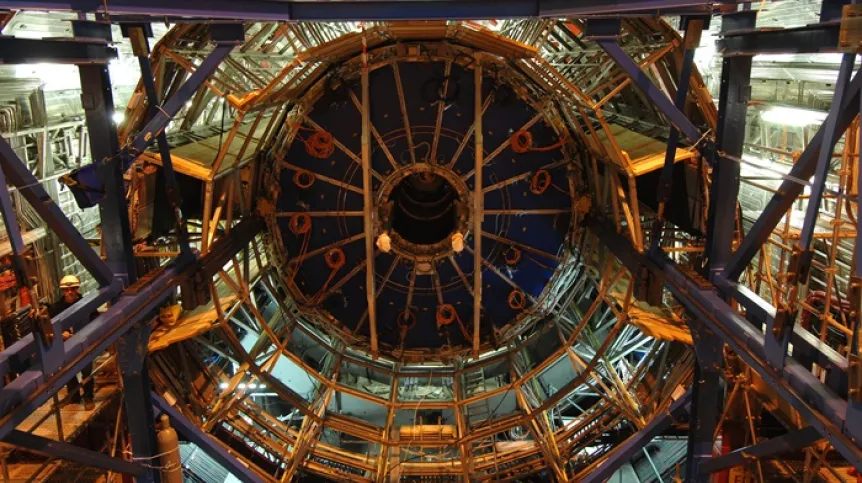
The LHCb experiment at CERN has confirmed for the first time the existence of the Ξcc⁺ baryon, a particle made up of two heavy charm quarks and one down quark. Physicists had predicted its existence years ago, but an earlier possible detection was never confirmed. The new signal exceeded seven standard deviations.
For years, physicists had been looking at a family of particles with a distinctly empty space. In 2017, the LHCb experiment discovered the Ξcc⁺⁺ baryon. According to theory, it should have a close partner – a Ξcc⁺ particle with almost the same mass. However, the search yielded only faint traces.
Now, the empty space has been filled.
Baryons are particles composed of three quarks. This group includes protons and neutrons, which differ in one of their three components. Physicists call the two types of quarks within them up and down. These are merely conventional names that do not describe their position or direction of motion. A proton contains two up quarks and one down quark, while a neutron contains one up quark and two down quarks.
A similar difference occurs in the pair studied by LHCb. The Ξcc⁺⁺ consists of two charm quarks and an up quark, while the Ξcc⁺ consists of two charm quarks and a down quark.
‘Charm’ is also simply a historical name for one of the six types of quarks. A charm quark is much heavier than the quarks that make up a proton and neutron, and it also decays rapidly.
Particles containing two such quarks are rare and extremely short-lived. The Ξcc⁺ likely disappears much faster than a trillionth of a second – far too quickly to reach a detector.
The search is therefore akin to reconstructing an event from the fragments left behind.
The Ξcc⁺ decays into several other particles, which are detected by LHCb. In the analysed case, these ultimately included a proton, two kaons and two pions.
The detector measured their trajectories and momenta, and scientists investigated which of them might previously have formed a single, heavier object.
If particles are grouped together randomly, the calculated masses of the combinations are scattered. If multiple combinations originate from the decay of the same baryon, however, a cluster appears on the graph.
Such a trace appeared in data collected in 2024.
It matched a particle with a mass of about 3620 MeV/c², almost four times the mass of a proton. The analysis revealed approximately 915 decays of the Ξcc⁺.
This was not the first lead.
The SELEX experiment, conducted in the US between 2002 and 2005, reported a possible detection of the Ξcc⁺, but the mass indicated at the time was about 101 MeV/c² smaller. Other experiments did not confirm the result.
A small excess of events also appeared in earlier LHCb data, but it was too weak to call it a discovery.
Only data collected after the detector upgrade provided a signal strong enough to solve the mystery. The reliability of the new signal exceeded seven standard deviations.
This means it is extremely difficult to explain the result as a random background arrangement. Particle physicists require five standard deviations before considering the existence of a new particle confirmed. This time, the result clearly exceeded that threshold.
A weaker but consistent trace was also found in older data from 2016–2018.
The central result indicates that the Ξcc⁺ is about 1.8 MeV/c² lighter than its partner, the Ξcc⁺⁺, as theorists expected.
The exact difference, however, remains uncertain, as the new particle's lifetime has not yet been measured. This determines how far it can travel before decaying and which events the detector detects.
Solving one puzzle immediately created another.
Finding the Ξcc⁺ does not lead directly to new technology. However, it gives physicists a rare opportunity to study a system in which two heavy quarks coexist with a single light one.
By comparing the near-twin baryons, they can examine how the exchange of a single quark affects the mass and decay of the entire particle.
This is a rigorous test of the theory of the strong interaction, which binds quarks into protons, neutrons and other baryons.
Scientists from AGH University of Science and Technology in Kraków, the Institute of Nuclear Physics of the Polish Academy of Sciences, the National Centre for Nuclear Research and Kraków University of Technology participated in the study.
This was the first new particle observed by the LHCb since its upgrade.
A paper describing the results was published in the prestigious scientific journal Physical Review Letters.
kmp/ zan/
tr. RL