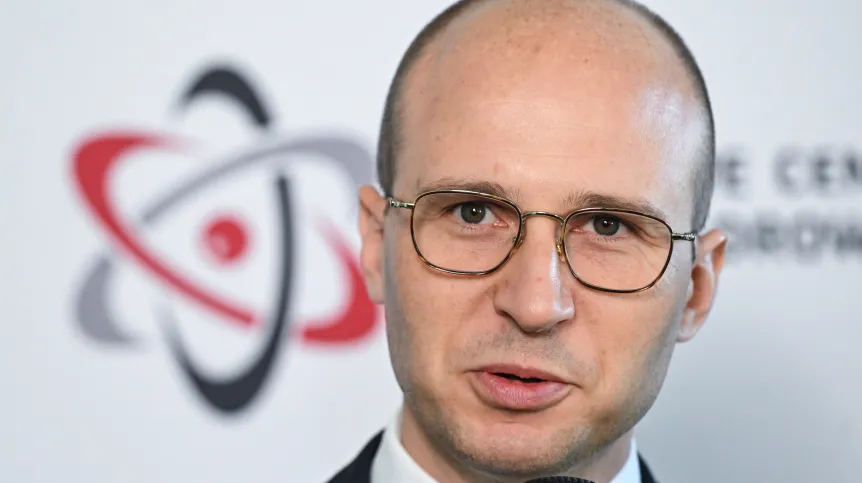
Poland is one of the world’s top hydrogen producers, while Polish researchers are developing technologies that could use the gas to store renewable energy and produce synthetic fuels, according to Professor Jakub Kupecki, head of the National Centre for Nuclear Research (NCBJ).
Some of these technologies are already being tested at industrial scale, while others remain at the basic research stage and could take 10 to 20 years to reach full-scale implementation, Kupecki said.
Hydrogen and synthetic fuels have applications ranging from energy and transport to heavy industry and energy storage, and their development could contribute to building a low- and zero-emission economy, according to the HYPOTHESIS XXI conference website. The conference on hydrogen technologies is taking place in Warsaw.
Kupecki, who is also Director of the Hydrogen Technology Centre at the Institute of Power Engineering and chair of the HYPOTHESIS XXI conference, said the future of energy would depend on both consumer choices and decisions made at the highest government levels.
Citizens are generally interested in keeping electricity, heating and vehicle fuel bills as low as possible, he said, while energy security and reliable supplies come at a cost.
“On the other hand, we must consider energy security and supply reliability, for which we unfortunately have to pay a premium. This is where scientists and engineers developing new technologies come into play. The accelerated development of the synthetic fuel and hydrogen technologies sector signifies a diversification of energy sources and forms part of the climate transition policy,” Kupecki said.
He added that energy security meant not only reliable supplies but also ensuring that energy was actually available when needed.
“Energy security is understood not only as supply reliability but also as a guarantee of energy availability, meaning that we actually have diesel or petrol to refuel our cars, or hot water in the tap. If we cannot ensure this, we must search for alternative energy carriers,” he said.
Some technologies associated with the hydrogen economy are already highly advanced, with their operation demonstrated in industrial settings or under conditions similar to their intended applications.
Examples include projects involving solid oxide electrolysers, including MEGA-SOE systems with capacities of 400 kW and 5 MW, and the 30 kW VETNI project, carried out in cooperation with the ORLEN Group.
However, many innovative solutions remain at the basic research stage, Kupecki said, adding that such work “lays the groundwork for the future”.
“It could take 10 to 20 years before the results of such research are implemented on a full scale. By then, we will be able to choose from fuels we produce ourselves. And such self-sufficiency guarantees energy independence. Today, we cannot say for certain which specific technology will be the ultimate solution; however, we cannot afford to remain passive or simply wait, so we must invest in research and development,” he said.
Kupecki said Poland was not yet fully using its renewable energy potential, citing infrastructure and geographical constraints as well as resistance to change.
He said scientists and engineers working on synthetic fuels and hydrogen technologies were seeking to balance energy supply and demand while making use of renewable energy sources.
This includes storing energy when there is a surplus and prices begin to fall rather than shutting down renewable energy installations, he said.
“We are talking about storage on hourly or daily timescales, but also long-term storage, spanning days, weeks, or even seasons,” Kupecki said.
“One of the key messages of our conference is that battery-based electricity storage does not cannibalise the hydrogen market, nor vice versa. These are complementary technologies that fulfil different roles,” he added.
Poland already has extensive experience using hydrogen, Kupecki said.
“A significant part of our economy relies on products for which hydrogen is essential. These include fertilizers and the ammonia production sector. We use hydrogen in industrial processes, including the food industry. For years, it has also been used to cool power plant generators and specialized research equipment,” he said.
Researchers are working not only to develop new hydrogen technologies but also to bring them to commercial and industrial scale, Kupecki said.
“The scientific community and researchers have long been working to develop technologies that are commercially promising and suitable for scaling up and industrial application. It is not just about conducting research, but also about the potential to put the results to use. We are therefore working on how to move from concept to full-scale implementation and, looking ahead, to facilities manufacturing components for both the domestic market and beyond. At the conference, we are showcasing many such examples based on Polish inventions, technologies, and research teams,” he said.
One area of research involves solid-oxide electrochemical cells, which can operate as electrolysers, converting electricity into hydrogen, or as fuel cells, including in combined heat and power systems.
“These are innovative, advanced projects. We hold an advantage over the West in this area. When we present our projects internationally, we are met with disbelief; colleagues suspect we are showing something generated by artificial intelligence,” Kupecki said.
He added that the largest facility in Europe using solid oxide electrolysers manufactured at the Institute of Power Engineering is currently being built in Poland.
According to Kupecki, the Institute owns numerous solutions, technologies and manufacturing methods applicable to hydrogen technologies.
The NCBJ is also developing a high-temperature gas-cooled reactor (HTGR), which could be integrated with systems producing synthetic fuels, including hydrogen.
Kupecki said the development of Poland’s nuclear energy programme would involve integrating sectors including district heating, the chemical industry and the power sector.
“Reactors for large power plants will enter the domestic market within the next 10 years. In 15-20 years, Small Modular Reactors (SMRs) will appear; these can also serve as facilities for synthetic fuel production, and we plan to be part of this new economic sector,” he said.
He explained that HTGR technology had originally been developed with synthetic fuel production in mind.
“For me, this is a particularly important direction, also for personal reasons. Fifteen years ago, after returning to Poland from Sweden, I led a research program on synthetic fuel production using an HTGR reactor. Years later, this concept - albeit with a slightly different process configuration - remains relevant. And at the HYPOTHESIS conference, our teams are presenting the results of analyses and the potential of this technological path specifically for the hydrogen economy. Our concepts are becoming reality,” Kupecki said.
He emphasised that energy and energy security had become issues that transcended politics and divisions.
“That is why many initiatives related to new technologies continue for years, regardless of political changes. We cannot afford to squabble over energy issues. We cannot allow that, given Poland’s national interest,” Kupecki said.
The Polish Press Agency (PAP) is the media sponsor of HYPOTHESIS XXI.
Anna Bugajska (PAP)
abu/ zan/ drag/
tr. RL