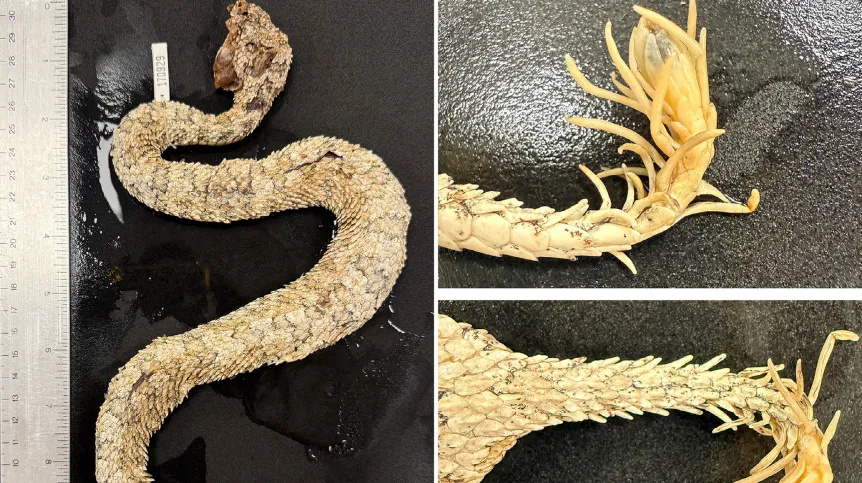
A horned viper found in Iran lures birds with a bizarre tail tip resembling a spider. Now, scientists have used 3D imaging to investigate the snake's anatomy, finding that its bizarre lure is formed by elongated scales rather than unusually shaped vertebrae.
The spider-tailed horned viper (Pseudocerastes urarachnoides) has been known to science for around 20 years. It is distinguished by its unusual anatomy and hunting technique, in which it moves its spider-like tail tip to attract birds before striking.
'As its apt name suggests, the spider-tailed horned viper is famous for the extraordinary modifications of its tail, which ends in bizarre, spider-like structures the snake uses to lure prey, as well as for its characteristic behaviour: moving the tail to attract prey. In practice, the snake uses its unusual, spider-like tail tip to attract and lure birds, which it then eats', palaeobiologist Georgios Georgalis, PhD, from the Institute of Systematics and Evolution of Animals of the Polish Academy of Sciences explains in an interview with PAP.
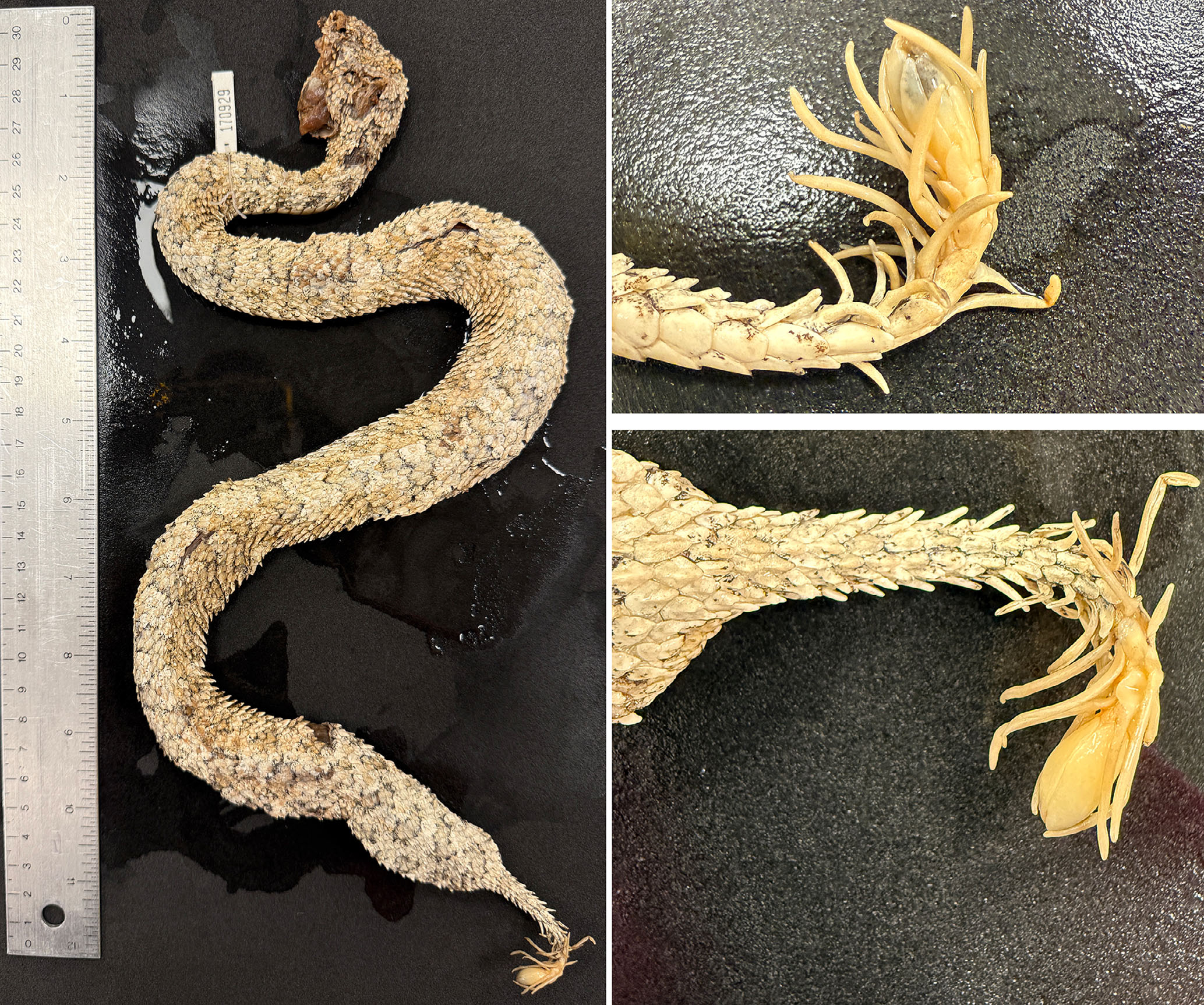
The viper is found in Iran. However, as Georgalis emphasises, its limited geographic range, combined with the current geopolitical situation in the Middle East, which is not conducive to herpetological research, makes it difficult to study the species in greater detail.
Georgalis, who studies both extinct and living reptiles, used micro-computed tomography (μCT) to investigate the viper's internal anatomy.
The study examined the species' holotype, the reference specimen used for its scientific description, housed at the Field Museum of Natural History in Chicago, USA. Sara Ruane, the museum's curator of herpetology, performed the scan. The resulting 3D images allowed the researchers to examine the snake's internal anatomy in detail.
Because the skull was heavily damaged, the researchers focused on vertebral morphology, particularly variation along the spinal column.
'This means that the snake possesses vertebrae that differ significantly along the length of its body. Different morphologies appear in the anterior section, different in the mid-body, and different still in the tail area', the palaeobiologist adds.
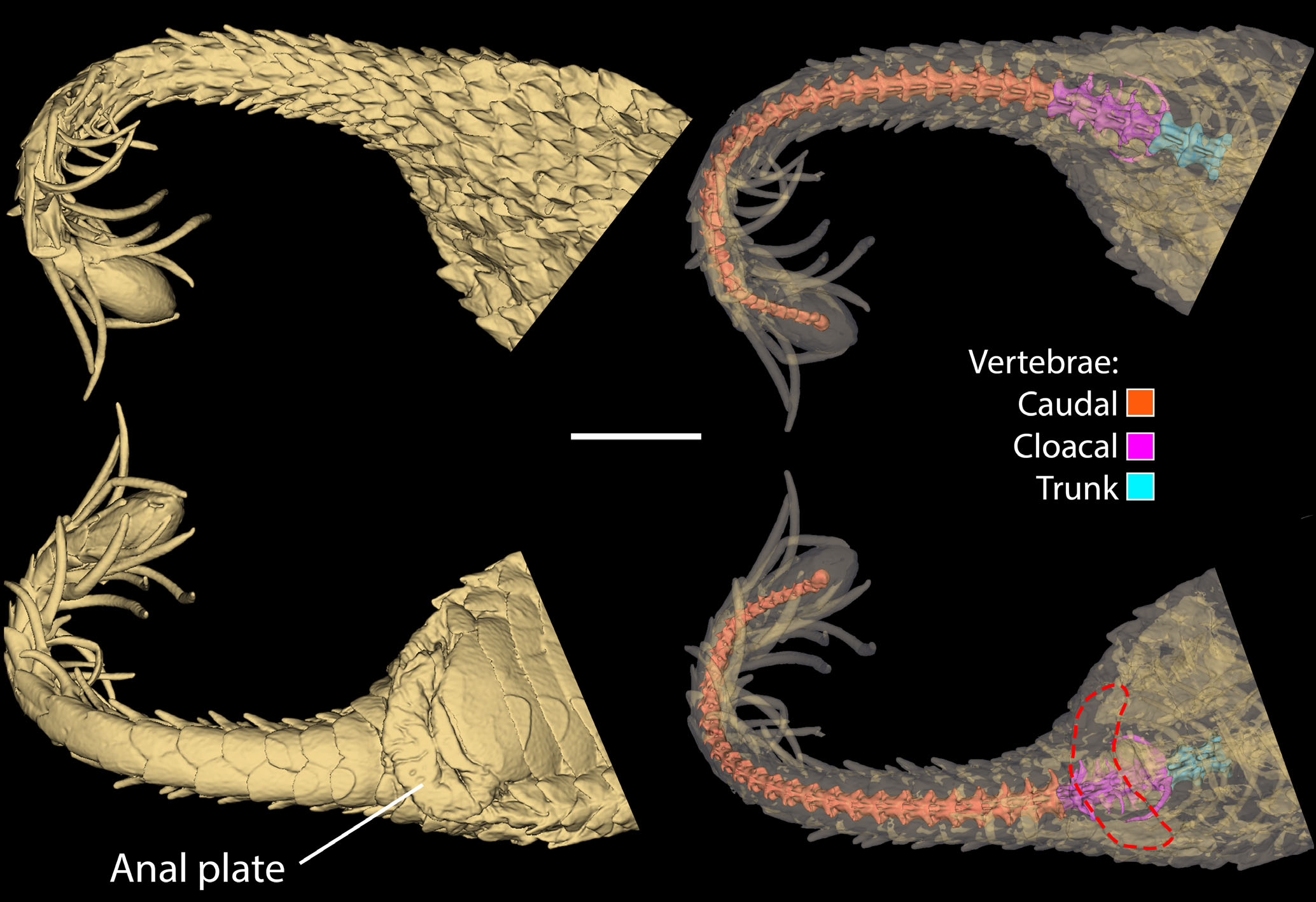
The research also examined the viper's remarkable tail, revealing that its spider-like appearance is not caused by unusually shaped vertebrae, but by elongated scales.
'Thanks to 3D imaging, we also examined the horned viper's remarkable tail. We demonstrated that there are no unusually shaped vertebrae beneath the famous spider-like tail tip. Instead, the study revealed that the viper's caudal scales gradually elongate to form long, flexible filaments. Interestingly, these elongated and modified scales represent an example of extreme skin evolution and differ significantly from any known structures found in modern reptiles', Georgalis emphasises.
The findings could also help palaeontologists identify fossil vertebrae. By documenting the viper's vertebral anatomy in detail, the researchers have provided a basis for comparisons with isolated fossil remains.
'As a result, this species is currently among the best-understood vipers in terms of vertebral morphology. This is also significant for palaeontology, as it enables comparisons with isolated fossil vertebrae and could facilitate the taxonomic identification of such finds in the future', the researcher concludes.
The results of the study, conducted under a grant from Poland's National Science Centre, were published in The Anatomical Record.
PAP - Science in Poland, Agnieszka Kliks-Pudlik
akp/ zan/
tr. RL