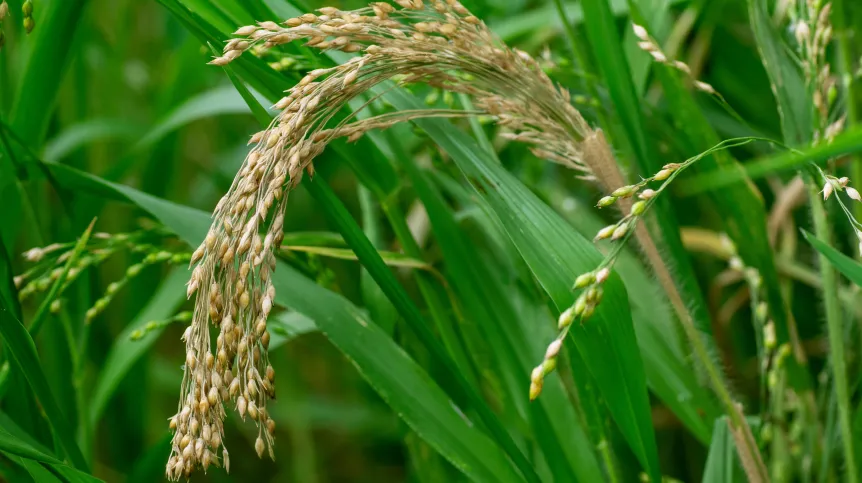
Evidence of millet consumption in what is now Poland dates back to around 1590 BCE, more than a century earlier than previously thought. Bronze Age communities gradually incorporated the drought-resistant, fast-growing cereal into their diets, expanding the range of land they could use for agriculture.
An international team of archaeologists, anthropologists and isotope analysis specialists traced dietary changes among inhabitants of what is now Poland between 2200 and 1000 BCE. The researchers analysed remains from 192 individuals found at various archaeological sites, combining isotope measurements with archaeological, anthropological and genetic data. The results were published in Science Advances.
The findings push back the earliest evidence of millet consumption in what is now Poland to around 1590 BCE. Previous research had placed its appearance in the region at around 1460 BCE.
The researchers identified changes in diet by comparing the isotopic composition of teeth and bones. Teeth form during specific stages of childhood and their composition remains essentially unchanged, while bones undergo continuous remodelling throughout life. Comparing the two can therefore reveal whether a person's diet changed between childhood and adulthood.
Human remains from sites including Pielgrzymowice provided evidence that millet was introduced gradually, initially being consumed by only a small group of people. Over time, it became increasingly important in the food economy of Bronze Age communities. Its consumption was not restricted by gender, age or social status.
'Until now, the appearance of millet in Europe has been linked to broad transformations occurring during the Bronze Age, such as the development of contacts between distant communities, the exchange of goods and ideas, and increased population mobility. However, new research provides no evidence that the spread of millet coincided with the arrival of large groups of migrants in what is now Poland. Individuals who consumed millet and those who did not shared similar archaeological and genetic profiles. Strontium isotope analyses indicate that the earliest millet consumers originated from southeastern Poland', explains Professor Przemysław Makarowicz from Adam Mickiewicz University in Poznań.
Millet grows quickly, tolerates periodic water shortages and can be cultivated in soils less suitable for traditional cereals. Its introduction offered Bronze Age communities a way to make use of previously less productive land, at a time when food demand was rising and climatic conditions were changing.
'The introduction of the new plant did not bring about a revolution involving the complete replacement of wheat or barley. Rather, it expanded land-use options. Bronze Age communities adopted a grain that could be sown in less fertile soils and complemented traditional crops', Makarowicz adds.
The researchers analysed carbon, nitrogen, oxygen and strontium isotope ratios, among other indicators, and combined the results with radiocarbon dating. They also drew on archaeological and anthropological evidence, palaeoproteomic data to determine biological sex, and previously published genetic data.
The study involved scientists from Adam Mickiewicz University in Poznań, the Institute of Archaeology and Ethnology of the Polish Academy of Sciences, the University of Gdańsk, Maria Curie-Skłodowska University in Lublin, the Archaeological Museum in Kraków, and the Institute of Systematics and Evolution of Animals of the Polish Academy of Sciences.
PAP - Science in Poland, Ewelina Krajczyńska-Wujec
ekr/ agt/
tr. RL