
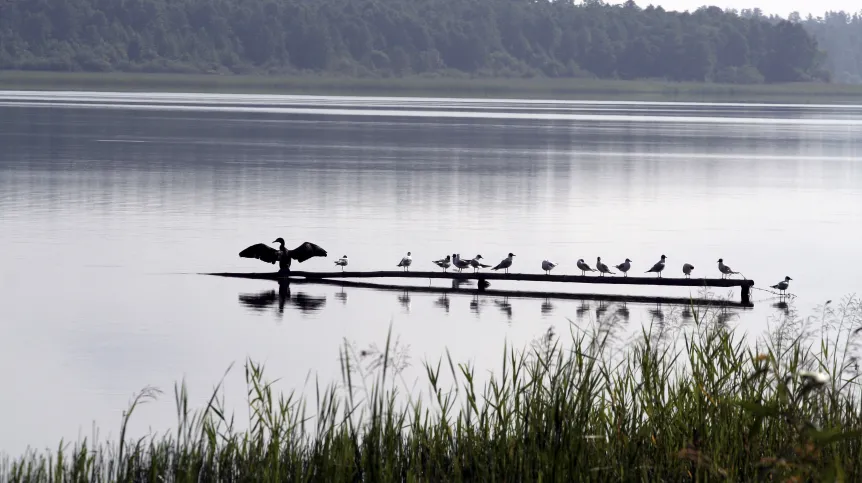
Even moderate artificial light that reaches the surface of a lake at night can change the distribution of predators and prey and disrupt the natural migrations of zooplankton. Limiting the light that reaches water bodies can help preserve natural relationships between aquatic organisms.
The effects of artificial light pollution are already well documented in terrestrial ecosystems. Night lighting can disrupt insect activity, increase insect mortality near light sources, and change relationships between predators and prey, for example between bats and insects. However, more attention is also being focused on aquatic ecosystems, where artificial light at night can disrupt the natural circadian rhythm of organisms and influence their behaviour, distribution and interactions.
In a lake, light is not just a signal informing organisms about the time of day. For many organisms, it also provides information about the probability of encountering a predator. In open water, zooplankton, or small animals floating in the water, have few opportunities to hide from predators. One of the most important strategies for reducing this risk is to change the depth at which they stay.
During the day, many organisms go deeper because they are harder for fish to see in darker layers. At night, many species of zooplankton migrate to the surface, where in natural darkness they can use the resources of the surface layers of water with a lower risk of detection by fish that use vision to hunt.
Artificial light can shorten or change the feeding time in the surface layers of water. If the surface layers of a lake are illuminated at night, they are no longer as safe for zooplankton as they are in natural darkness. Artificial light can therefore change both the behaviour of prey organisms and the activity of predators hunting them.
So far, few studies have investigated this mechanism directly under natural conditions in open lake waters. Scientists from the Faculty of Biology of the University of Warsaw investigated the phenomenon and published the results of their study in Scientific Reports.
The study was carried out in Lake Roś, in the Masurian Lake District, with a maximum depth of over 31 metres. The experiment was conducted in a shallower bay, where the depth was about seven metres. Scientists conducted two six-day research campaigns, both around the new moon, to limit the impact of the Moon's natural light. The light was clearly stronger than natural night lighting, but still many times weaker than daylight. At the surface, it corresponded to approximately 4-15 lux, decreasing with depth.
'It turns out that artificial light does not have to cause a significant decline in the number of zooplankton to significantly change its relationship with predators. It is enough to change the vertical arrangement of organisms in the water column, and thus the space in which fish and their prey can meet', says study co-author Ewa Babkiewicz, PhD.
During the day and during the naturally dark night, fish did not form a clear cluster near the surface. After the artificial light was turned on, a dense concentration of fish appeared under the lamp in the surface layer of water. Artificial light clearly changed their spatial arrangement.
'Remember that many planktivorous fish locate their prey primarily by sight. Therefore, if we introduce light into the water column at a time when it should be naturally dark, we disrupt one of the basic mechanisms on which zooplankton base their behaviour. For thousands of generations, the natural rhythm of light and darkness has been important information for these organisms about when and where they can safely stay, and when the risk of encountering a predator increases. Artificial light can disrupt this specific warning system', the researcher explains.
The most pronounced differences between the conditions of natural darkness and artificial lighting were found in the case of larvae of Chaoborus flavicans and large cladocerans, especially Daphnia longispina. Under artificial lighting at night, these organisms remained deeper in the water column than during a naturally dark night.
In the case of several analysed species, their distribution in the water column also depended on the size of individuals. In natural darkness, differences in the distribution of individuals of different sizes partially disappeared. In the presence of artificial light, size-dependent stratification reappeared, meaning that larger individuals were more likely to limit their use of illuminated surface layers.
'There is an ecological rationale for this. Large organisms are generally more visible to fish that use vision to hunt. Consequently, as size increases, so does the risk of falling prey. Artificial light can further exacerbate this disparity by rendering surface water layers unsafe at night', Babkiewicz comments.
Artificial light also triggered distinct and consistent changes in the distribution of egg-bearing females. Under artificial lighting, females of the four analysed species (Bosmina longirostris, Eubosmina thersites, Daphnia cucullata, and Daphnia longispina) were found at greater depths than during natural darkness. This may have implications for population dynamics, as the shift in distribution affects individuals directly involved in reproduction.
Limiting the amount of light reaching water bodies could be a key element in protecting their ecosystems. Among other measures, the study authors highlight the importance of properly shielding light sources, directing light beams only where they are truly needed, limiting the duration of illumination, and avoiding unnecessary light spill over the water.
Ewelina Krajczyńska-Wujec (PAP)
ekr/ agt/
tr. RL