A visitor from another star system has given astronomers a rare glimpse of material formed far beyond our Solar System.
In 2025, astronomers observed 3I/ATLAS, only the third known celestial body from outside the Solar System to pass through the vicinity of our star. The interstellar comet was closely monitored by an international team that included astronomers from Poland’s Adam Mickiewicz University in Poznan.
3I/ATLAS is a fleeting visitor. It formed near another star, was ejected from its home system and, after travelling through interstellar space, entered our planetary neighbourhood. It is the third confirmed interstellar object and the first interstellar comet discovered early enough to allow detailed observations of its approach to the Sun.
Ideally, studying such an object would involve sending a mission to land on it and collect a sample. But such an undertaking would cost enormous sums and require years of preparation. Much can instead be learned by observing the comet from Earth.
As the Sun heats the comet, gas escapes from its nucleus, carrying dust with it and creating a diffuse envelope known as a coma. The light from this coma contains information about the material from which the comet formed near its distant parent star.
An international team, including astronomers from the Adam Mickiewicz University, observed 3I/ATLAS from late July to mid-September 2025. They combined images taken at different wavelengths with measurements of the comet’s spectrum – its light separated into constituent colours – to examine its dust, gases and coma. Their findings were published in The Astrophysical Journal.
One striking feature was the comet’s colour. As 3I/ATLAS approached the Sun, it did not change significantly, with its coma remaining reddish because the dust reflected relatively more red light than blue. It was slightly redder closer to the nucleus, possibly because the proportion of differently sized dust grains varied with distance. Gas contributed only about 1-2 percent of the measured brightness.
To interpret these observations, the researchers developed a model capable of reproducing the observed effects. The colour and previously measured light polarization were best matched by a model containing compact clusters of particles made primarily of processed organic matter mixed with silicates.
Here, “organic” refers to carbon compounds and does not imply the presence of life. The researchers stress that the model is not a direct measurement of the comet’s composition, but rather one scenario consistent with the observations.
The comet’s gas spectrum provided another clue. It revealed CN, an unstable and highly reactive molecule consisting of carbon and nitrogen. By contrast, C2, made up of two carbon atoms, was not detected, while the signal for C3, containing three carbon atoms, was too weak to be considered conclusive.
These molecules form in the coma from larger compounds released by the nucleus, so their presence or absence provides information about the comet’s chemistry. Their scarcity makes 3I/ATLAS unusual compared with most known comets.
Previous observations by other teams also found an unusually high proportion of carbon dioxide relative to water. The findings do not reveal where the comet formed, but they may indicate that it developed under conditions different from those experienced by most comets in our Solar System.
The comet also provided clues about how it was releasing material into space. For several months, a dust fan pointing in a consistent direction persisted on the side facing the Sun. It was probably fed by an active region near one of the poles of the rotating nucleus.
Small changes in the direction of the stream could indicate that the comet’s rotation axis was slowly tracing a cone, similar to the motion of the axis of a spinning top.
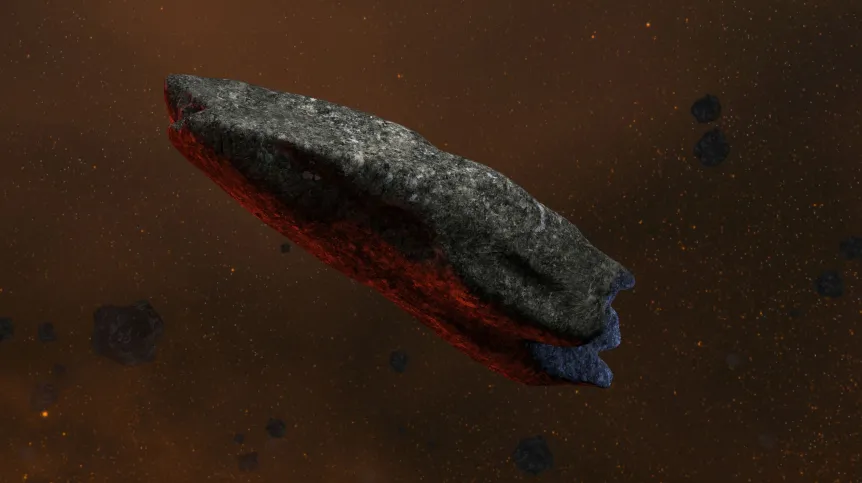
3I/ATLAS is only the third interstellar visitor ever identified. The first, 1I/ʻOumuamua, was detected in 2017, after it had already made its closest approach to the Sun. It showed no visible gas or dust envelope and instead resembled an asteroid.
The second, 2I/Borisov, was discovered in 2019 and was clearly active. Its dust showed characteristics of material that had undergone relatively little alteration since its formation.
3I/ATLAS is different again. It released both gas and dust, but stood out because of its high carbon dioxide content and scarcity of certain carbon-bearing molecules.
Three objects are far too few to establish a classification system, but their differences already show that bodies ejected from other planetary systems may form or evolve under very different conditions.
The study was co-authored by Sofiia Mykhailova, Tomasz Kwiatkowski and Dagmara Oszkiewicz from the Astronomical Observatory of the Adam Mickiewicz University. The Polish contribution also included the Southern African Large Telescope observation programme. The research was funded by the Polish Ministry of Science and Higher Education and the Polish National Science Centre. (PAP)
kmp/ agt/
tr. RL