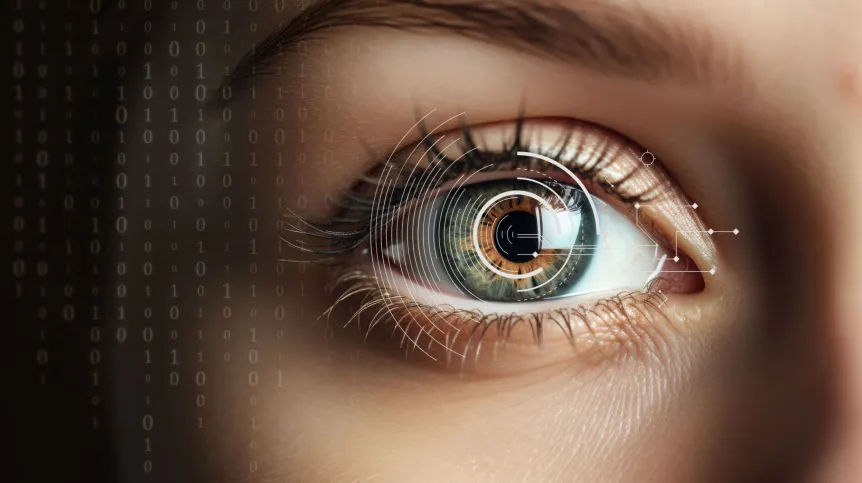
Tiny changes in pupil size can predict how successfully a person will remember information, in some cases appearing hundreds of milliseconds before the memory is formed or recalled, Polish researchers have found.
The finding suggests that measuring pupil size could eventually provide a simple, non-invasive way to monitor memory processes in the brain. The researchers found that pupil changes were at least as sensitive as signals recorded directly from the brain and, in some cases, appeared earlier.
Memory impairment is one of the hallmark symptoms of brain aging, Alzheimer’s disease, epilepsy and various psychiatric conditions. Scientists have therefore long sought reliable indicators that could track memory processes in real time.
Intracranial electroencephalography (iEEG) currently provides some of the most precise information of this kind. The technique involves placing electrodes directly on the surface of the brain or within its deeper structures, allowing neuronal activity to be recorded with exceptional temporal and spatial precision. However, it is highly invasive and used only in patients undergoing neurosurgery, most often because of epilepsy.
Researchers are therefore looking for simpler and safer ways to detect the same processes. Pupillometry – the measurement of pupil size – may be one such tool.
Human pupils respond to more than light. Their diameter also changes in response to nervous system activity and the action of neurotransmitters involved in attention, arousal and learning. In recent years, research has increasingly suggested that these changes can also provide information about memory processes.
“Pupillometry is not as widely used as eye-tracking methods. Eye-tracking is technically much simpler; it is used not only in virtual or augmented reality headsets for gaming, training, attention monitoring, assistive technology for the disabled, and medical diagnostics and therapy, but also in personal devices with high-quality cameras, such as our smartphones. Pupillometry, on the other hand, requires far more advanced infrared cameras and algorithms to estimate the size of the pupil ellipse in real time. Few systems can reliably measure pupil dilation, yet the pupil serves as a window into the cognitive processes of the mind, reflecting their activity,” says Michał T. Kucewicz, PhD, from the BioTechMed Center at the Gdańsk University of Technology.
Researchers from the Gdańsk University of Technology, the Czech Technical University in Prague and the Mayo Clinic in the US investigated whether pupil changes reflected brain activity recorded using established neurophysiological methods. Their findings were published in Scientific Reports (https://www.nature.com/articles/s41598-026-64850-9).
The experiment involved seven young patients with drug-resistant epilepsy who already had electrodes implanted to monitor seizures. This allowed the researchers to record brain activity and pupil behaviour simultaneously without carrying out any additional procedures.
The participants performed a standard task designed to assess episodic memory. First, they viewed a list of nouns displayed one after another on a screen. They then solved a short maths problem to distract them from the words they had just memorised. Finally, they had 30 seconds to recall as many of the words as possible.
Each sequence was treated as a separate trial. If a participant recalled five or more words, the trial was classified as successful; if they recalled four or fewer, it was classified as less successful in terms of memory performance.
“Our results show that, thanks to pupillometry, the mind's cognitive processes can be detected several hundred milliseconds before we see their effect on the patient's memory performance,” said Kucewicz, a co-author of the study.
Changes in pupil size allowed the researchers to predict whether a participant would successfully memorise a given list of words. Differences appeared even before the word to be memorised was shown, approximately 400-600 milliseconds earlier. During recall, a similar effect appeared 100-300 milliseconds before the memorised word was spoken.
Pupil size was found to be just as sensitive, and often an even earlier signal of successful word memorisation, as the signals analysed from electrodes placed in the brain. The pupil-related effect was stronger than that of 92 percent of the EEG indicators analysed during word memorisation and 96 percent during recall.
The authors hypothesise that changes in brain activity and pupil behaviour may both reflect the operation of a shared system regulating attention and arousal.
A small brainstem structure that produces noradrenaline, the locus coeruleus, may play a key role. It is involved in alertness, concentration and preparing the brain to process new information. Previous studies have shown that activity in this centre is also linked to pupil dilation and constriction.
If the findings are confirmed in larger studies, pupillometry could have a range of practical applications.
Because pupil measurement is inexpensive, fast and non-invasive, it could potentially be used to monitor cognitive function in older people, patients with neurological disorders or individuals undergoing rehabilitation. In the future, such measurements could be incorporated into glasses, goggles or mobile devices to assess attention and memory status in real time.
The researchers caution that the experiment involved only seven participants, all of whom had drug-resistant epilepsy, and that the comparisons were based on relatively simple indicators of brain activity. It remains unclear whether similar patterns would be observed during other types of memory tasks or in healthy individuals.
PAP - Science in Poland, Ewelina Krajczyńska-Wujec (PAP)
ekr/ bar/
tr. RL