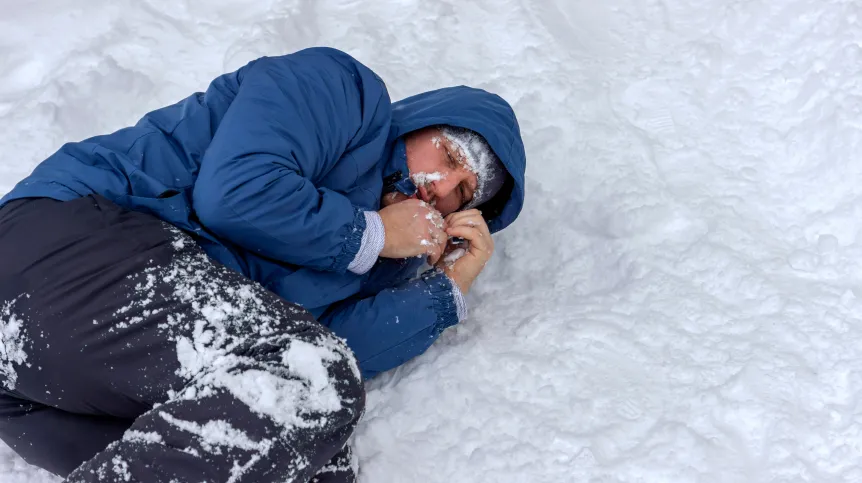
Polish doctors who developed a nationwide system for treating profound hypothermia want to create a national registry to find out which treatments work best and where the system can be improved.
Their guidelines have now been published in Nature Reviews Disease Primers, but the researchers say they still cannot access the hospital data needed to properly assess hypothermia treatment across Poland.
The team has been working to improve hypothermia care since 2013, when Sylweriusz Kosiński, Tomasz Darocha and their colleagues identified a lack of systemic solutions for managing patients suffering from profound hypothermia.
They developed treatment procedures and distributed informational posters to hospital emergency departments, emergency medical teams and mountain rescue services across Poland. They also trained nearly 50,000 people through an e-learning platform and provided in-person training to nearly 1,000 paramedics and physicians.
The system initially operated only in the Lesser Poland region, but continued efforts eventually led to the creation of a nationwide alert and rescue system for people suffering from dangerously low body temperatures.
The system has already helped save lives. One of the most remarkable cases came in the winter of 2015, when a two-year-old boy named Adaś was found near a river wearing only his pyjamas. His body temperature had fallen to 12.7°C.
“About two months before that incident, Tomek Darocha called me and asked: ‘Kosa, we do have a procedure for managing adult hypothermia, but what if a child with hypothermia were to appear?’ And indeed, at that time, no procedures had been developed for children. So, we got to work: we analysed cases from around the world and established protocols. When Adaś was found, his treatment followed the path we had devised right from the very first minute. The medical dispatcher had previously attended our courses on hypothermia, so he immediately called Tomek and set the entire chain of survival in motion. The child was taken to the University Children’s Hospital in Kraków,” Kosiński recalls in an interview with the Polish Press Agency.
The boy underwent extracorporeal blood warming using ECMO. His hospital treatment lasted several months, and he survived. To this day, this remains the lowest body temperature at which a patient has been successfully saved.
In 2022, the Polish researchers received an award from the World Health Organization for their efforts to save people suffering from hypothermia. Their guidelines for managing profound hypothermia have now been published in Nature Reviews Disease Primers.
The researchers believe they have done everything possible with the data currently available to develop increasingly effective treatment procedures. But they say much more could be learned by analysing medical records from Polish hospitals covering the past 13 years, since the treatment protocols were changed. Their aim is to create a registry that could identify gaps in care, show where procedures need improvement and help assess how the system performs over time.
“We would like to conduct a free, transparent audit of the treatment of patients with profound hypothermia and review medical records from Polish hospitals covering the last 13 years, since we changed our management protocols, and identify gaps, areas for improvement, assess where we might stand in another decade,” said Professor Tomasz Darocha, affiliated with the Medical University of Silesia, the Upper Silesian Medical Centre and the Air Ambulance Service.
Japan already maintains such a registry, which Darocha helped develop as an international expert, and consequently has the best data in the world on the subject.
It turns out that as many as 70 percent of hypothermia cases in Japan are classified as “urban hypothermia”, involving elderly, impoverished individuals who succumb to the cold in their own homes during winter. In Poland, it is impossible to determine this conclusively because no one collects aggregate data.
“In my opinion, the majority of hypothermia cases in Poland also do not involve tourists stranded in the mountains, but elderly, impoverished, and diseased individuals whose homes go unvisited by others,” Kosiński says.
He also points to another problem: standard thermometers used by emergency medical teams do not register body temperatures below 28°C, while only one in 30 ambulances in Poland is equipped with technology capable of measuring core body temperature in hypothermia cases. As a result, many cases may go unnoticed by medical professionals.
“If this chain of survival fails to function properly, the result is a preventable death,” Darocha says.
The researchers say it is currently impossible to determine how hospitals routinely manage patients with profound hypothermia, which treatment measures produce good results and which need to be improved. Answering those questions would require retrospective analysis of medical records from a large group of patients.
Hospitals already collect much of this information, often in searchable digital systems, including details of procedures performed. Yet emergency responders and researchers have been unable to obtain the data for four years.
“Officials usually cite GDPR,” Darocha says.
Under current law, researchers would have to send separate requests to hundreds of hospitals across Poland seeking access to anonymised data. Each facility could decide how to respond.
In response to questions from the Polish Press Agency, Poland’s Personal Data Protection Office said one potential challenge is anonymising patient medical data in a way that makes it impossible to identify an individual. The process could “require significant human and financial resources exceeding the capabilities of public entities, which may explain the refusals to share the data”.
The Ministry of Health said data contained in medical registries can be made available for scientific and statistical purposes if it is provided in a form that prevents it from being linked to a specific person.
“However, no such registry currently exists for hypothermia,” ministry representatives added.
The list of National Medical Registries currently includes only four registries maintained in Poland, all related to treatment for heart disease.
The ministry said conceptual work on the registries is under way: “Due to ongoing work on optimising medical registries and the medical registry system, there are currently no plans to create any new registries until that work is completed”.
The problem extends beyond hypothermia. Other physicians and scientists have also been calling for national registries for years.
One is Professor Wojciech Szczeklik, head of the Centre for Intensive Care and Perioperative Medicine at Jagiellonian University Medical College, who has long advocated creating a registry of patients admitted to intensive care units.
Szczeklik said such a registry, had it been created several years ago, could have helped doctors treat patients more effectively, including during the COVID-19 pandemic. He said that opportunity had been lost.
“I get the impression that creating new registries is an unpopular topic because they could expose system shortcomings. It is somewhat of a taboo subject,” he says.
The Centre for Quality Monitoring in Health Care, however, points to a regulation stating that teams collaborating with the Polish Medical Research Agency can gain access to medical data.
The Medical Research Agency told the Polish Press Agency that the appropriate response to such challenges should not be ad hoc solutions, but permanent, transparent and standardised mechanisms for accessing data. In its assessment, future solutions should combine a clear legal basis, uniform procedures, common technical standards and secure processing environments.
“A key role in the secondary use of electronic health data will be played by the national Health Data Access Body (HDAB); according to the EU regulation's timeline, this body is to be officially designated and established by March 26, 2027, and must achieve full operational capacity by March 26, 2029,” Medical Research Agency representatives said.
Meanwhile, according to the e-Health Centre, the European Health Data Space (EHDS) is intended to provide easier access to medical data for scientific research. Its primary goal is to define who can access medical data and how that access should be granted.
The various measures are scheduled to come into effect in 2029 and 2031.
Ludwika Tomala (PAP)
lt/ agt/ bar/ mow/
tr. RL