Polish firm Creotech Instruments will lead a €13.9 million European Space Agency (ESA) mission to monitor space weather, marking a first for Poland.
The SAWA mission will put a Polish company in charge of the entire project, from building the satellite to operating it in orbit. It is the first ESA project in which a Polish entity is responsible for end-to-end execution, including systems integration and launch preparation.
The agreement was signed during the Warsaw Security Forum, according to Poland’s Ministry of Economic Development and Technology. The project will be financed through Poland’s contribution to ESA under the agency’s Space Safety programme, with funding allocated by the ministry.
“This is an important day for Polish business, technological innovation, and the national economy. The SAWA mission demonstrates that domestic companies are prepared to take full responsibility for the execution of the most advanced space projects. It represents a shift to a higher tier in the value chain, moving from mere participation in European projects to leading them. It is also proof that the funds Poland contributes to the European Space Agency return to the country in the form of contracts, new competencies, technological development, and highly skilled jobs,” Finance and Economy Minister Andrzej Domański said at the signing ceremony.
The SAWA mission will monitor space weather and assess how solar activity affects infrastructure critical to the economy, including navigation and communication systems, satellites and power grids.
The satellite will observe the Earth's magnetic field, ionosphere and thermosphere, providing data in near real time. According to the ministry, the measurements will support European space weather monitoring services, including ESA’s early-warning system.
SAWA will be the second ESA nanosatellite dedicated to monitoring space weather, complementing the SWING mission.
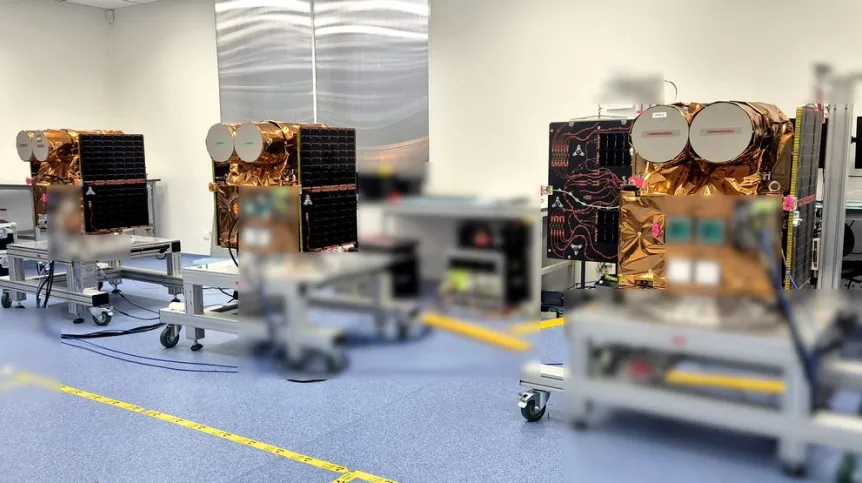
Creotech Instruments will provide its HyperSat satellite platform and oversee mission integration and satellite operations.
The project’s other Polish partners include the Space Research Centre of the Polish Academy of Sciences, which will supply instruments to measure magnetic and electric fields, as well as data-processing systems for space weather analysis and forecasting. Wrocław University of Science and Technology will provide an instrument to study oxygen density, while N7 Space will be responsible for the software.
The satellite is scheduled for launch in early 2029. The mission is expected to last one year, with the possibility of an extension for a further two years.
During the Warsaw Security Forum, Domański also discussed the development of European space capabilities and the Polish industry's role in delivering them with ESA Director General Josef Aschbacher and EU Commissioner for Defence and Space Andrius Kubilius, the ministry said.
The minister also attended a meeting of the Poland-ESA team working to establish an ESA centre in Warsaw. The centre is intended to strengthen Polish expertise and increase the participation of Polish companies and research institutions in European space programmes. (PAP)
PAP - Science in Poland
bar/
tr. RL