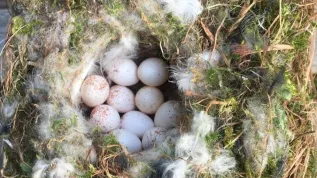
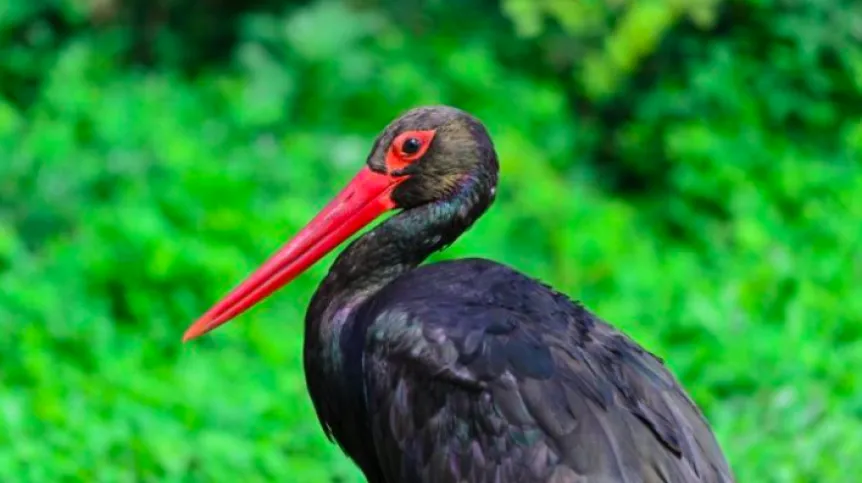
Online broadcast from the nest of black storks living in one of the forests in the Łódź province is available again. The birds, covered by strict protection in Poland, have returned to the nest after a winter stay in Africa.
The daily life of black storks has been broadcasted for two years. The educational project, pioneering in the country and one of the few in Europe, is carried out jointly by the Regional Directorate of State Forests in Łódź, the University of Lodz and the Committee for the Protection of Eagles. This is a unique opportunity to watch these strictly protected birds. Unauthorised persons may not get close to these birds` nests - they are surrounded by protective zones set by foresters, reaching 500 m radius during the breeding season, and the locations of black stork habitats are kept secret.
A stork pair have already inhabited the nest in the 20-meter-tall oak tree, where the cameras are installed. The first stork appeared at the end of March, the second in early April. The Regional Directorate of State Forests in Łódź spokeswoman Hanna Bednarek-Kolasińska explains that the birds are now getting closer to each other. The camera shows that they spend a lot of time in the nest, where they clean each other`s feathers. "You can see that it is a very well-matched pair" - the spokeswoman says.
The black stork breeds between April and May. The female has already laid two eggs.
The popular live broadcast can be viewed on the website of the Regional Directorate of State Forests in Łódź - www.lodz.lasy.gov.pl. The creators of the project encourage viewers to send screenshots showing interesting behaviour of the storks.
The broadcast will be supplemented with news about one of the two black stork chicks, which left another nest in 2016, equipped with GPS locators. That nest in a pine tree was also fitted with a camera, but it is now empty. The second young stork was shot in Turkey during autumn migration.
The black stork (Ciconia nigra) is under strict protection in Poland. These birds are currently monitored by about a thousand foresters across the country. It is estimated that their population reaches 1.4-1.6 thousand pairs. Naturalists emphasize that in the early 1980s, the estimated black stork population in Poland was about 900 pairs, while in the 1960s there were only 500 pairs. The exact location of black stork nests is kept secret to protect the birds from intruders. Each pair usually builds more than one nest (they can weigh as much as one ton). The nests can be even several kilometres from each other and become inhabited in case of loss or deterioration of quality of the primary nest.
Black storks from the forests of Łódź can be watched until autumn. In September, this species migrates to East and Central Africa for winter. (PAP)
author: Bartłomiej Pawlak
bap/ agz/ kap/
tr. RL