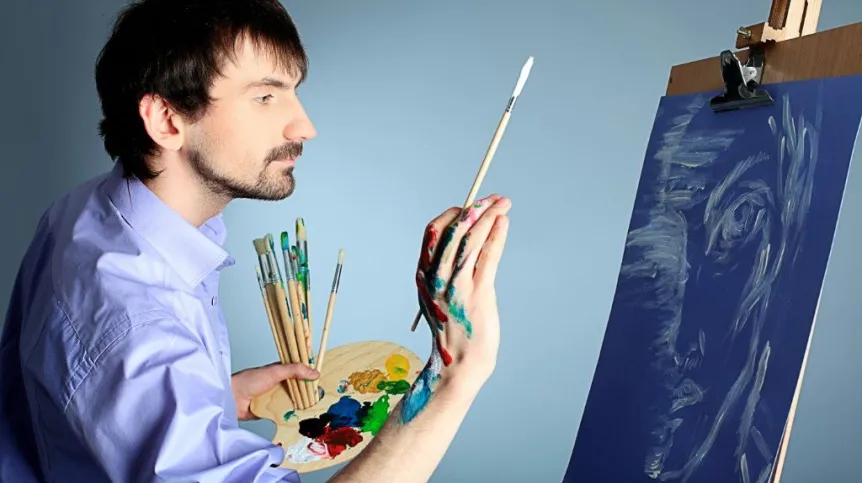
With methods such as digital radiography, researchers reveal secrets of old paintings. Sometimes under the outer layer of the work they find another painting - as it happens in the Laboratory of Analysis and Nondestructive Testing of the Historic Objects of the National Museum in Kraków.
Kraków lab of the National Museum was founded in 2004 and is the first research facility of its kind in Poland. The laboratory (abbreviated LANBOZ) works on many levels. The main part are conservation studies of objects using non-destructive methods - that is, without sampling - mainly from the collections of the National Museum in Kraków.
The purpose of the analysis is determining the structure of works of art, including their chemical composition, and their state of preservation. In addition to this activity, LANBOZ also helps assess the authenticity of works of art, although the laboratory employees do not issue this kind of expert opinions.
Piotr Frączek of LANBOZ explained that the laboratory uses all sorts of methods of analysing paintings, including taking photographs using sources of radiation other than visible light. "This includes infrared reflectography, ultraviolet, X-ray. With regard to the latter method, Kraków lab uses digital radiography based on the use of digital detector" - explained Frączek.
PAINTING HIDDEN UNDER PAINTING
These imaging methods are the main type of painting diagnostics. They often result in spectacular discoveries, such as revealing a canvas repainted the by the author.
"Many paintings by Piotr Michałowski, whose works can be seen in the Polish paint art gallery in Kraków’s Sukiennice, hides the other compositions underneath. It can be assumed that in his mansion near Kraków - without access to new canvas - Michałowski would first begin several compositions, then paint over those he considered unsatisfactory" - explained Frączek.
He added that it happened that LANBOZ employees discovered with X-ray that a twentieth century painting it is painted on a layer of well-preserved eighteenth century painting.
Author’s changes, invisible to the naked eye, can be detected not only with X-ray, but also other imaging techniques, such as infrared reflectography.
An interesting example of the use of the latter technique was the study of "The Girl in the bath" by nineteenth-century painter Pantaleon Szyndler (it can also be seen in Sukiennice), showing an almost naked woman standing with her back to the viewer against a dark wall. Infrared showed that in the first version there were also two male figures, which the painter apparently found inappropriate and painted them over.
HOW "THE LADY WITH AN ERMINE" WAS X-RAYED
The laboratory in Kraków has recently studied the famous work of Leonardo da Vinci, "The Lady with an Ermine" to check whether it has suffered any damage. "The painting was in the care of our museum. Then it travelled to many foreign exhibitions, and the purpose of our work was to assess its preservation. We used UV to checked whether anyone had painted anything on it, whether it had suffered any microdamages invisible to the naked eye. We did a number of tests that confirmed the good state of preservation of the painting" - said Frączek.
Ultraviolet rays show all the buildup on the surface of the painting, they perfectly detect all retouched done long after the creation of the work.
Thanks to modern techniques, researchers have long known that the background against which we see the figure of the Lady with an Ermine today, originally was not black, but much lighter, and it was later repainted. This change certainly was not done by the hand of Leonardo, although the author of this retouching remains unknown.
Secrets of LANBOZ work could be explored recently at the Kraków Science Festival in May, when employees opened the doors of the laboratory to the public.
PAP - Science and Scholarship in Poland, Szymon Łucyk
szl/ agt/
tr. RL