
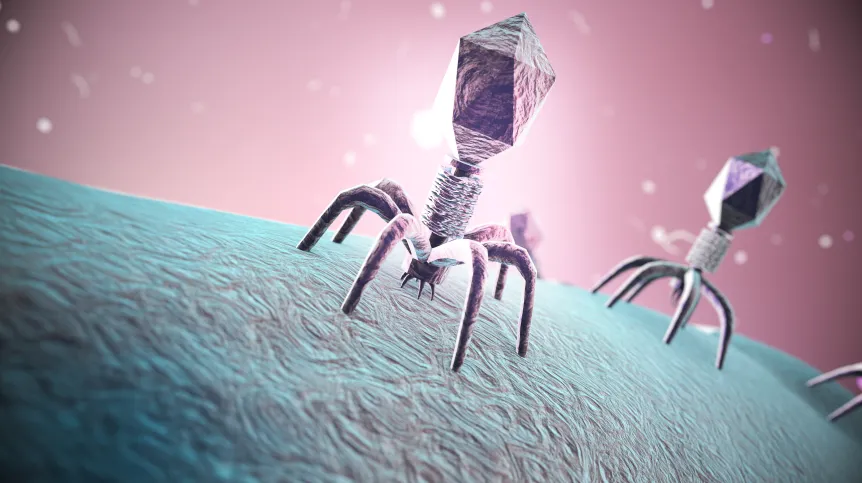
Previously unknown mechanisms used by viruses that infect bacteria to overcome bacterial defences, have been discovered by researchers from Jagiellonian University. The findings, published in PLOS Biology could open new paths for therapies targeting antibiotic-resistant infections, the researchers say.
The viruses, known as Bacteriophages, or phages, have evolved over billions of years to recognise and destroy specific bacterial strains. Interest in their medical use has increased as antibiotic resistance spreads, making some infections increasingly difficult to treat.
The researchers focused on Klebsiella pneumoniae infections, a major cause of hospital-acquired infections. The bacterium protects itself with a thick sugar capsule that acts as a chemical shield against the immune system.
Phages attack bacteria using specialised proteins located at the ends of tail-like appendages. Scientists previously believed these proteins mainly took the form of depolymerases, enzymes that break down the bacterial capsule.
The new research suggests phages use a broader arsenal of strategies.
“To better understand how phages recognise and destroy bacterial capsules, we came up with the idea of virus archaeology. It turns out that bacteria often have dormant viruses encoded within them - remnants of past infections that, instead of destroying the bacterium, integrated into its DNA and remained there. We decided to search through them. We used machine learning to look for statistical associations between proteins of these dormant viruses and the capsule type of their bacterial hosts. In other words, which protein sequences match which bacterial capsules’, said Professor Rafał Mostowy, study leader from Małopolska Centre of Biotechnology in collaboration with scientists from the University of Wrocław.
Using computational analysis and laboratory experiments, the scientists identified not only known capsule-destroying enzymes but also a previously unknown class of proteins.
The newly identified proteins do not destroy the bacterial capsule. Instead, they remove small chemical structures from its surface, allowing the virus to gain access to the bacterium.
“Imagine that the bacterial capsule is not a smooth wall, but one covered with a plethora of tiny hooks. Some viruses demolish this wall, while others - as we discovered - quietly remove the hooks. This mechanism alone is enough for them to gain entry’, Mostowy said. ‘We started with DNA sequences. The computer pointed us to interesting sequences; we then used them to produce real proteins in the lab and they worked’, he adds.
Researchers said the findings could help develop new treatments against resistant bacterial strains.
“Bacteria are constantly evolving and changing their capsules. The more we understand how phages adapt to this diversity, the better prepared we will be for future threats’, Mostowy said.
The team also released a comic book https://mostowylab.com/media/comic-pl.jpg. explaining phage biology, illustrated by Paweł Piechnik.
The research was funded by the Polish National Science Centre, the National Agency for Academic Exchange and the European Molecular Biology Organisation.
PAP - Science in Poland
ekr/ agt/
tr. RL