
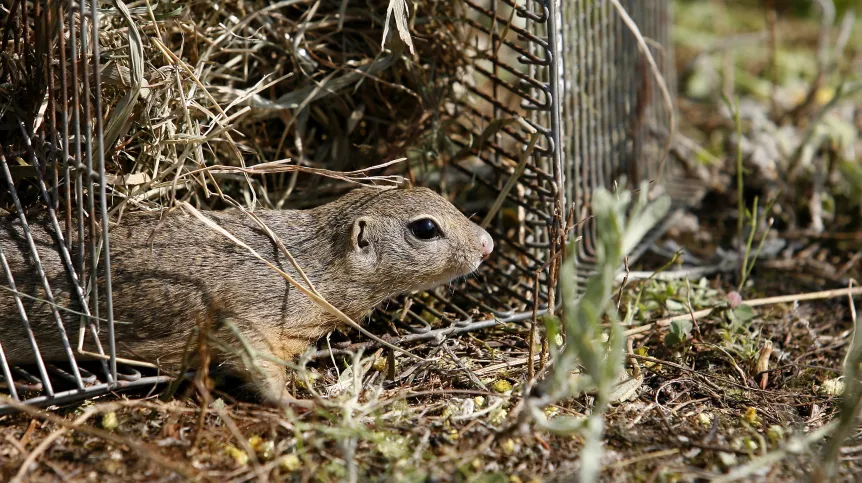
It is not easy to restore a species that has become completely extinct in the country due to human activity. It worked with bison, and now, thanks to the efforts of +Salamandra+, it is being done with European ground squirrel - noted Dr. Kepel, program manager for European ground squirrel restoration in Polish nature. On Friday (July 26) naturalists of the organization began resettlement these rodents into the fourth site in Poland..
European ground squirrel became extinct in Poland at the turn of 1970s and 1980s. In the project of the species restoration, the animals from Hungary and Slovakia are grown in Poznań zoo and released at several sites. The first colony "Salamandra" began to restore was in Kamień Śląski, in the Opole province. The first animals were released in 2005. Now, the site has a strong, stable population, numbering several hundred animals. Two colonies more have been established in Lower Silesia, in Jakubowo Lubińskie and Głębowice. On Friday, few dozens of European ground squirrels were released to special cages on a meadow privately owned by a nature lover.
"Ground squirrel reintroduction is not easy and often fails. The problem is that if they are simply released it into the wild, they scatter, and as colony animals alone they have little chance of survival and often fall prey to predators. Ground squirrels have to be in a group, in which several animals watch for threats, and others feed. In case of emergency, guardians whistle and all animals hide in their holes. Therefore, it is important to restore the entire colony when releasing these animals" - explained Andrzej Kepel in an interview with PAP.
Naturalists were able to develop an effective method of releasing the animals. They build large acclimatization cages, dug into the ground so that ground squirrels can not get out too quickly. "They will, eventually, but it takes them one to two weeks - said the project manager. - In a place they are released, there are prepared cages with pre-dug holes. When we release them, squirrels deepen the holes, build several exits and one-two weeks later the first ground squirrels start to come out. During this time, however, they get used to the place. After a while we remove the cages and ground squirrels remain where we have released them".
"This year\'s long winter and cold weather and rains in June meant that it was not a good season for ground squirrels. But, thanks to good conditions in Poznań Zoo, we still have managed to get a large number of young. We have enough not only to maintain the breeding group, but also start the next restoration site" - emphasised Dr. Kepel.
He added that people often do not feel the presence of ground squirrels in the environment. These small animals, however, are significant as a so-called umbrella species. "By protecting ground squirrels, we protect their habitat - meadows that are not very fertile, not attractive for development. By protecting these meadows for ground squirrels, we also protect them for butterflies, rare plants and other, much less charismatic species" - said Dr. Kepel.
PAP - Science and Scholarship in Poland
zan/ agt/
tr. RL